
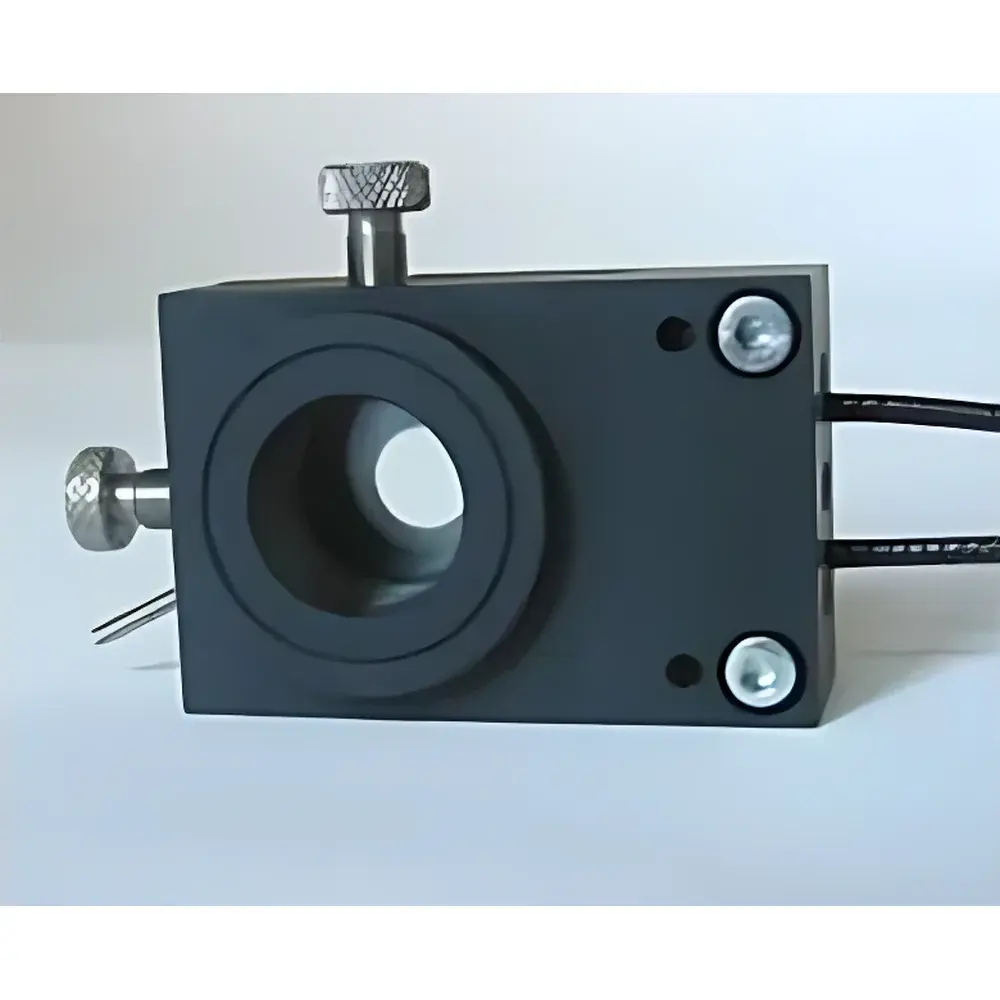
Radial Polarization Converter by SPL Photonics
| Origin | Canada |
|---|---|
| Manufacturer Type | Distributor |
| Origin Category | Imported |
| Model | Radial Polarization Converter |
| Pricing | Upon Request |
| Component Category | Light Source |
Overview
The Radial Polarization Converter is an advanced optical component engineered to transform a linearly polarized Gaussian beam into a radially or azimuthally polarized vector beam with high spatial fidelity and polarization purity. Based on the principle of geometric phase (Pancharatnam–Berry phase) modulation via subwavelength-structured metasurfaces or segmented waveplate architectures, this converter enables precise control over the transverse polarization state across the beam profile. It operates within standard visible to near-infrared spectral ranges (e.g., 400–1100 nm), supporting applications requiring tight focusing, enhanced longitudinal field components, or symmetry-sensitive light–matter interaction—such as STED microscopy, particle trapping, laser materials processing, and plasmonic excitation.
Key Features
- High-efficiency conversion (>92% transmission for design wavelength, typical)
- Engineered for minimal wavefront distortion (<λ/10 RMS over 10 mm clear aperture)
- Compatible with collimated free-space beams; optimized for TEM00 input mode
- Robust fused silica or crystalline quartz substrate with anti-reflection coatings (R < 0.25% per surface)
- No active alignment required—pre-aligned fixed-orientation mounting interface
- Thermally stable design (operating range: −10 °C to +60 °C; Δn < 5×10⁻⁶/°C)
Sample Compatibility & Compliance
This converter is designed for integration into OEM optical systems and academic laboratory setups using standard kinematic mounts (e.g., SM1-threaded housings or Ø25.4 mm lens tubes). It accepts input beams with diameters from 3 mm to 8 mm (1/e² intensity) and maintains polarization fidelity under moderate power densities (<5 W/cm² CW, <100 MW/cm² pulsed, assuming appropriate pulse duration and repetition rate). The device complies with ISO 10110-7 (surface quality: 20–10 scratch-dig), RoHS Directive 2011/65/EU, and meets mechanical shock resistance per MIL-STD-810G Method 516.6 (Shock, Functional).
Software & Data Management
As a passive optical component, the Radial Polarization Converter requires no firmware, drivers, or software control. Its performance is characterized and validated using calibrated Stokes polarimetry and interferometric wavefront analysis—methods traceable to NIST standards. Documentation includes full polarization point-spread function (PSF) maps, retardance uniformity profiles, and spectral transmission data (provided in CSV and PDF formats upon request). For integration into automated optical benches, mechanical drawings (STEP and DXF) and alignment reference marks are supplied to support reproducible positioning in alignment-critical systems.
Applications
- Generation of longitudinally polarized focal spots in high-NA microscopy and nanofabrication
- Enhanced resolution in stimulated emission depletion (STED) fluorescence imaging
- Optical trapping of metallic nanoparticles and dielectric microspheres via axial gradient forces
- Polarization-resolved spectroscopy of anisotropic 2D materials (e.g., MoS₂, WS₂)
- Input conditioning for vortex beam generation and vector beam interferometry
- Calibration reference for vector beam analyzers and polarization-resolved CCD characterization systems
FAQ
What input polarization state is required for optimal conversion efficiency?
Linear polarization aligned at 45° relative to the converter’s internal symmetry axis is required; deviations >±2° reduce radial purity by >5% (measured via azimuthal Stokes parameter S₃ integration).
Can this converter be used with femtosecond pulses?
Yes—when paired with dispersion-compensated beam paths; group delay dispersion (GDD) introduced is <10 fs² across 800±50 nm (measured via spectral interferometry).
Is custom center wavelength available?
Yes—standard versions cover 532 nm, 633 nm, 780 nm, and 1064 nm; custom designs for 355 nm or 1550 nm are available with lead time of 12–16 weeks.
Does the device require recalibration over time?
No—passive all-dielectric construction ensures long-term polarization stability; no drift observed after 5,000 hours of continuous operation under ambient lab conditions.
How is polarization purity quantified?
Via azimuthally resolved Stokes measurements: radial purity >98.5% (defined as ∫|S₁(r,φ)|dφ / ∫√(S₁²+S₂²+S₃²)dφ over full aperture, at design wavelength).





