
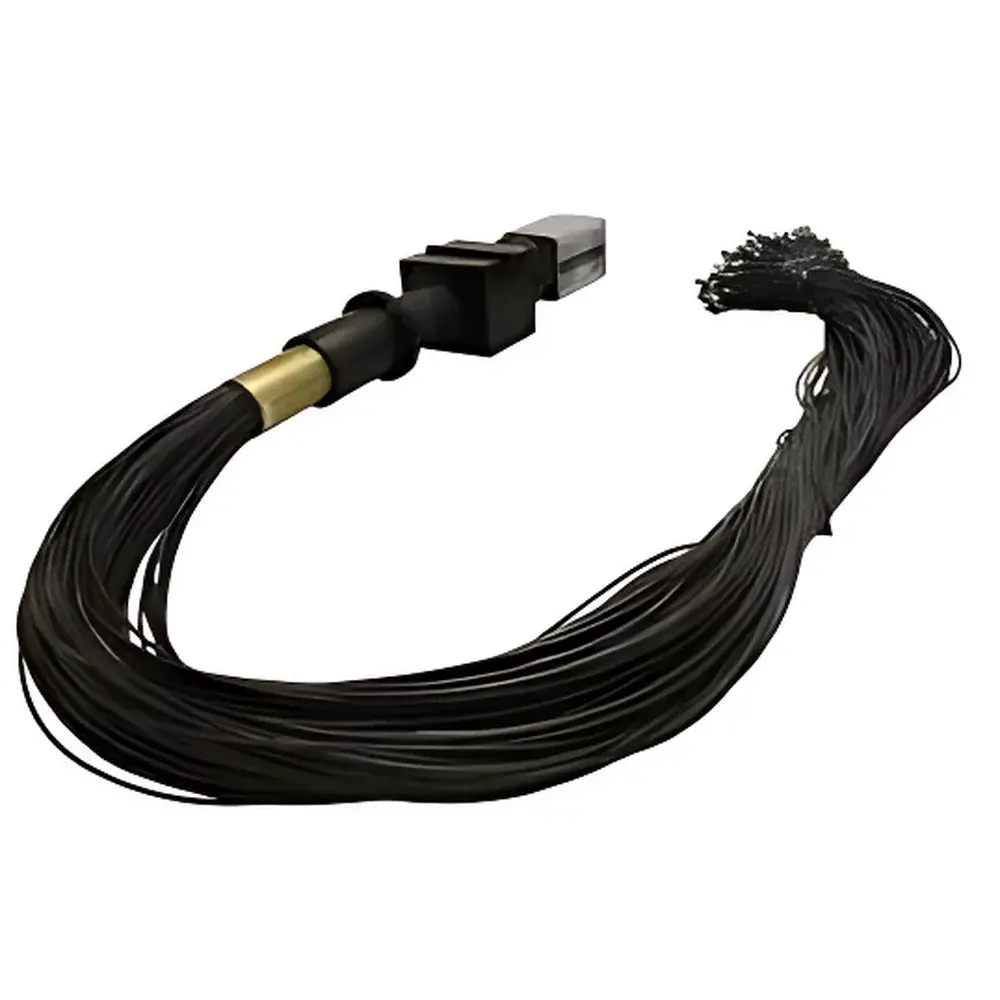
SPL Photonics MultiChannel PPO-Gel Grating Based Multichannel Spectrometer
| Origin | USA |
|---|---|
| Manufacturer Type | Authorized Distributor |
| Import Status | Imported |
| Model | MultiChannel Multichannel Spectrometer |
| Pricing | Available Upon Request |
Overview
The SPL Photonics MultiChannel PPO-Gel Grating Based Multichannel Spectrometer is a fixed-grating, non-scanning optical spectrometer engineered for parallel spectral acquisition across up to 200 independent optical channels in a single exposure. It operates on the principle of transmission-based diffraction using a proprietary polymeric photonic crystal (PPO) gel grating—offering high optical efficiency, thermal stability, and minimal polarization dependence compared to conventional ruled or holographic gratings. Unlike sequential scanning systems, this architecture eliminates timing artifacts and channel-to-channel synchronization overhead, making it particularly suitable for time-critical applications such as real-time process monitoring, optical coherence tomography (OCT) reference arm calibration, and dynamic multi-site physiological sensing. The system accepts input from multiple optical fibers—each delivering spatially distinct spectra onto a two-dimensional CCD or CMOS detector array—enabling simultaneous capture of spectral signatures from physically separated sample locations or process streams.
Key Features
- Parallel acquisition across up to 200 independent spectral channels per exposure
- PPO-gel transmission grating with broad spectral coverage (typical range: 200–1100 nm, configurable per application)
- No moving parts—robust, maintenance-free design optimized for industrial environments
- High signal-to-noise ratio: >5000:1 per channel (SNR improves with coherent channel summation)
- Up to 1000 resolvable spectral data points per channel
- Compact form factor with integrated thermal stabilization for long-term wavelength fidelity
- Fiber-coupled input architecture supporting standard SMA905 or FC/PC connectors
- Low-light performance enabled by back-illuminated, deep-depletion detector options
Sample Compatibility & Compliance
The MultiChannel Spectrometer accommodates diverse sampling configurations including flow cells, cuvettes, fiber-optic probes, integrating spheres, and free-space collimated beams. Its modular input interface supports custom fiber bundle geometries, enabling spatially multiplexed measurements without mechanical repositioning. The instrument complies with IEC 61326-1 (EMC for laboratory equipment) and meets CE marking requirements for safety and electromagnetic compatibility. While not inherently GMP-certified, its deterministic data acquisition architecture—including hardware timestamping, non-volatile memory buffers, and metadata-enriched file export—supports integration into GLP/GMP workflows when deployed with validated software and audit-trail-enabled drivers. It is routinely used in applications aligned with ASTM E131 (Standard Terminology Relating to Molecular Spectroscopy) and ISO/IEC 17025-accredited laboratories where traceable spectral measurement consistency is required.
Software & Data Management
The spectrometer is controlled via a vendor-provided SDK supporting Windows, Linux, and macOS platforms. APIs are available for Python, MATLAB, LabVIEW, and C/C++. Raw spectral data is exported in HDF5 or ASCII formats with embedded metadata (wavelength calibration coefficients, exposure time, temperature, fiber mapping indices). Optional software modules include real-time spectral clustering, multivariate curve resolution (MCR), and batch-processing pipelines compliant with FDA 21 CFR Part 11 requirements—including electronic signatures, user access control, and immutable audit trails. All firmware updates are digitally signed and verified prior to installation to ensure system integrity.
Applications
- Multi-point tissue oximetry: Simultaneous oxygen saturation mapping across tumor margins during surgical guidance
- Inline process analytics: Concurrent spectral monitoring of chemical composition at multiple stations along a continuous manufacturing line
- OCT system calibration: Parallel reference spectrum acquisition for dispersion compensation and phase-stability verification
- Light source characterization: High-throughput spectral response profiling of LED arrays, laser diodes, and broadband standards
- Mixture heterogeneity analysis: Spatially resolved spectral fingerprinting of emulsions, slurries, and pharmaceutical blends
- Environmental sensor networks: Distributed spectral sensing using fiber-optic sensor arrays for water quality or gas concentration mapping
FAQ
What spectral range is supported by the standard configuration?
Standard models cover 200–1100 nm; customized versions extend into NIR (up to 1700 nm) or UV-C (down to 190 nm) upon request.
Can individual channels be calibrated independently?
Yes—each channel supports separate wavelength and intensity calibration using NIST-traceable standards and optional automated calibration routines.
Is the system compatible with third-party fiber bundles?
Yes—provided fiber core diameters, numerical apertures, and spacing conform to the optical design envelope defined in the mechanical interface specification.
How is inter-channel crosstalk mitigated?
Crosstalk is minimized through optimized slit length, pixel binning strategies, fiber pitch control, and post-acquisition deconvolution algorithms based on measured point-spread functions.
Does the system support trigger-synchronized acquisition with external devices?
Yes—TTL-compatible input/output triggers enable hardware-level synchronization with lasers, shutters, or motion stages at sub-microsecond jitter.
Related Products







