
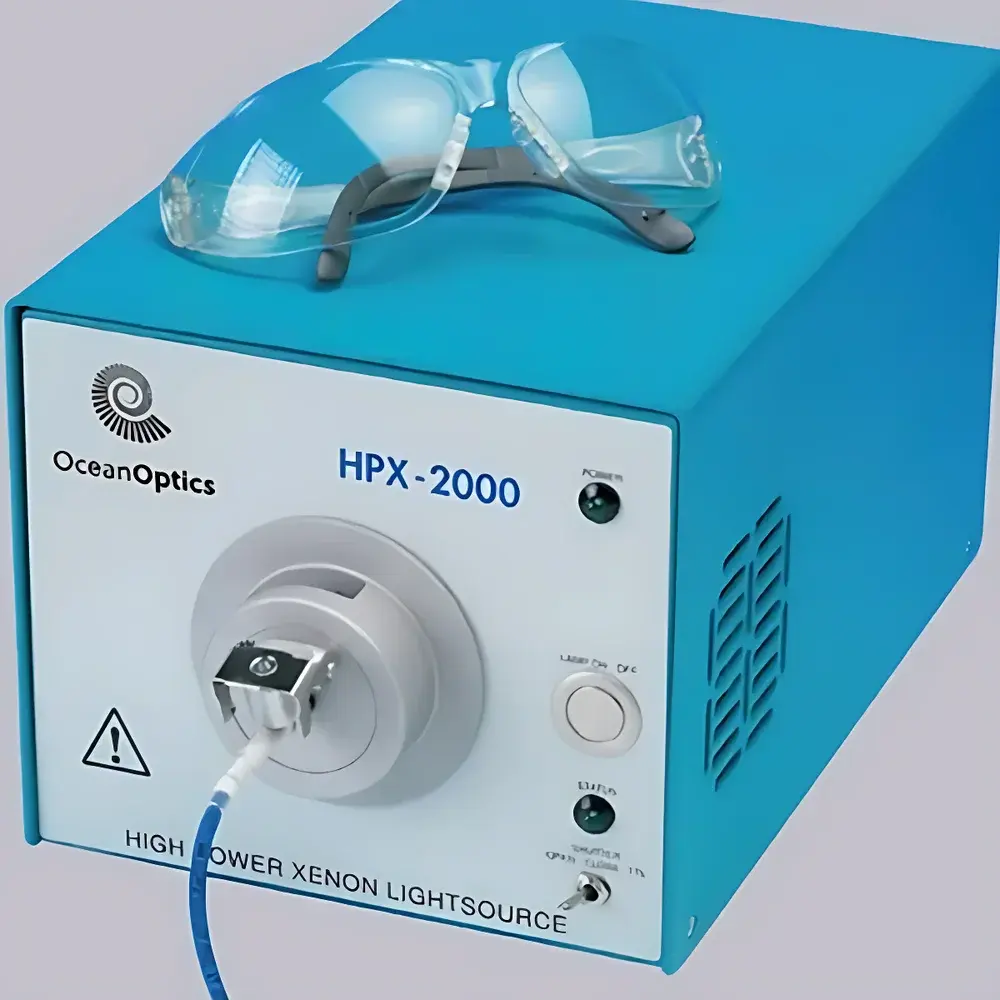
Ocean Optics HPX-2000 High-Power Continuous Xenon Light Source
| Brand | Ocean Optics |
|---|---|
| Origin | USA |
| Model | HPX-2000 |
| Light Source Type | Xenon Arc Lamp |
| Spectral Range | 185–2000 nm |
| Output Power | 35 W (UV-VIS-NIR) |
| Electrical Input | 60 W AC |
| Dimensions | 145 × 165 × 260 mm |
| Weight | 5 kg |
| Shutter | Integrated, TTL-triggerable (positive pulse via 15-pin D-sub) |
| Filter Slot | Accepts round or square filters up to Ø25 mm or 25 × 25 mm, max thickness 14 mm |
| Fiber Coupling | SMA 905 |
| Lamp Lifetime | ≥1000 h (typ. 2000 h) |
| Illumination Mode | Internal (in-situ) illumination |
Overview
The Ocean Optics HPX-2000 is a high-intensity, continuous-output xenon arc light source engineered for demanding optical applications requiring broad spectral coverage and stable radiometric output. Based on a 35 W short-arc xenon lamp, the HPX-2000 delivers a smooth, continuum spectrum spanning 185 nm to 2000 nm—encompassing deep ultraviolet (DUV), visible, and near-infrared (NIR) regions without discrete emission lines. This spectral continuity makes it especially suitable for applications where wavelength-dependent artifacts from line-source lamps (e.g., mercury or deuterium) must be avoided—such as quantitative fluorescence excitation profiling, reflectance calibration of spectrometers, and broadband absorbance reference measurements. Unlike pulsed xenon sources, the HPX-2000 provides steady-state irradiance ideal for time-resolved photoluminescence setup synchronization, lock-in detection, or integration with scanning monochromators. Its compact benchtop form factor (145 × 165 × 260 mm) and low thermal footprint enable straightforward integration into optical tables, custom enclosures, or OEM instrumentation platforms.
Key Features
- Stable 35 W continuous-output short-arc xenon lamp with >1000 h rated lifetime (typically 2000 h under recommended operating conditions)
- Broadband spectral output from 185 nm to 2000 nm—covering UV-C through NIR II—without spectral gaps or strong atomic emission lines
- Integrated mechanical shutter controllable via front-panel switch or external TTL positive pulse (via 15-pin D-sub connector), enabling precise temporal gating for kinetic experiments
- Dedicated filter slot accommodating round (Ø25 mm) or square (25 × 25 mm) optical filters up to 14 mm thick—facilitating spectral shaping, UV blocking, or order-sorting in dispersive systems
- SMA 905 fiber-optic coupling interface optimized for efficient light delivery to spectrometers, microscopes, or sample chambers
- Low-noise AC-powered design (60 W input) with internal thermal management ensuring radiometric stability over extended operation cycles
- Internal illumination geometry supports in-situ excitation configurations—ideal for flow cells, cuvette holders, and custom sample interfaces
Sample Compatibility & Compliance
The HPX-2000 is compatible with standard quartz cuvettes, fused silica flow cells, and reflective or transmissive sample mounts used across UV-Vis-NIR spectroscopy. Its deep-UV output (down to 185 nm) requires optics and sample compartments constructed from UV-grade fused silica or calcium fluoride to minimize absorption losses. The device complies with IEC 61000-6-3 (EMC emission limits) and IEC 61000-6-2 (immunity requirements) for laboratory equipment. While not certified for medical or industrial safety-critical use, its design adheres to ANSI Z87.1 recommendations for UV radiation containment when used with appropriate shielding. For GLP/GMP-regulated environments, the TTL shutter trigger enables audit-trail-capable timing control when integrated with compliant data acquisition systems.
Software & Data Management
The HPX-2000 operates as a hardware-controlled peripheral—no proprietary software driver is required. Shutter actuation is managed via simple TTL logic (5 V CMOS-compatible), allowing seamless integration with LabVIEW, Python (PyVISA), MATLAB, or custom C/C++ instrument control frameworks. Radiometric calibration data (spectral irradiance in W/cm²/nm at specified distances) is provided in NIST-traceable format upon request and can be imported into Ocean Insight’s OceanView software or third-party spectral analysis tools for absolute intensity correction. Firmware-level shutter timing resolution is <10 µs, supporting sub-millisecond exposure control in time-gated fluorescence or pump-probe configurations.
Applications
- Fluorescence excitation profiling across UV-Vis-NIR for quantum yield determination and Stokes shift analysis
- Reference source for spectrometer wavelength and radiometric calibration (per ASTM E275 and ISO/IEC 17025 protocols)
- Photostability testing of dyes, pharmaceuticals, and photoactive materials under broadband irradiation
- Excitation source for Raman spectroscopy when combined with notch or edge filters
- Light source for reflectance and transmittance measurements of optical coatings, thin films, and biological tissues
- OEM integration into automated analytical platforms requiring stable, line-free broadband illumination
FAQ
What is the typical spectral irradiance output at 1 meter distance?
Typical irradiance is ~1.2 mW/cm²/nm at 365 nm and ~0.8 mW/cm²/nm at 600 nm (measured at 1 m with collimating optics; values scale inversely with distance squared).
Can the HPX-2000 be operated in continuous mode without shutter cycling?
Yes—the shutter is optional; the lamp remains continuously lit unless actively gated via switch or TTL signal.
Is ozone generation a concern below 200 nm?
Yes—operation below 200 nm in ambient air produces ozone; use in purged (N₂ or O₂-free) or vacuum environments is recommended for sustained DUV output.
Does the HPX-2000 support analog intensity modulation?
No—it is designed for on/off control only; intensity regulation is achieved externally via neutral density filters or variable apertures.
What maintenance is required for long-term lamp stability?
Lamp alignment verification every 500 hours and periodic cleaning of the output window with spectroscopic-grade methanol are recommended to maintain throughput and spectral fidelity.



