
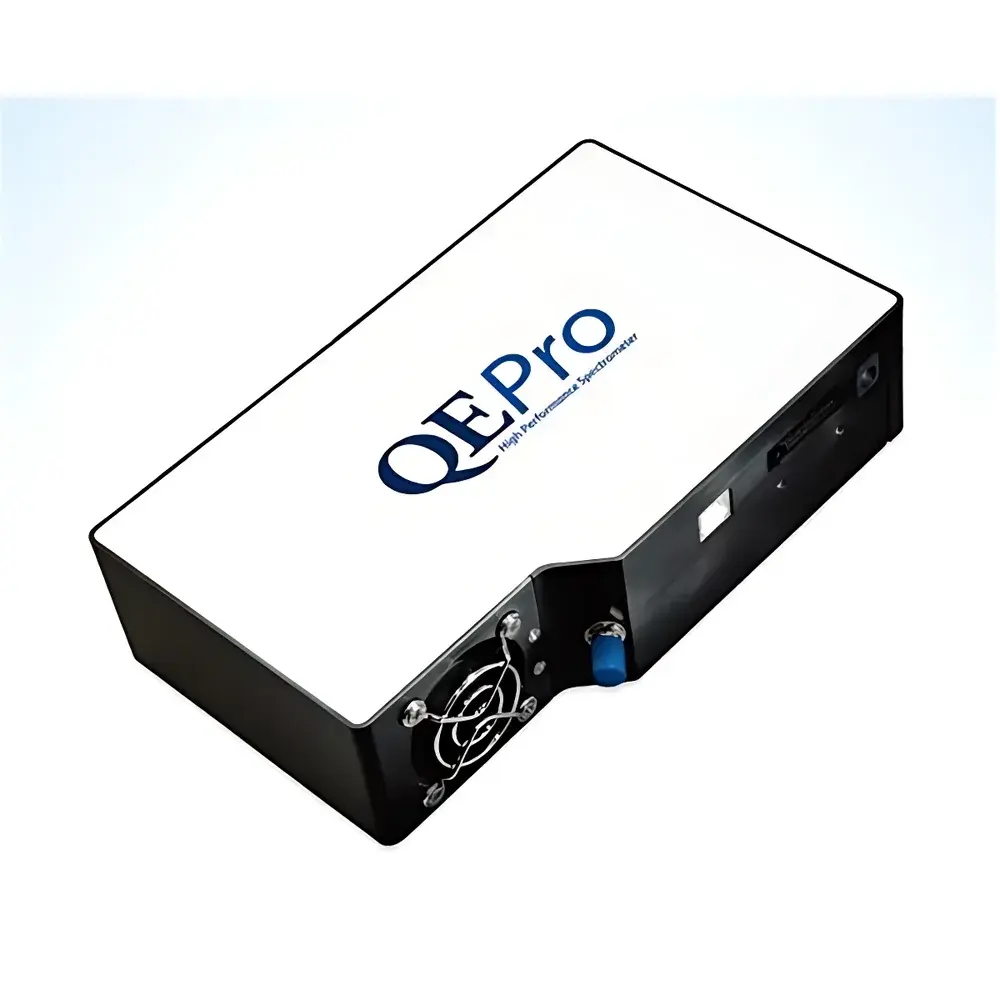
Ocean Optics QE65 Pro Research-Grade Spectrometer
| Brand | Ocean Optics |
|---|---|
| Origin | USA |
| Model | QE65 Pro Research-Grade Spectrometer |
| Detector | Hamamatsu S7031-1006 back-illuminated CCD |
| Quantum Efficiency | up to 90% |
| Cooling | TEC-controlled, down to −15 °C |
| Spectral Range (configurable) | 200–950 nm or 350–1100 nm |
| Slit Options | Interchangeable SMA905-mount slits |
| Stray Light Rejection | Enhanced via optimized grating and optical design |
| Signal-to-Noise Ratio | 1000:1 (full signal, 1 s integration) |
| Thermal Wavelength Stability | <0.005 nm/°C |
| Trigger Interface | TTL-compatible hardware trigger input/output |
Overview
The Ocean Optics QE65 Pro Research-Grade Spectrometer is a high-performance, thermoelectrically cooled spectrometer engineered for demanding low-light spectroscopic applications in academic, industrial, and regulatory laboratories. Built around the Hamamatsu S7031-1006 back-illuminated, deep-depletion CCD detector, it delivers exceptional quantum efficiency—peaking at 90% in the visible to near-infrared range—while minimizing etalon fringes through optimized detector architecture and anti-reflection coatings. Its two-stage thermoelectric cooler (TEC) stabilizes the detector at −15 °C, reducing dark current by over two orders of magnitude compared to uncooled operation and enabling integration times up to several seconds without significant thermal noise accumulation. This thermal management system directly enhances both spectral intensity stability (<0.5% RMS over 1 hour) and wavelength reproducibility (<±0.005 nm/°C), critical for quantitative fluorescence, Raman, DNA sequencing, and time-resolved photoluminescence measurements.
Key Features
- Back-illuminated CCD detector (Hamamatsu S7031-1006) with peak quantum efficiency ≥90% and minimal etalon artifacts
- Integrated dual-stage TEC cooling system capable of maintaining detector temperature at −15 °C, independent of ambient fluctuations
- Configurable spectral coverage: 200–950 nm (with HC1-QE UV-VIS grating) or 350–1100 nm (with NIR-optimized grating)
- Optimized optical bench design featuring low-expansion materials and kinematic mounting to minimize thermal drift
- SMA905 fiber interface with field-replaceable slit assemblies (10–200 µm options) for rapid adaptation to resolution/sensitivity trade-offs
- Dedicated TTL trigger I/O port supporting external synchronization with lasers, shutters, or data acquisition systems—enabling gated detection and pump-probe experiments
- Enhanced stray light suppression via holographic or ruled gratings selected per application requirements (e.g., Raman-grade blazed gratings with <0.05% stray light at 532 nm)
Sample Compatibility & Compliance
The QE65 Pro interfaces seamlessly with standard 400 µm or 600 µm core optical fibers and accommodates liquid cuvettes, solid reflectance probes, integrating spheres, and custom sample chambers via modular optical coupling. It supports compliance-critical workflows through stable calibration traceability (NIST-traceable wavelength and irradiance calibration available), long-term intensity repeatability (verified per ASTM E275 and ISO 17025 guidelines), and compatibility with GLP/GMP documentation protocols when paired with validated software environments. While the instrument itself does not carry FDA 21 CFR Part 11 certification, its data output structure (ASCII, CSV, HDF5) and metadata tagging support audit-ready data archiving when deployed within validated laboratory information management systems (LIMS).
Software & Data Management
Ocean Insight’s OceanView software provides full instrument control, real-time spectral visualization, batch processing, and export to industry-standard formats (CSV, TXT, MATLAB .mat, HDF5). The SDK (C++, Python, LabVIEW, .NET) enables integration into custom automation frameworks—including those compliant with IEEE 1588 PTP time synchronization for multi-instrument temporal alignment. Raw spectra include embedded metadata: integration time, detector temperature, grating ID, slit width, and calibration file hash—ensuring full experimental provenance. For regulated environments, optional IQ/OQ documentation packages and electronic logbook modules are available to support validation under ISO/IEC 17025 or pharmaceutical quality systems.
Applications
- Low-light fluorescence spectroscopy (e.g., single-molecule detection, quantum dot characterization)
- Stokes/anti-Stokes Raman spectroscopy using 532 nm, 785 nm, or 1064 nm excitation sources
- UV-Vis-NIR absorbance and reflectance quantification in thin-film metrology and material science
- Time-gated luminescence lifetime analysis when synchronized with pulsed laser sources
- DNA fragment analysis and capillary electrophoresis detection in molecular biology labs
- Environmental monitoring of trace species via differential optical absorption spectroscopy (DOAS)
FAQ
What is the typical dark noise level at −15 °C and 1 s integration?
At −15 °C and 1 s integration, RMS dark noise is typically ≤3 counts (16-bit ADC), corresponding to <0.01% of full scale.
Can the QE65 Pro be calibrated for absolute irradiance measurement?
Yes—NIST-traceable irradiance calibration kits (e.g., HL-3-CAL with cosine corrector) are available; calibration files are applied in software during post-processing.
Is the detector sensitive to polarization effects?
The S7031-1006 exhibits <5% polarization-dependent response across 400–900 nm; polarization-insensitive configurations require optional depolarizing optics.
How does the thermal wavelength stability compare to non-cooled spectrometers?
Thermal drift is reduced from ~0.02 nm/°C (uncooled) to <0.005 nm/°C—critical for long-duration Raman mapping or high-resolution gas-phase line analysis.
What operating systems are supported?
OceanView supports Windows 10/11 (64-bit), macOS 12–14, and Ubuntu 20.04/22.04 LTS via native drivers and SDK bindings.






