
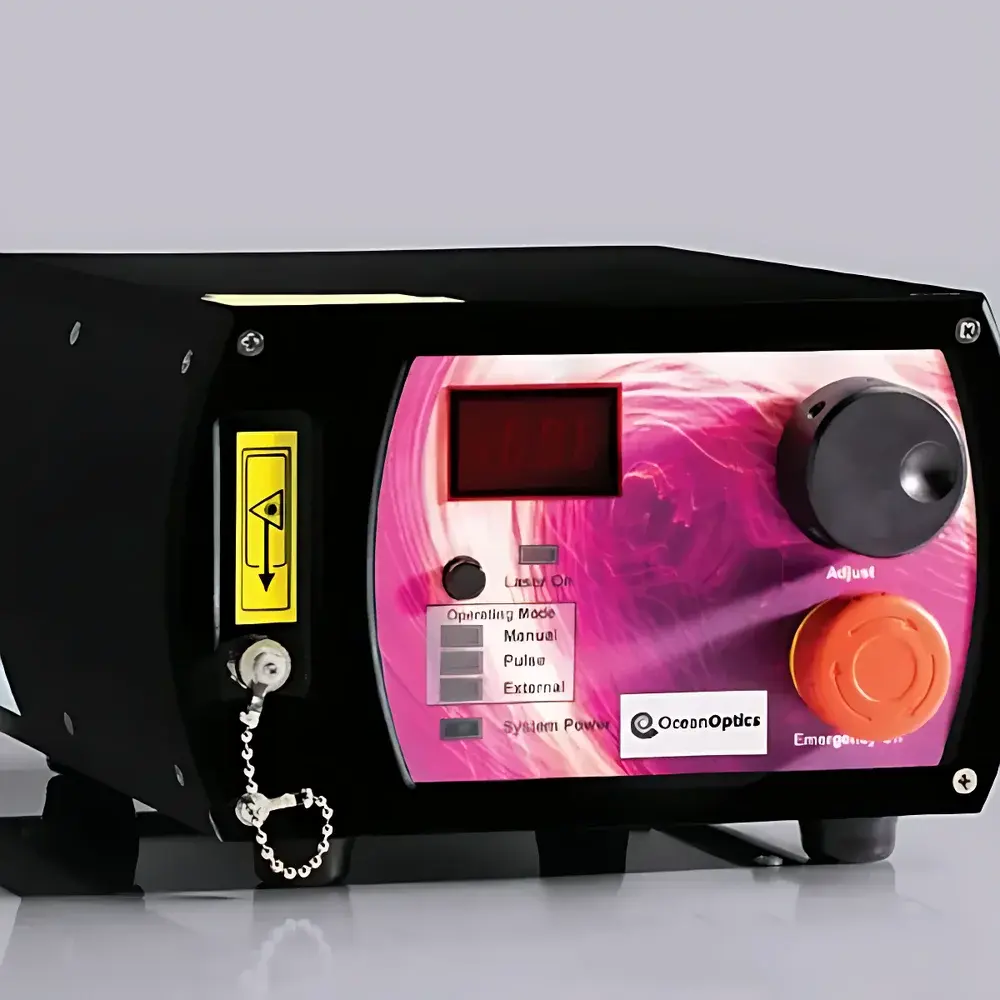
Ocean Optics Raman Lasers Series – High-Power Diode-Based Excitation Sources (532 nm to 1064 nm)
| Brand | Ocean Optics |
|---|---|
| Origin | USA |
| Manufacturer Type | Authorized Distributor |
| Product Category | Imported |
| Model Series | Raman Lasers |
| Core Technology | Semiconductor Diode Laser |
| Wavelength Options | 532 nm, 638 nm, 785 nm, 1064 nm |
| Output Power Range | >100 mW to >500 mW (wavelength-dependent) |
| Cooling | Integrated Thermoelectric Cooler (TEC) |
| Driver Integration | Built-in Constant-Current Laser Driver |
| Beam Delivery | FC or SMA905 fiber-coupled output |
| Spectral Linewidth | Narrow (<0.1 nm FWHM, typical) |
| Safety Compliance | IEC 60825-1 Class 3B / Class 4 (model-dependent) |
Overview
Ocean Optics Raman Lasers Series are engineered high-stability, fiber-coupled semiconductor diode lasers designed specifically for Raman spectroscopy excitation across four critical wavelengths: 532 nm, 638 nm, 785 nm, and 1064 nm. These lasers operate on the principle of stimulated emission in III–V semiconductor gain media, optimized for narrow spectral linewidth (<0.1 nm FWHM, typical), low intensity noise (<0.5% RMS, 10 Hz–10 MHz), and long-term power stability (<±2% over 8 hours). Unlike gas or solid-state lasers, this diode-based architecture delivers superior wall-plug efficiency, compact form factor, and rapid thermal equilibration—enabling consistent signal-to-noise ratio in both benchtop and OEM-integrated Raman systems. The 785 nm and 1064 nm variants are particularly suited for fluorescence-suppressed analysis of organic compounds, pharmaceuticals, and biological tissues, while the 532 nm source provides high scattering cross-section for inorganic crystalline materials and nanomaterials characterization.
Key Features
- Fiber-coupled output with FC or SMA905 connectors—ensuring repeatable alignment and compatibility with standard spectrometer input optics
- Integrated thermoelectric cooler (TEC) and precision temperature controller—maintaining junction temperature stability within ±0.1 °C for wavelength drift <0.005 nm/°C
- Onboard constant-current laser driver with analog modulation input (0–5 V) and TTL enable/disable—supporting external triggering and pulse-width modulation up to 10 kHz
- Interlocked safety circuit compliant with IEC 60825-1:2014—featuring key-switch enable, emission indicator LED, and hardware-enforced power cutoff
- Adjustable output power models (e.g., LASER-785-LAB-ADJ-FC)—allowing fine-tuning between 10%–100% of maximum rated power without mode hopping
- Rugged aluminum housing with conductive anodization—designed for ESD immunity and stable operation in laboratory environments per IEC 61326-1 (EMC)
Sample Compatibility & Compliance
These lasers are validated for use with a broad range of Raman sampling interfaces—including immersion probes, backscattering cuvette holders, and confocal microscope couplers—across material classes such as polymers, catalysts, battery electrode materials, and biofluids. All models meet RoHS Directive 2011/65/EU and REACH Regulation (EC) No. 1907/2006. For regulated analytical workflows, the series supports audit-ready operation when paired with compliant data acquisition software: laser ON/OFF timestamps, power setpoint logs, and TEC temperature records can be exported in CSV format for GLP/GMP documentation. While not FDA 21 CFR Part 11–certified as standalone devices, they are routinely deployed in ISO/IEC 17025-accredited laboratories performing ASTM E1840 (Raman Spectroscopy Terminology) and USP (Raman Spectroscopy)–aligned method validation.
Software & Data Management
Ocean Optics provides the OceanView Raman Edition software suite (v3.5+), which includes native drivers for all Raman Lasers models. This platform enables real-time power monitoring via integrated photodiode feedback, synchronized acquisition triggering, and automated calibration of laser-induced background subtraction. Exported spectral datasets adhere to JCAMP-DX v6.00 format, ensuring interoperability with third-party chemometric tools (e.g., MATLAB, Unscrambler X, Pirouette). For enterprise integration, the lasers support SCPI command set over USB virtual COM port—facilitating remote control in LIMS or MES environments. Audit trail functionality captures operator ID, timestamp, power setting, and thermal status for each acquisition session—meeting ALCOA+ data integrity principles.
Applications
- Pharmaceutical solid-state analysis: Polymorph identification and crystallinity assessment using 785 nm excitation to minimize fluorescence interference from excipients
- Materials science: Stress/strain mapping in CVD-grown graphene and transition metal dichalcogenides via 532 nm resonance Raman
- Environmental monitoring: In-situ detection of microplastics in aqueous matrices using 1064 nm NIR-Raman coupled with FT-Raman detection schemes
- Forensic chemistry: Non-destructive identification of illicit substances (e.g., fentanyl analogues) through library-matched 785 nm spectra under ambient lighting conditions
- OEM instrumentation: Embedded laser engines in portable Raman analyzers (e.g., handheld explosives detectors, food authenticity scanners) leveraging the compact 78 × 50 × 25 mm footprint
FAQ
What is the typical spectral linewidth for these lasers?
Full width at half maximum (FWHM) is typically <0.1 nm for all models, measured with a high-resolution optical spectrum analyzer (OSA) under stabilized thermal conditions.
Can these lasers be used with free-space optics instead of fiber coupling?
No—these are exclusively fiber-coupled sources. Free-space collimation requires external optics (e.g., aspheric collimators) and is not supported by the manufacturer’s mechanical or thermal design.
Do the adjustable-power models maintain spectral purity across the entire output range?
Yes—power adjustment is achieved via current modulation within the diode’s linear operating region; no mode hopping or wavelength shift occurs between 10% and 100% setpoint.
Is there a warranty or calibration certificate included?
All units ship with a 24-month limited warranty and NIST-traceable factory calibration report documenting output power, center wavelength, and power stability at three temperature setpoints (20 °C, 25 °C, 30 °C).
How is laser safety enforced during system integration?
Each unit incorporates a Class 3B/4 interlock loop (pin 1 = ground, pin 2 = interlock return) that must be closed before enabling lasing—compatible with standard lab safety interlock panels per ANSI Z136.1.




