
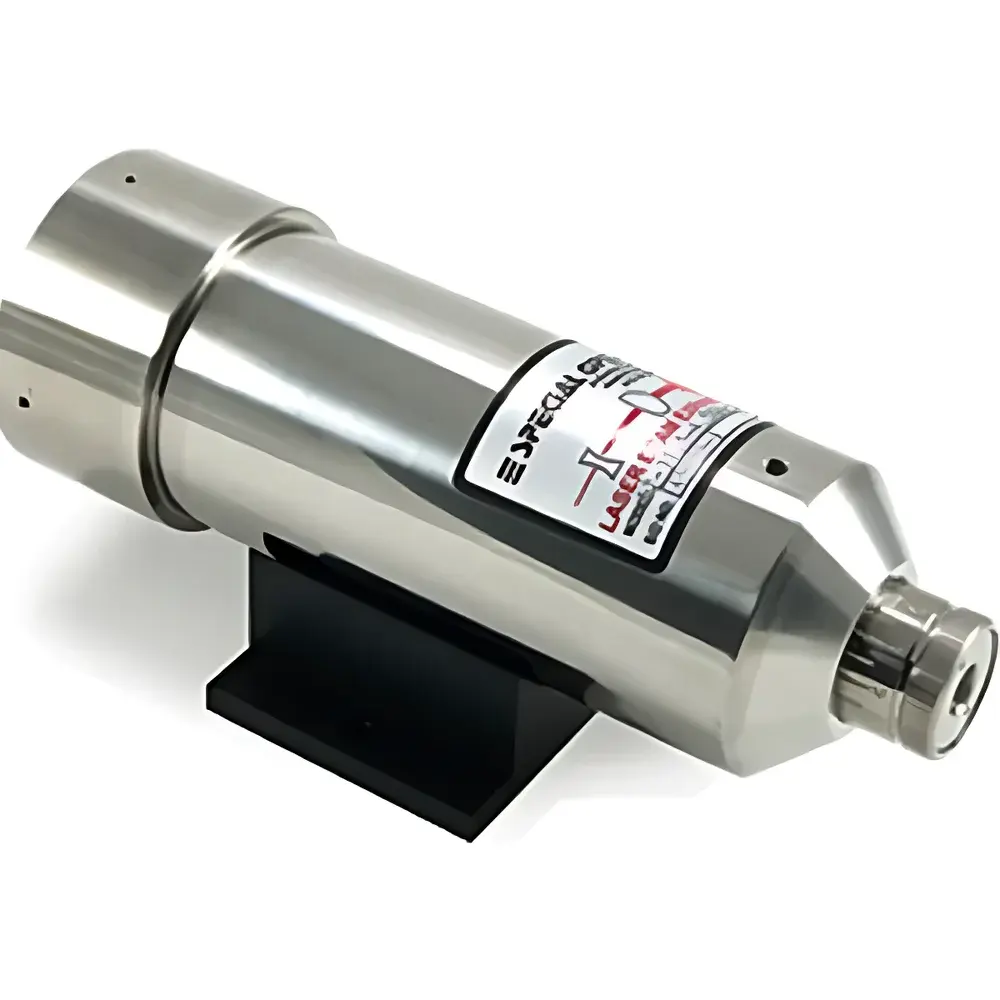
Ametek Special Optics Galilean Beam Expander
| Brand | AMETEK Special Optics |
|---|---|
| Origin | USA |
| Component Type | Precision Optical Beam Expander |
| Design Principle | Achromatic Galilean Telescope |
| Transmission Range | 248 nm – 1550 nm |
| Magnification Range | 2× – 40× |
| Input Aperture | 1.3 mm – 20 mm |
| Output Clear Aperture | ≥1.3 mm – >100 mm |
| Wavefront Distortion | λ/10 or better (specified at single/dual wavelengths) |
| Damage Threshold | ≥500 MW/cm² (pulsed, 10 ns @ 1064 nm) |
| Housing Material | Anodized Aluminum Alloy |
| Thermal Stability | Engineered for minimal thermal drift |
| Focal Length Range | 18 mm – 111 mm (manual zoom) |
| Working Distance | 5 inches to infinity |
| Compatible Sensor Format | ≤2/3″ |
Overview
The AMETEK Special Optics Galilean Beam Expander is a high-precision, diffraction-limited optical component engineered for demanding laser applications requiring stable beam magnification, controlled divergence correction, and exceptional wavefront fidelity. Based on an optimized Galilean telescope architecture—comprising a negative front element and a positive rear element—it eliminates internal focus points and intracavity reflections, making it inherently suitable for high-power and ultrafast laser systems where ghost reflections or focal plane heating must be avoided. Unlike Keplerian designs, this configuration maintains a compact, collimated optical path throughout the full magnification range (2× to 40×), enabling seamless integration into multi-wavelength platforms (e.g., simultaneous 1064 nm and 532 nm operation) and vacuum-compatible beamlines. Its performance is rigorously validated across UV (248 nm), visible, and near-IR (up to 1550 nm) spectral bands, with wavefront error specified at λ/10 or better under defined test conditions.
Key Features
- Diffraction-limited optical design validated per ISO 10110 standards for surface quality and transmitted wavefront error
- Manually adjustable zoom mechanism enabling continuous magnification tuning from 2× to 40× while maintaining parfocality
- Input aperture range: 1.3 mm to 20 mm; output clear aperture up to >100 mm—supporting large-diameter beam handling without vignetting
- High laser-induced damage threshold (≥500 MW/cm², 10 ns pulse, 1064 nm), verified per ISO 21254-1
- Anodized aluminum housing engineered for dimensional stability: coefficient of thermal expansion matched to fused silica optics to minimize thermal lensing and misalignment
- Low-absorption, multi-layer dielectric coatings optimized for specified dual-wavelength operation (e.g., 1064/532 nm) with average transmission >98% per surface
- No internal focus—eliminates plasma formation risk in high-peak-power regimes and enables use in Class 4 laser environments
Sample Compatibility & Compliance
This beam expander is compatible with any spatially coherent, collimated input source—including CW, pulsed, Q-switched, and mode-locked lasers—provided beam diameter and divergence fall within specified input aperture and angular acceptance limits. It supports compliance-critical workflows in regulated environments: optical alignment procedures are documented per ISO/IEC 17025 calibration traceability guidelines; coating durability meets MIL-C-48497A abrasion resistance requirements; and mechanical mounting interfaces conform to standard kinematic (e.g., SM1, SM2) and vacuum-flange (CF-35, CF-63) specifications. For FDA-regulated laser processing equipment (e.g., medical device micromachining), the unit’s non-outgassing housing and certified coating adhesion support 21 CFR Part 11–aligned validation protocols when integrated into GMP-compliant systems.
Software & Data Management
As a passive optical component, the beam expander requires no firmware, drivers, or embedded software. However, its optical parameters—including magnification factor, effective focal length, and beam divergence post-expansion—are fully integrable into third-party optical design and system modeling platforms (Zemax OpticStudio, CODE V, Synopsys LightTools). AMETEK provides comprehensive Zemax-compatible .ZAR and .DAT files, including surface sag maps and coating dispersion data (n(λ), k(λ)) for accurate multi-wavelength simulation. All units ship with NIST-traceable test reports detailing measured wavefront error (via interferometry), transmission spectra (per ASTM E903), and damage threshold verification logs—structured in CSV and PDF formats for LIMS or ELN ingestion.
Applications
- Laser micromachining: increasing focal spot intensity for precision ablation of metals, ceramics, and thin-film photovoltaic materials
- LIDAR transmitter optics: extending effective range via reduced beam divergence while preserving étendue
- Interferometric metrology: generating uniform, low-noise reference beams for sub-nanometer displacement sensing
- Harmonic generation setups: conditioning fundamental beams prior to nonlinear crystals to maximize conversion efficiency
- Remote sensing platforms: enabling long-path atmospheric transmission studies with minimized diffraction spread
- High-power laser delivery: collimating outputs from fiber-coupled amplifiers prior to focusing optics in industrial cutting/welding heads
- Ultrafast science: supporting CPA (chirped pulse amplification) beam transport lines where dispersion control and wavefront integrity are critical
FAQ
Is this beam expander vacuum-compatible?
Yes—the anodized aluminum housing and low-outgassing optical coatings meet UHV compatibility requirements (≤1×10⁻⁹ mbar base pressure); optional CF flange mounts available.
Can it be used with femtosecond pulses?
Yes—its all-reflective-free design avoids group delay dispersion; however, material dispersion must be modeled separately for <100 fs pulses using provided refractive index data.
Does AMETEK offer custom magnification or wavelength optimization?
Yes—custom designs include non-standard magnifications, multi-band AR coatings (e.g., 355/532/1064 nm), and motorized zoom variants with encoder feedback for automated process control.
What alignment tolerances apply during integration?
Maximum lateral decenter: ±15 µm; tilt tolerance: ±30 arcsec—exceeding typical OEM laser cavity alignment specs.
How is calibration traceability maintained?
Each unit includes a certificate of conformance referencing NIST-traceable interferometric wavefront measurements and spectrophotometric transmission verification performed in ISO 17025-accredited laboratories.





