
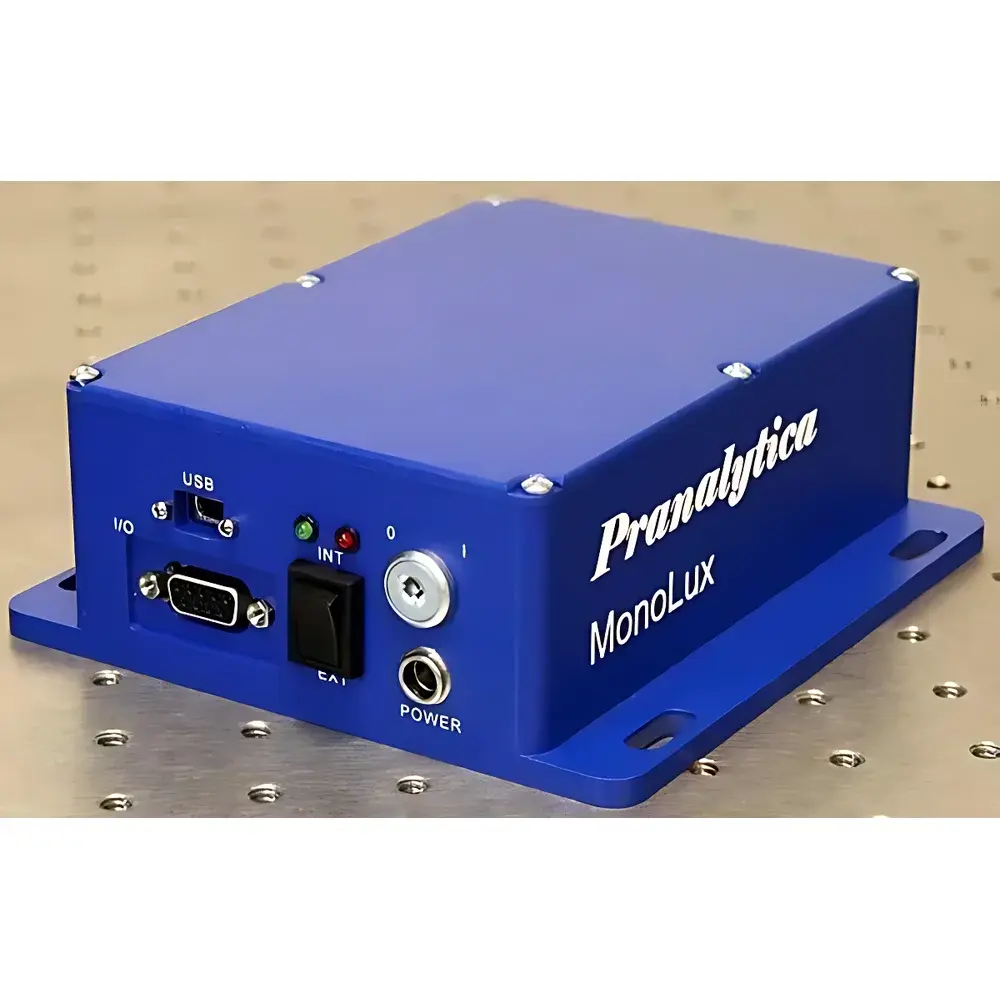
Pranalytica MonoLux-AA Tunable External Cavity Quantum Cascade Laser (QCL) System
| Brand | Pranalytica |
|---|---|
| Origin | USA |
| Model | MonoLux-AA |
| Output Power | Up to 4 W (pulsed), >500 mW avg. (quasi-CW, 50% duty cycle) |
| Tuning Range | ±5% around center wavelength (optional extended range) |
| Wavelength Coverage | 3.8–12+ µm |
| Operating Modes | Quasi-CW (200–500 ns pulses, 500 kHz–2 MHz rep rate, ~50% duty cycle) and true CW (100% duty cycle) |
| Cooling | Passive, fanless thermal management |
| Compliance | MIL-STD-810G qualified |
| Form Factor | Integrated laser head with collimating optics |
Overview
The Pranalytica MonoLux-AA is a high-performance, tunable external cavity quantum cascade laser (EC-QCL) system engineered for precision mid-infrared spectroscopy and trace gas sensing applications. Unlike conventional diode lasers, QCLs operate on intersubband transitions within engineered quantum well heterostructures—enabling intrinsically narrow linewidth emission, high power density, and broad spectral coverage across the molecular fingerprint region (3.8–12+ µm). The MonoLux-AA leverages an external Littrow-type grating cavity to achieve continuous, mode-hop-free wavelength tuning over ±5% of the center wavelength—supporting high-resolution absorption spectroscopy with sub-wavenumber accuracy. Its monolithic laser head integrates the QCL chip, thermally stabilized mount, and aspheric collimation optics, enabling robust operation in non-laboratory environments including field-deployable platforms, industrial process lines, and airborne or mobile detection systems.
Key Features
- High-output power architecture: Delivers up to 4 W peak pulsed power and >500 mW average optical power in quasi-CW mode at central tuning wavelengths—among the highest commercially available output levels for EC-QCL systems.
- Wide spectral coverage: Configurable across 3.8–12+ µm, spanning key atmospheric transmission windows (3–5 µm and 8–12 µm) and targeting fundamental vibrational bands of critical analytes (e.g., NO, CO, CH4, NH3, HCN, SF6, VOCs).
- External cavity tuning: Precision motorized grating rotation enables reproducible, software-controlled wavelength scanning with <0.01 cm−1 resolution and <0.1 cm−1 absolute accuracy—fully compatible with Fourier-transform reference calibration protocols.
- MIL-STD-810G compliant design: Ruggedized mechanical housing, passive thermal management (fanless operation), and shock/vibration resistance ensure reliable performance in defense, aerospace, and industrial field deployments.
- Flexible operational modes: Supports both quasi-CW (200–500 ns pulses, 500 kHz–2 MHz repetition rate, ~50% duty cycle) and true continuous-wave (CW) operation—enabling optimization for either high peak power (for nonlinear detection) or ultra-stable frequency delivery (for heterodyne or cavity-enhanced measurements).
- OEM-ready integration: Modular architecture supports custom beam delivery, fiber coupling (with ZnSe or chalcogenide fibers), and synchronization I/O (TTL triggers, analog modulation inputs) for embedded system integration.
Sample Compatibility & Compliance
The MonoLux-AA is designed for direct interaction with gaseous, vapor-phase, and surface-adsorbed samples via open-path, multi-pass cell, or photoacoustic detection configurations. Its mid-IR output is fully compatible with standard IR gas cells (e.g., Herriott, White, or astigmatic multipass designs), quantum cascade detector (QCD) arrays, mercury cadmium telluride (MCT) photodiodes, and pyroelectric sensors. From a regulatory standpoint, the system meets electromagnetic compatibility (EMC) requirements per FCC Part 15 Class A and CE Directive 2014/30/EU. Its firmware architecture supports audit-trail logging and user-access controls aligned with GLP and GMP documentation practices. While not inherently FDA 21 CFR Part 11 compliant, the system’s deterministic control interface and timestamped data export facilitate integration into validated analytical workflows requiring electronic record integrity.
Software & Data Management
Pranalytica provides the MonoLux Control Suite—a cross-platform (Windows/Linux) application built on Qt and Python-based backend libraries—for full instrument orchestration. Capabilities include real-time wavelength calibration using built-in reference gas cells (e.g., N2O or CO), automated scan sequencing, spectral stitching across multiple tuning segments, and export in HDF5, CSV, and JCAMP-DX formats. The SDK (C/C++, Python, MATLAB APIs) enables integration with third-party DAQ systems (NI PXI, Keysight, Spectrum) and spectral analysis toolchains (e.g., HITRAN-based line fitting, PLS regression, PCA modeling). All parameter changes—including current, temperature setpoints, grating angle, and modulation depth—are logged with UTC timestamps and user identifiers, satisfying traceability requirements for ISO/IEC 17025-accredited laboratories.
Applications
- Defense & Security: Infrared countermeasures (IRCM), standoff explosive detection (e.g., TNT, RDX), chemical warfare agent identification (e.g., sarin, mustard gas), and container screening via backscatter or photoacoustic spectroscopy.
- Medical Diagnostics: Non-invasive breath analysis for ammonia (liver/kidney dysfunction), acetone (diabetes monitoring), isoprene (cholesterol metabolism), and sevoflurane (anesthetic concentration tracking) with sub-ppb detection limits.
- Environmental Monitoring: Real-time stack emission monitoring (NOx, SO2, CO2, CH4), urban air quality networks, agricultural methane flux quantification, and marine vessel exhaust profiling under IMO MARPOL Annex VI compliance frameworks.
- Industrial Process Control: In-line natural gas composition analysis (C1–C4 hydrocarbons), leak detection in petrochemical refineries (H2S, Cl2, HF), pharmaceutical solvent residue verification (acetone, methanol, dichloromethane), and semiconductor fab ambient gas purity assurance (NH3, HF, SiH4).
- Research & Metrology: High-resolution molecular spectroscopy, cavity ring-down spectroscopy (CRDS), frequency-comb-referenced calibration, and development of next-generation dual-comb QCL sources.
FAQ
What is the typical tuning speed of the MonoLux-AA system?
Tuning across a 10 cm−1 spectral window takes ≤100 ms; full-range scans (±5% of center wavelength) require 200–500 ms depending on resolution settings and acceleration profiles.
Does the system support fiber coupling?
Yes—ZnSe or soft-glass (e.g., AMTIR-1) fiber pigtailing is available as a factory option; free-space collimated output (1.5 mm Ø, M² < 1.3) is standard.
Can the MonoLux-AA be operated in a vacuum environment?
The laser head is sealed and rated for operation at ambient pressures from 100 Pa to 101 kPa; vacuum-compatible variants with feedthrough-rated electronics are available upon request.
Is spectral calibration traceable to NIST standards?
Yes—factory calibration uses NIST-traceable gas cells; users may perform in-situ recalibration using certified reference gases (e.g., SRM 1964, SRM 2622).
What maintenance is required for long-term operation?
No consumables or periodic alignment are required; recommended annual verification includes thermal drift assessment and wavelength repeatability testing using internal reference lines.






