
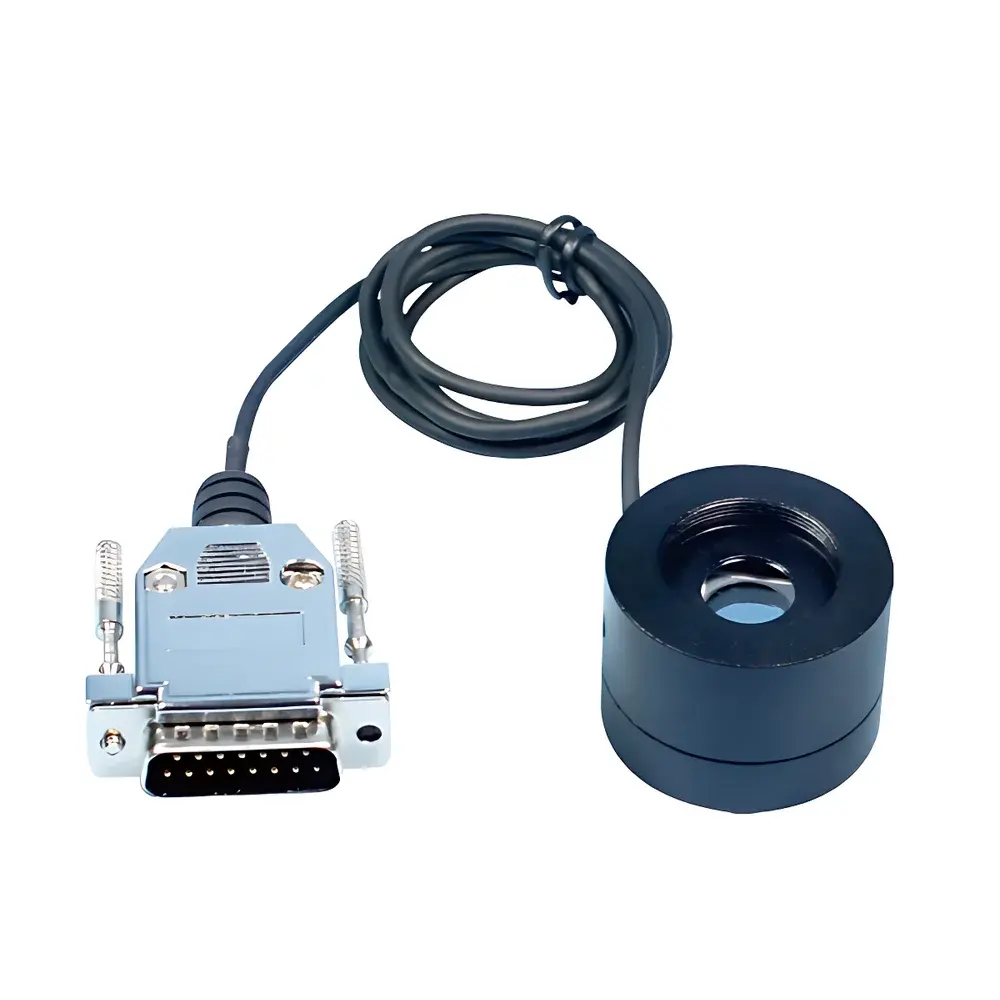
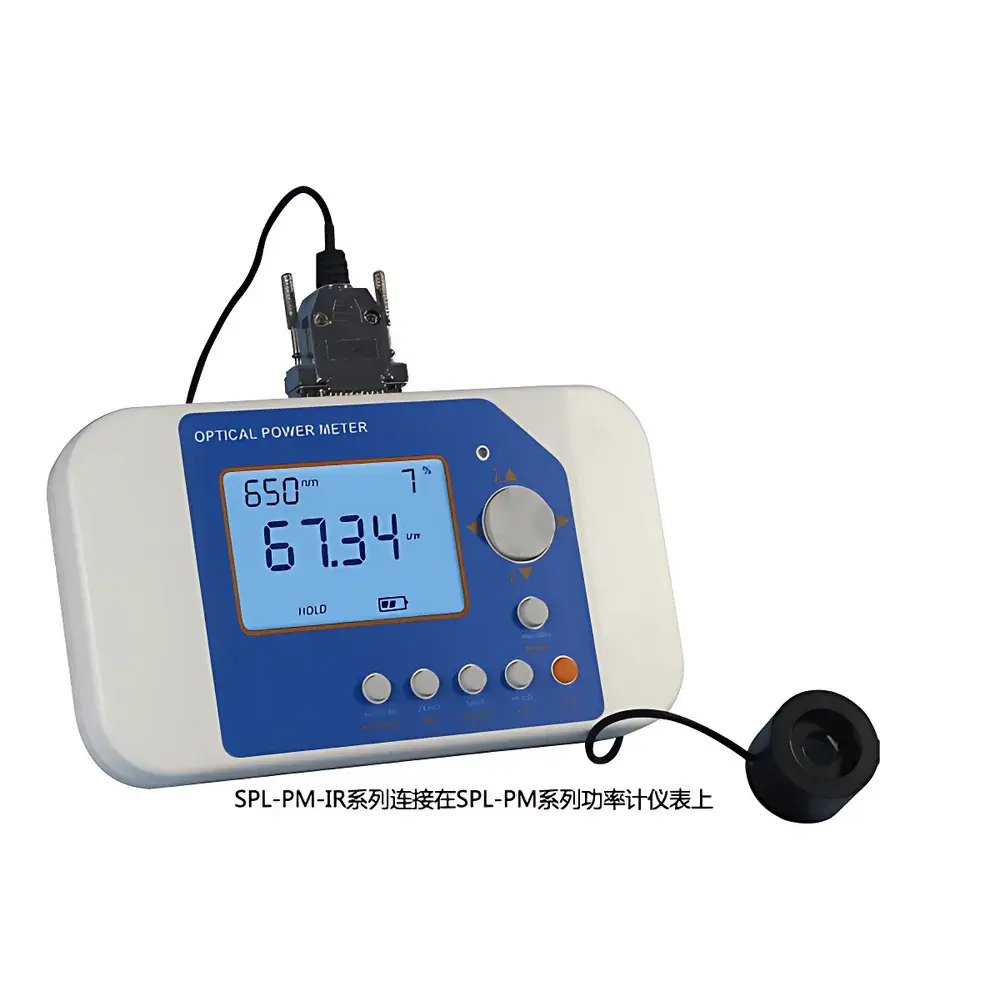
SPL SPL-PM-IR Digital Low-Power Photodetector (200–1700 nm)
| Brand | SPL |
|---|---|
| Model | SPL-PM-IR |
| Spectral Range | 200–1700 nm |
| Detector Types | UV-enhanced Si, Si, InGaAs |
| Calibration Data Storage | Integrated EEPROM |
| Interface | Digital (SPL-PM series compatible) |
| Attenuation Options | 10×, 100×, 1000× ND filters |
| Origin | Zhejiang, China |
| Distribution Type | Authorized Distributor |
Overview
The SPL SPL-PM-IR Digital Low-Power Photodetector is an engineered solution for precise, low-intensity optical power measurement across a broad spectral range—from deep ultraviolet (200 nm) to short-wave infrared (1700 nm). Unlike analog photodiodes requiring external amplification and calibration, this detector integrates signal conditioning, analog-to-digital conversion, and factory-applied wavelength-dependent responsivity correction directly within the sensor head. It operates on the principle of photoelectric conversion with embedded digital compensation, ensuring traceable, repeatable measurements without reliance on external DAQ hardware or manual calibration tables. Designed for integration into research-grade optical test benches, laser characterization setups, and spectroscopic instrumentation, the SPL-PM-IR delivers high linearity (<±0.5% over 6 decades), low dark current (<10 pA for Si variants; <1 nA for InGaAs), and minimal thermal drift—critical attributes for long-duration stability in academic and industrial metrology environments.
Key Features
- Digital output interface optimized for seamless communication with SPL-PM series power meters—eliminating analog noise susceptibility and grounding loop errors.
- Three detector material options: UV-enhanced silicon (200–1100 nm), standard silicon (350–1100 nm), and extended-range InGaAs (900–1700 nm), enabling application-specific spectral coverage.
- Onboard EEPROM stores NIST-traceable calibration coefficients per wavelength point, automatically applied during measurement—no user calibration required.
- Integrated neutral density filter selection (10×, 100×, or 1000× attenuation) allows dynamic range extension from sub-nanowatt to multi-milliwatt levels without changing detectors.
- Compact, thermally stabilized housing with SMA905 or FC/PC fiber coupling options; designed for OEM integration and benchtop use under ambient laboratory conditions (15–30 °C, <70% RH non-condensing).
Sample Compatibility & Compliance
The SPL-PM-IR supports free-space beam and fiber-coupled input configurations, accommodating collimated beams down to Ø1 mm and multimode/single-mode fibers (core diameters 5–400 µm). Its detector active areas range from 0.2 mm² (InGaAs) to 1.0 mm² (Si), minimizing spatial non-uniformity errors. The device complies with IEC 61326-1:2013 for electromagnetic compatibility (EMC) in laboratory environments and meets RoHS 2011/65/EU material restrictions. While not certified to ISO/IEC 17025 as a standalone calibration instrument, its embedded calibration data conforms to ISO/IEC 17025:2017 Annex A.2 guidelines for internal calibration records. For GLP/GMP applications, audit trails—including firmware version, calibration date, and serial-numbered EEPROM write logs—are accessible via SPL’s proprietary configuration utility.
Software & Data Management
SPL provides the PM-Control Suite v3.x—a cross-platform (Windows/macOS/Linux) application supporting real-time power monitoring, time-stamped data logging (CSV/TXT), and batch export of calibrated irradiance values. The software implements IEEE 1588-2019-compatible timestamping for synchronization in multi-sensor optical experiments. All calibration data reside exclusively in the detector’s non-volatile memory; no host-based calibration files are required—ensuring measurement integrity even when switching between different power meter units. Raw ADC counts and corrected power values are simultaneously accessible via ASCII command protocol (RS-232/USB-VCP), facilitating integration with LabVIEW, Python (PySerial), or MATLAB environments. Audit-ready features include user-defined measurement tags, electronic signature fields, and exportable PDF reports compliant with FDA 21 CFR Part 11 requirements for electronic records.
Applications
- Laser diode output characterization in telecom (1310/1550 nm) and quantum optics (780/852 nm) labs.
- Low-power broadband source stability monitoring (e.g., supercontinuum or LED-based illumination systems).
- UV curing process validation where spectral sensitivity below 250 nm must be preserved.
- Fiber-optic sensor interrogation systems requiring stable reference detection over temperature gradients.
- Teaching laboratories for hands-on photodetector physics, responsivity mapping, and noise floor analysis.
FAQ
Does the SPL-PM-IR require periodic recalibration?
No—factory calibration data is permanently stored in onboard EEPROM and remains valid for the detector’s operational lifetime under specified environmental conditions. Users may optionally perform verification checks using a NIST-traceable reference source.
Can multiple SPL-PM-IR detectors be daisy-chained to a single SPL-PM meter?
Yes—the digital interface supports up to four detectors via a shared RS-485 bus with individual addressing; each unit retains its unique calibration profile independent of connection order.
Is the InGaAs variant suitable for measuring pulsed lasers?
It supports CW and quasi-CW operation up to 10 kHz modulation frequency; for nanosecond pulses, consult the datasheet for rise time (typically <10 ns for Si, <25 ns for InGaAs) and peak power limits.
How is spectral responsivity correction applied in real time?
The firmware interpolates from a 5-nm resolution calibration table stored in EEPROM, applying correction factors based on the selected wavelength setting in the host software or front-panel interface.
What mechanical mounting options are available?
Standard configurations include M4 threaded holes for kinematic mounts and a removable C-mount adapter; custom flanges (e.g., SM1, SM2) are available upon request for OEM integration.



