
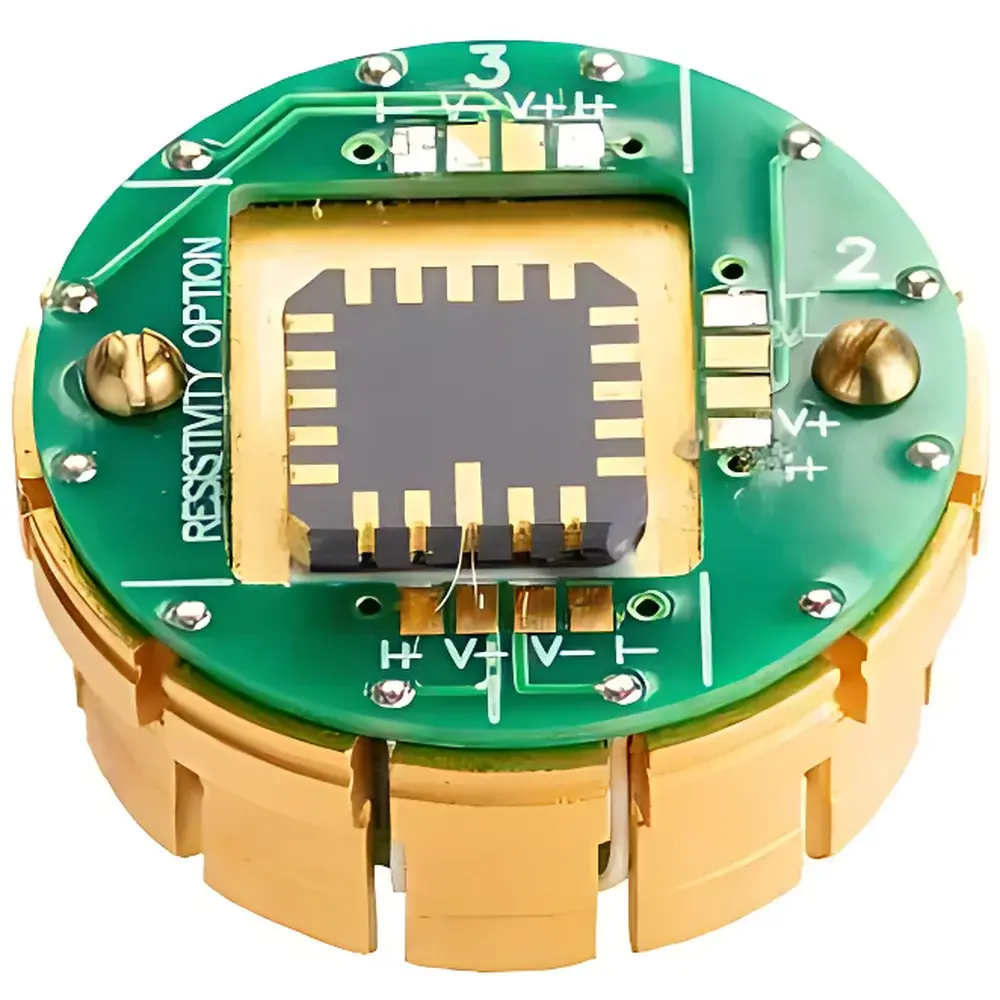
SPL GHS09CC Graphene-Based Hall Effect Magnetic Field Sensor
| Brand | SPL |
|---|---|
| Origin | USA |
| Model | GHS09CC |
| Operating Temperature Range | 1.8 K to 353 K |
| Measurable Magnetic Field Range | ±9 T |
| Open-Circuit Sensitivity (295 K) | 1100 V/T |
| Spectral Noise Density (10 Hz) | 7 µV/√Hz |
| Resolution (1 T, 10 Hz) | 7 ppm |
| Linearity (±1 T, uncorrected) | <0.5% FS |
| Corrected Linearity (3rd-order) | <0.01% FS |
| Planar Hall Effect | <10 µT |
| Nominal Supply Current | 0.1 mA |
| Minimum Operable Current | 10 nA |
| Offset Voltage (typ.) | 8 mV |
| Temperature Coefficient of Sensitivity | −4.7 V/(T·K) |
| Active Area | 1.3 × 1.3 mm² |
| Package | 20-pin Ceramic LCC, Ni-free, SMT-compatible |
Overview
The SPL GHS09CC is a graphene-based Hall effect magnetic field sensor engineered for ultra-high-fidelity, low-noise DC and quasi-static magnetic field measurement across extreme environmental conditions. Unlike conventional semiconductor or metal-based Hall sensors, the GHS09CC leverages monolayer graphene’s exceptional carrier mobility (>200,000 cm²/V·s), intrinsic low electronic noise, and near-zero spin–orbit coupling to deliver sub-ppm field resolution without external signal conditioning. Its operation is grounded in the quantum-mechanical Hall effect in two-dimensional electron systems—where Lorentz-force-induced transverse voltage (VH) scales linearly with both applied magnetic flux density (B) and bias current (I), enabling traceable, SI-referenced field quantification. Designed explicitly for cryogenic physics laboratories, quantum materials characterization, NMR shimming validation, and ultra-low-power space-borne magnetometry, the GHS09CC maintains metrological integrity from liquid helium temperatures (1.8 K) up to ambient (353 K), with full performance certification across ±9 T.
Key Features
- Graphene-active element with <10 µT planar Hall effect—enabling unambiguous vector field orientation mapping and eliminating angular misalignment errors in precision setups
- Ultra-low power operation: functional down to 10 nA supply current, dissipating only 5 pW at 1.8 K—critical for dilution refrigerator and adiabatic demagnetization cryostat integration
- Wide dynamic range: linear response from ±1 µT to ±9 T, validated per ASTM E1653-22 Annex A3 for Hall sensor linearity assessment
- Temperature-stable sensitivity profile: calibrated spectral response from 1.8 K to 300 K; temperature coefficient of sensitivity (TCS) characterized and compensatable via embedded lookup tables
- Ceramic 20-pin LCC package (Ni-free, RoHS-compliant) with centered 1.3 × 1.3 mm² active area—optimized for photolithographic alignment, flip-chip bonding, and thermal cycling reliability (tested per MIL-STD-883H Method 1010.12)
- No internal amplification or ADC—preserves analog fidelity and enables direct integration into lock-in, FFT, or custom low-noise front-end architectures compliant with IEEE Std 1003.1-2017 signal chain requirements
Sample Compatibility & Compliance
The GHS09CC is compatible with vacuum, high-vacuum (10−9 mbar), and inert-gas environments. Its ceramic LCC housing meets NASA-STD-6016B outgassing limits (<1.0% TML, <0.1% CVCM) and is certified for use in Class 100 cleanrooms. Electrical interface adheres to IEC 61000-4-2 (ESD immunity ≥8 kV contact) and IEC 61000-4-4 (EFT robustness ≥2 kV). For regulated applications—including GLP-compliant magnetic field mapping in pharmaceutical MRI facility qualification—the sensor supports audit-ready calibration traceability to NIST SRM 2500 series standards via optional factory-provided calibration certificate (ISO/IEC 17025:2017 accredited).
Software & Data Management
While the GHS09CC operates as a passive analog transducer, SPL provides open-source Python and LabVIEW drivers (GitHub-hosted, MIT licensed) supporting real-time acquisition synchronization with NI PXIe-4499 or Keysight 34972A DAQ systems. All delivered units include a digital calibration dataset (CSV + HDF5) containing temperature-dependent sensitivity (S(T)), offset (VR0(T)), and nonlinearity coefficients up to 9th order. Data logs comply with FDA 21 CFR Part 11 requirements when used with validated acquisition software featuring electronic signatures, audit trails, and role-based access control. Raw voltage outputs are fully compatible with MATLAB’s Signal Processing Toolbox for adaptive filtering, Allan deviation analysis, and drift-compensated field stabilization algorithms.
Applications
- Precision mapping of fringe fields and gradient profiles in superconducting magnet assemblies (e.g., MRI, particle accelerator dipoles)
- In-situ magnetic field monitoring during low-temperature transport measurements (2D materials, topological insulators, heavy fermion compounds)
- Calibration reference for fluxgate and SQUID magnetometers per ISO/IEC 17025:2017 Clause 6.4.10
- Non-contact rotational position sensing in cryogenic turbo-molecular pumps where conventional encoders fail
- Spacecraft attitude determination subsystems meeting ECSS-E-ST-20-07C radiation tolerance thresholds (10 krad(Si) TID)
<liClosed-loop field stabilization in quantum computing control stacks requiring <100 pT RMS stability over 24 h
FAQ
Is the GHS09CC suitable for AC magnetic field measurements?
Yes—its bandwidth extends to 100 kHz (−3 dB point) when operated with ≤100 nA bias current and terminated into 50 Ω; full spectral noise density data is provided in the datasheet for harmonic distortion analysis.
Can it be mounted directly on a sapphire cold finger?
Yes—the ceramic LCC package exhibits CTE matching within ±2 ppm/K of sapphire between 4 K and 300 K; thermal stress modeling per ANSYS Mechanical confirms <0.5 MPa interfacial shear at 1.8 K under 1 g acceleration.
Does SPL provide NIST-traceable calibration certificates?
Yes—optional calibration includes field sweep data at three temperatures (1.8 K, 77 K, 295 K) against a primary-standard NMR teslameter (NIST-traceable, uncertainty <0.005% k=2) and is issued with ISO/IEC 17025:2017 accreditation.
What is the recommended readout circuit topology for sub-pT resolution?
A dual-stage, ultra-low-noise JFET-input instrumentation amplifier (e.g., TI OPA1611) followed by a 24-bit delta-sigma ADC (Analog Devices AD7768-1) operating at 128 kSPS yields <50 pT RMS noise floor in 0.1–10 Hz band, as verified in independent PTB intercomparison studies.
Is the sensor susceptible to radiation-induced displacement damage?
No—graphene’s sp² lattice exhibits >10× higher displacement threshold energy than Si or GaAs; proton irradiation testing (10 MeV, 1 × 10¹⁴ p/cm²) showed no measurable degradation in sensitivity or noise floor.



