
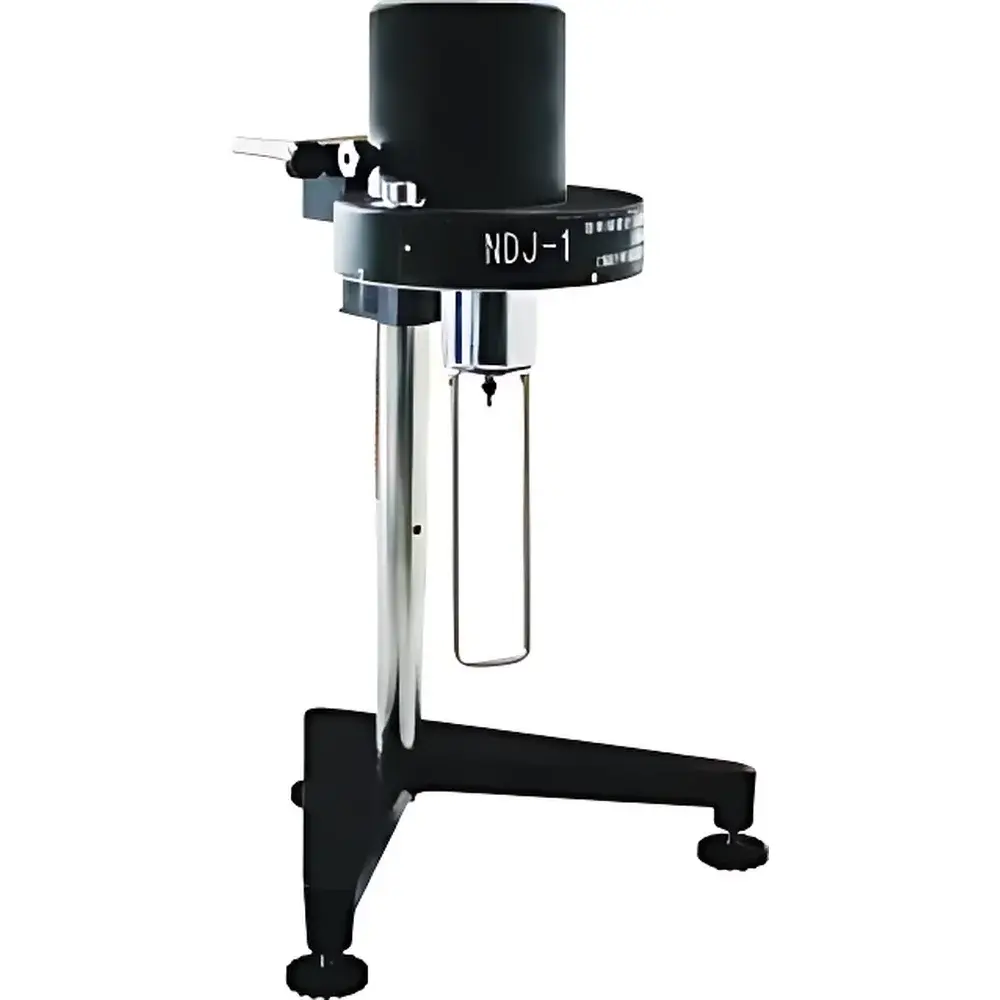
SHYP NDJ-1 Rotational Viscometer
| Brand | SHYP |
|---|---|
| Origin | Shanghai, China |
| Manufacturer Type | Authorized Distributor |
| Country of Origin | China |
| Model | NDJ-1 |
| Price | USD 315 (FOB Shanghai) |
| Measurement Range | 1–1×10⁵ mPa·s |
| Accuracy | ±5% for Newtonian fluids |
| Rotational Speeds | 6, 12, 30, 60 rpm |
| Spindles | No. 0, No. 1, No. 2, No. 3, No. 4 |
| Dimensions | 280 × 290 × 450 mm |
Overview
The SHYP NDJ-1 Rotational Viscometer is a mechanically driven, coaxial cylinder-type viscometer engineered for routine viscosity assessment of Newtonian and mildly non-Newtonian liquids in quality control, R&D, and production environments. It operates on the principle of rotational viscometry—measuring the torque required to rotate a spindle at a defined angular velocity within a stationary sample. The resulting drag force is directly proportional to the fluid’s dynamic viscosity under laminar flow conditions governed by Couette flow theory. Designed for simplicity, reliability, and repeatability, the NDJ-1 complies with foundational metrological practices outlined in ISO 2555 and ASTM D2196 for single-point viscosity determination. Its fixed-speed motor drive and analog dial readout provide immediate, operator-independent readings without software dependency—making it especially suitable for laboratories requiring rapid pass/fail checks or where digital infrastructure is limited.
Key Features
- Four discrete rotational speeds (6, 12, 30, and 60 rpm) enable selection of appropriate shear rate conditions for diverse sample rheologies.
- Five interchangeable spindles (No. 0 through No. 4) expand effective measurement coverage across low- to medium-viscosity ranges—from thin solvents to semi-solid pastes—without requiring recalibration between spindles.
- Mechanically robust cast-aluminum housing and precision-machined spindle shaft ensure long-term dimensional stability and resistance to thermal drift during extended operation.
- Analog torque-sensing mechanism with calibrated mechanical dial eliminates electronic noise, battery dependency, or firmware updates—supporting uninterrupted use in regulated or resource-constrained settings.
- Compliance-ready design facilitates integration into GLP-compliant workflows; all operational parameters (spindle ID, speed, reading time) are manually logged per test, supporting audit-trail documentation requirements.
Sample Compatibility & Compliance
The NDJ-1 accommodates homogeneous, non-aerated liquids including mineral oils, polymer solutions, emulsions, syrups, molten waxes, and aqueous suspensions—with optimal performance observed for samples exhibiting minimal thixotropy or yield stress. It is not intended for highly shear-thinning, viscoelastic, or particulate-laden systems requiring controlled ramp/shear history. For regulatory alignment, the instrument supports manual adherence to USP (Viscosity Measurements), ISO 3219 (Rotational Viscometers), and GB/T 2794–2013 (Chinese national standard for adhesive viscosity testing). While it does not incorporate electronic data logging or 21 CFR Part 11 functionality, its deterministic mechanical output enables full traceability when used with standardized lab notebooks and SOP-controlled procedures.
Software & Data Management
The NDJ-1 operates independently of software or computer interfaces. All measurements are recorded manually via the front-panel analog scale, which displays viscosity directly in millipascal-seconds (mPa·s). Users maintain data integrity through handwritten logs or spreadsheet entry, ensuring compatibility with legacy LIMS platforms and paper-based QA/QC systems. For laboratories transitioning toward digital workflows, optional external USB microscopes or digital calipers may be used to capture dial readings; however, no proprietary drivers, APIs, or cloud services are associated with this model. Calibration verification is performed using certified standard oils (e.g., Cannon-Fenske or Brookfield-certified reference fluids), with certificates traceable to NIM (National Institute of Metrology, China) or NIST-equivalent standards.
Applications
- QC screening of lubricating oils and greases in automotive and industrial maintenance labs.
- Batch consistency verification for paint and coating formulations prior to canning.
- Viscosity grading of edible oils, honey, and dairy-based sauces in food processing facilities.
- Stability assessment of topical pharmaceutical gels and ointments during formulation development.
- Routine monitoring of adhesive viscosity in packaging and assembly lines to prevent dispensing faults.
- Educational demonstrations of Newtonian behavior, temperature dependence, and spindle selection logic in undergraduate materials science laboratories.
FAQ
What is the minimum sample volume required for accurate measurement with the NDJ-1?
For spindles No. 1–No. 4, a minimum volume of 20 mL in a standard 60-mm-diameter cylindrical container is recommended. Spindle No. 0 requires ≥10 mL and is typically used with small-volume adapters.
Can the NDJ-1 measure non-Newtonian fluids?
It provides single-point apparent viscosity values for mildly shear-thinning or thixotropic samples at each selected speed—but does not compute flow curves, yield stress, or time-dependent recovery. For full rheological profiling, a programmable rheometer is advised.
Is calibration traceable to international standards?
Yes—when calibrated using NIST-traceable standard oils (e.g., Cannon Viscosity Standards), results are traceable to SI units via accredited calibration laboratories.
Does the instrument include temperature control?
No. Ambient temperature must be stabilized externally (±0.5 °C) during testing; optional water-jacketed sample cups may be sourced separately.
How often should the NDJ-1 be verified?
Daily verification with a reference oil is recommended before first use; full recalibration is advised every 6 months or after mechanical impact or spindle replacement.



