
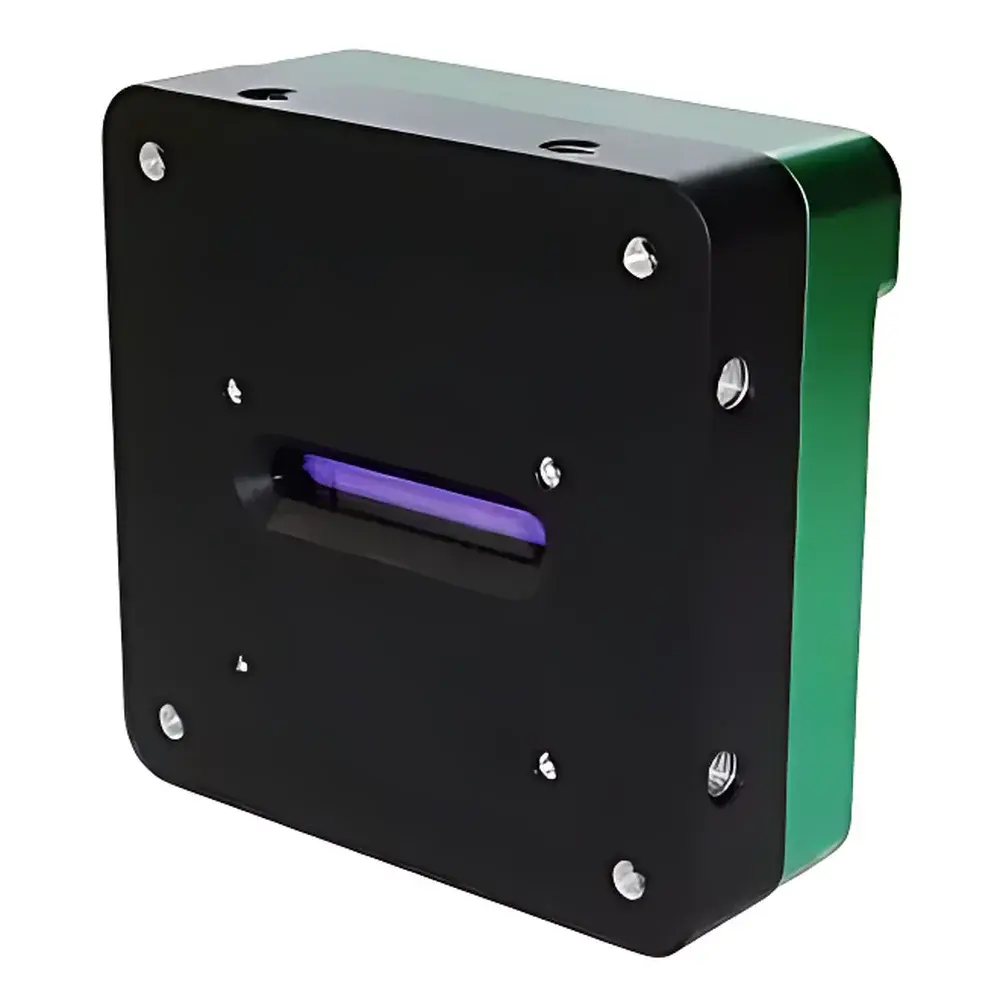
e2v OCTOPLUS High-Speed CMOS Line-Scan Camera for Optical Coherence Tomography
| Brand | e2v |
|---|---|
| Origin | France |
| Model | OCTOPLUS |
| Pixel Size | 10 × 20 µm, 10 × 200 µm |
| Resolution | 2048 pixels |
| Max Line Rate | 20–250 kHz |
| Bit Depth | 10/11/12-bit |
| Interface | Camera Link® (Basic/Medium/Full), USB3 |
| Full Well Capacity | 140 ke⁻ / 200 ke⁻ |
| Quantum Efficiency | 54% @ 850 nm, 41% @ 890 nm |
| Read Noise | 5 e⁻ |
| Dynamic Range | 69–72 dB |
| SNR Max | 51–53 dB |
| PRNU (HF) | ≤ 0.5% |
| Integration Dead Time | 0.6 µs |
| Power Supply | 10–15 V DC (PoCL-compliant) |
| Power Consumption | < 3 W |
| Sensor Package | Ceramic or Organic |
| Programmable Gain | Analog ×1/×2/×4, Digital ×1–×7.996 |
| Offset Adjustment | −4096 to +4096 (12-bit LSB) |
| Trigger Modes | Internal/External line trigger with programmable exposure and line period |
Overview
The e2v OCTOPLUS is a modular, high-speed CMOS line-scan imaging platform engineered specifically for optical coherence tomography (OCT) systems and spectral-domain spectroscopy applications. Unlike legacy CCD-based line sensors—limited by charge transfer speed and architectural inflexibility—the OCTOPLUS leverages monolithic CMOS architecture to deliver significantly higher line rates (up to 250 kHz at 10-bit depth), improved quantum efficiency in the near-infrared (54% at 850 nm), and enhanced system-level integration flexibility. Its core measurement principle relies on synchronized line-by-line acquisition of interferometric spectral data, enabling real-time Fourier-domain reconstruction of axial (A-scan) and cross-sectional (B-scan) tissue morphology. Designed for clinical ophthalmic OCT, intravascular imaging, and industrial metrology, the OCTOPLUS supports both swept-source and spectrometer-based OCT topologies while maintaining strict adherence to photonic signal fidelity requirements—including low read noise (5 e⁻), high dynamic range (up to 72 dB), and sub-1% photometric nonlinearity.
Key Features
- 2048-pixel monochrome CMOS linear sensor with two pixel height variants: 20 µm (optimized for alignment tolerance and defocused edge response) and 200 µm (enabling passive optical alignment and eliminating active calibration overhead)
- Configurable full-well capacity options: 140 ke⁻ (standard) and 200 ke⁻ (high-SNR mode), supporting extended integration times without saturation in low-light OCT environments
- Four selectable maximum line rate grades: 20 kHz, 80 kHz, 130 kHz, and 250 kHz—each matched to specific bit-depth configurations (e.g., 250 kHz at 10-bit, 130 kHz at 12-bit) to balance speed, resolution, and signal integrity
- Dual packaging options: hermetically sealed ceramic package (for ultra-stable flatness, minimal thermal drift, and precision optical alignment) and cost-optimized organic package (suitable for less demanding thermal or mechanical stability requirements)
- Programmable analog and digital gain stages (analog ×1/×2/×4; digital ×1–×7.996), offset adjustment (−4096 to +4096 LSB in 12-bit format), and flexible trigger logic (internal line trigger with programmable exposure/period or external TTL-synchronized triggering)
- PoCL-compliant 10–15 V DC power interface with total system power draw < 3 W—enabling integration into compact, fanless OCT consoles and portable diagnostic platforms
Sample Compatibility & Compliance
The OCTOPLUS is compatible with standard OCT optical paths operating in the 800–900 nm wavelength band, including fiber-coupled spectrometers with grating dispersion elements and free-space collimated beam configurations. Its 10 × 20 µm and 10 × 200 µm pixel geometries accommodate both high-resolution retinal layer segmentation and deep-tissue penetration modes, respectively. The sensor meets ISO 13485 design control principles for medical device components and supports traceable calibration workflows required under FDA 21 CFR Part 11 for electronic records and signatures. While not itself a Class II medical device, the OCTOPLUS is routinely integrated into IEC 62304-compliant OCT systems validated per ANSI/AAMI ES60601-1 and EN 60601-2-66 for ophthalmic diagnostic equipment. Its low PRNU (< 0.5% HF) and stable QE characteristics ensure compliance with ASTM E2912–21 guidelines for quantitative spectral imaging performance verification.
Software & Data Management
The OCTOPLUS operates via standardized Camera Link® (Basic/Medium/Full) or USB3 Vision-compliant interfaces, eliminating dependency on proprietary SDKs. Native support for GenICam v3.1 enables seamless integration with common OCT reconstruction toolchains—including MATLAB-based FD-OCT pipelines, Python-based OpenCV/Numpy processing stacks, and commercial platforms such as National Instruments LabVIEW and HALCON. Firmware-upgradable registers allow runtime reconfiguration of ROI, gain, offset, and trigger parameters without hardware modification. All configuration states are logged with timestamped audit trails, satisfying GLP/GMP documentation requirements for regulated development environments. Optional firmware extensions provide on-chip line averaging, defect pixel correction, and real-time histogram equalization—reducing post-acquisition computational load in embedded OCT processors.
Applications
- Ophthalmic OCT: High-density B-scan acquisition for macular thickness mapping, optic nerve head analysis, and anterior segment imaging—with reduced motion artifact at 130–250 kHz line rates
- Intravascular OCT (IVOCT): Real-time catheter pullback imaging at >10 mm/s, leveraging 200 µm pixel height for robust focus tolerance across variable lumen diameters
- Industrial metrology: Non-contact surface profiling of transparent or semi-transparent layered materials (e.g., polymer films, coated glass, battery separators) using spectral-domain reflectometry
- Research spectroscopy: High-throughput spectral acquisition in Raman, fluorescence lifetime, and absorption spectroscopy setups requiring precise line synchronization and low temporal jitter
- Endoscopic OCT: Miniaturized probe integration enabled by low-power operation (<3 W) and compact ceramic-packaged variants with sub-5 µm alignment repeatability
FAQ
What OCT system architectures is the OCTOPLUS compatible with?
The OCTOPLUS supports both spectrometer-based SD-OCT and swept-source OCT configurations. Its programmable exposure timing and low-latency trigger modes enable synchronization with A-line clocks in SS-OCT and grating scan timing in SD-OCT.
Can the OCTOPLUS be used outside the 800–900 nm range?
While peak quantum efficiency is specified at 850 nm and 890 nm, the sensor exhibits usable responsivity from 400 nm to 1050 nm. Performance beyond 900 nm requires characterization of dark current and thermal noise under application-specific cooling conditions.
Is USB3 operation limited to 130 kHz due to bandwidth or firmware constraints?
The 130 kHz limit is imposed by USB3.0 SuperSpeed theoretical throughput (400 MB/s) and protocol overhead—not firmware. Camera Link® is required for 200–250 kHz operation.
How does the ceramic vs. organic package affect long-term calibration stability?
Ceramic packaging provides < ±0.5 µm thermal-induced pixel displacement over −10°C to +60°C, whereas organic packages exhibit up to ±3 µm shift—making ceramic essential for applications requiring multi-year calibration retention without field recalibration.
Does the OCTOPLUS support region-of-interest (ROI) readout?
Yes. Programmable ROI allows partial-line readout (e.g., 1024 pixels centered within the 2048 array), reducing data volume and increasing effective frame rate for targeted anatomical regions without sacrificing full-resolution capability.




