
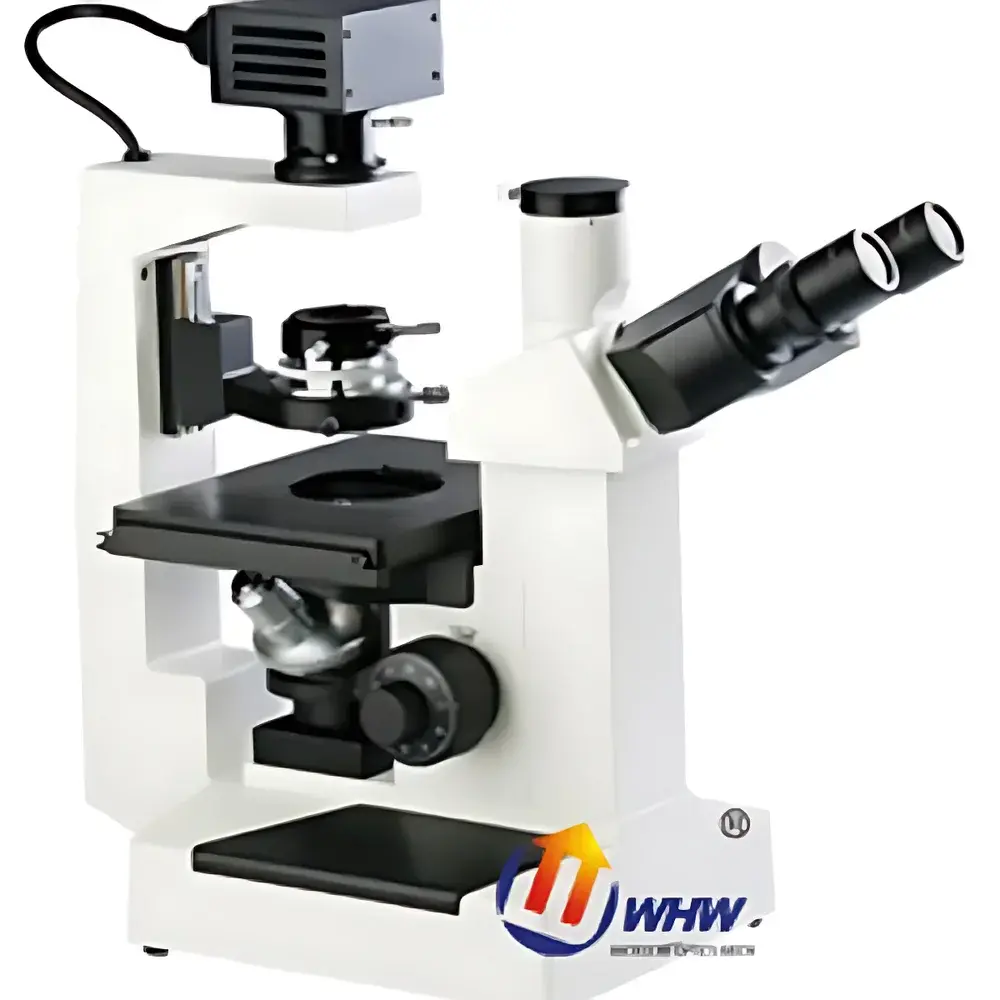
YANRUN XSD-100 Trinocular Inverted Biological Microscope
| Brand | YANRUN |
|---|---|
| Origin | Shanghai, China |
| Manufacturer Type | Direct Manufacturer |
| Product Category | Domestic (China-Made) |
| Model | XSD-100 Trinocular Inverted Biological Microscope |
| Microscope Type | Inverted Microscope |
| Eyepiece Configuration | Trinocular |
| Eyepieces | Wide-field WF10X (20 mm field number) |
| Objectives | Long-working-distance achromat plan objectives PL L 10X/0.25, PL L 25X/0.40, PL L 40X/0.60 |
| Condenser | Adjustable height, NA = 0.4, working distance = 55 mm (30 mm with phase condenser) |
| Eyepiece Tube | 30° inclined trinocular tube with 100% light path split for photomicrography |
| Focusing Mechanism | Coaxial coarse/fine focus |
| fine focus graduation | 2 µm |
| Nosepiece | 4-position revolving nosepiece with ball-bearing centering |
| Stage | Dual-layer mechanical stage (200 mm × 152 mm), travel range 75 mm × 30 mm |
| Specimen Holder | Compatible with culture dishes up to Ø72 mm or 77 mm × 33 mm |
| Filter Set | Blue and green interference filters included |
| Phase Contrast Accessories | Alignment telescope (10X), plug-in phase annuli, slide-in phase annuli set (10X/25X/40X) |
| Illumination | 6 V / 20 W halogen lamp with continuous intensity control |
Overview
The YANRUN XSD-100 Trinocular Inverted Biological Microscope is engineered for routine and advanced live-cell observation in academic laboratories, biotechnology R&D facilities, and quality control environments. Its inverted optical architecture places the objective lenses beneath the specimen stage—enabling direct imaging of adherent cells cultured in standard Petri dishes, multi-well plates, and flasks without sample inversion or mounting. This configuration preserves physiological conditions during prolonged time-lapse studies and minimizes mechanical disturbance during manipulation. The system employs Köhler illumination with a 6 V / 20 W halogen source and an adjustable NA = 0.4 condenser optimized for both brightfield and phase contrast modalities. All optical components—including wide-field WF10X eyepieces (20 mm field number) and long-working-distance plan achromat objectives (PL L 10X/0.25, 25X/0.40, 40X/0.60)—are corrected for chromatic and spherical aberrations across the visible spectrum, ensuring high-fidelity contrast and spatial fidelity at all magnifications.
Key Features
- Trinocular head with 30° inclination and 100% beam-splitting capability for simultaneous visual observation and high-resolution digital imaging
- Coaxial coarse/fine focusing mechanism with 2 µm fine-focus graduation, adjustable coarse-tension control, and integrated mechanical lock plus upper/lower travel limiters for reproducible Z-axis positioning
- Dual-layer mechanical stage (200 mm × 152 mm) with 75 mm × 30 mm translation range and precision vernier scales for accurate specimen repositioning
- Modular phase contrast compatibility via interchangeable plug-in or slide-in annuli sets supporting 10X, 25X, and 40X objectives—fully aligned using the included 10X alignment telescope
- Long-working-distance objectives (≥5.1 mm at 40X) accommodate thick culture vessels and enable unobstructed access for micromanipulation tools or perfusion systems
- Standard blue and green interference filters; optional yellow filter for enhanced contrast in specific fluorophore-free assays
Sample Compatibility & Compliance
The XSD-100 accommodates common in vitro cell culture formats including Ø68 mm, Ø72 mm, and 77 mm × 33 mm Petri dishes, T-flasks, and 6–96-well plates. Its 55 mm condenser working distance (reduced to 30 mm when using the dedicated phase contrast condenser) ensures unimpeded access to vessel bases while maintaining optimal illumination geometry. All optical paths conform to ISO 8578:2017 (Microscopes — Requirements for inverted microscopes) and support GLP-compliant documentation workflows when paired with validated digital imaging systems. While the microscope itself does not incorporate electronic audit trails, its mechanical design facilitates integration into FDA 21 CFR Part 11–compliant environments through third-party camera and software solutions that provide electronic signatures, user access controls, and immutable metadata logging.
Software & Data Management
As a hardware platform, the XSD-100 interfaces seamlessly with industry-standard USB 3.0 or HDMI-enabled CMOS cameras (e.g., Sony IMX series sensors). It is compatible with open-architecture imaging suites such as NIS-Elements (Nikon), ZEN (Zeiss), and open-source platforms like Micro-Manager and Fiji/ImageJ. These environments support time-series acquisition, multi-channel overlay, region-of-interest (ROI) intensity profiling, and export of TIFF, OME-TIFF, or ND2 file formats compliant with FAIR data principles. Metadata—including objective ID, magnification, filter position, and illumination intensity—is preserved in EXIF or OME-XML headers to ensure traceability across experimental replicates.
Applications
- Long-term live-cell monitoring of proliferation, migration, and morphological dynamics in primary cultures and immortalized lines
- Phase contrast evaluation of unstained mammalian cells, protozoa, and early-stage embryos without cytotoxic dyes
- Quality assurance of hybridoma cultures, stem cell monolayers, and organoid integrity prior to passaging or cryopreservation
- Supporting electrophysiology setups where electrode placement requires overhead clearance and stable focal plane maintenance
- Educational use in undergraduate biology and pharmacology labs for teaching cellular structure-function relationships
FAQ
What is the maximum working distance achievable with the 40X objective?
The PL L 40X/0.60 objective provides a working distance of 5.1 mm—sufficient to image through standard 1 mm-thick glass-bottom dishes and accommodate micropipette approaches.
Can the XSD-100 be upgraded for fluorescence imaging?
No. The base configuration lacks epi-illumination capability, excitation/emission filter cubes, or dichroic mirrors required for fluorescence. It is optimized exclusively for transmitted-light techniques: brightfield, phase contrast, and oblique illumination.
Is the halogen lamp replaceable with an LED module?
Yes—third-party 6 V DC LED replacements with color temperature matching (~3200 K) and uniform output profiles are mechanically and electrically compatible, offering extended service life and reduced thermal load on specimens.
Does the microscope include calibration certification?
Factory calibration certificates for mechanical stage linearity and focus scale accuracy are available upon request and comply with ISO/IEC 17025 requirements when issued by an accredited metrology provider.
What is the warranty coverage for the optical train?
YANRUN provides a 24-month limited warranty covering manufacturing defects in lenses, prisms, and coated optical surfaces under normal laboratory use conditions; consumables (e.g., bulbs, filters) and misuse-related damage are excluded.




