
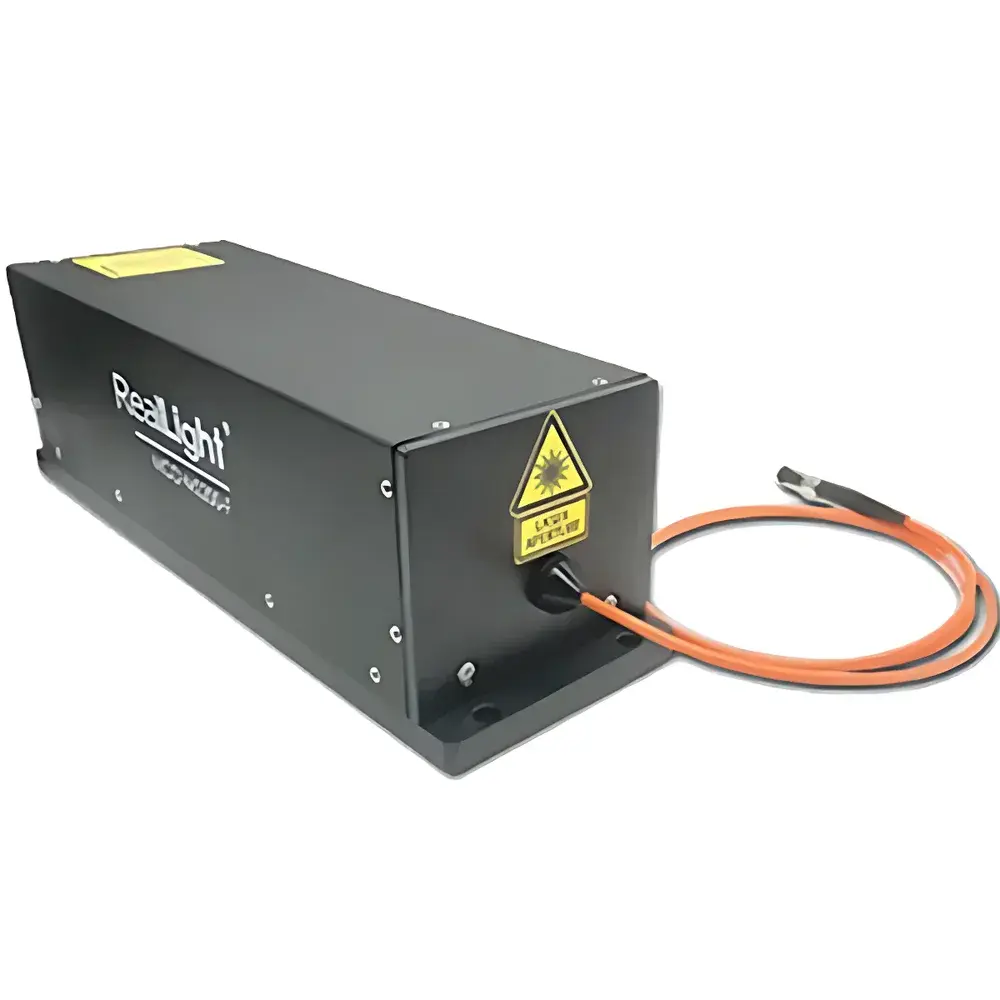
RealLight MCO Series Electro-Adjustable Energy Fiber-Coupled Microchip Laser
| Brand | RealLight |
|---|---|
| Origin | Beijing, China |
| Manufacturer Type | Authorized Distributor |
| Product Category | Domestic |
| Model | MCO Fiber-Coupled |
| Core Components | Semiconductor Laser Systems & Integrated Microchip Laser Modules |
| Wavelengths | 1064 / 532 / 355 / 266 nm |
| Repetition Rate | 1–200 Hz (16–200 Hz in Continuous & Burst Modes) |
| Pulse Width | ≤1 ns |
| Max. Fiber-Coupled Pulse Energy | 50 µJ @ 1064 nm, 25 µJ @ 532/355 nm, 10 µJ @ 266 nm |
| Energy Stability (RMS) | ≤3% |
| Energy Tuning Step Accuracy | ≤2% |
| Polarization Ratio | ≥100:1 |
| Fiber Output | 200 µm core / 0.22 NA |
| Power Input | 24 V DC (90–260 V AC adapter included) |
| Peak Power Consumption | <20 W |
| Average Power Consumption | <10 W |
| Dimensions (W×H×L) | 82 × 79 × 250 mm |
| Operating Temperature | 15–35 °C |
| Storage Temperature | −10–60 °C |
| Trigger Jitter | <100 ps (Optical Sync Output) |
| Control Interface | RS-232 |
| Modulation Input | TTL 0–5 V via SMB connector |
| Enclosure | Fully Sealed, Industrial-Grade Housing |
Overview
The RealLight MCO Series Electro-Adjustable Energy Fiber-Coupled Microchip Laser is a compact, solid-state pulsed laser system engineered for precision photonics applications requiring sub-nanosecond temporal resolution, high pulse-to-pulse stability, and flexible energy control. Based on monolithic Nd:YAG or Nd:YVO4 microchip architecture with intracavity harmonic generation, the MCO platform delivers fundamental output at 1064 nm and harmonics at 532 nm (SHG), 355 nm (THG), and 266 nm (FHG). Its integrated electro-optic energy modulation module enables real-time, software-controlled attenuation of pulse energy without mechanical adjustment—ensuring repeatability across long-term operation. The laser head features hermetic sealing and passive thermal management, eliminating active cooling requirements and supporting stable performance in laboratory, industrial, and field-deployable environments. Designed for integration into OEM instrumentation and automated test systems, the MCO series complies with IEC 60825-1:2014 Class 4 laser safety standards when operated within specified parameters.
Key Features
- Sub-nanosecond pulse width (≤1 ns FWHM) enabling high peak power delivery for nonlinear excitation and ablation
- Electronically tunable pulse energy via onboard digital control—no manual attenuators or beam-splitting losses
- Optical synchronization output with jitter <100 ps RMS, supporting time-resolved measurements in pump-probe or LIBS configurations
- Fiber-coupled output via SMA-905 connector with 200 µm core / 0.22 NA multimode fiber—optimized for efficient coupling into spectrometers, microscopes, or scanning optics
- Full RS-232 command set compliant with SCPI-like syntax for seamless integration into LabVIEW, Python, or MATLAB control environments
- Robust mechanical design: aluminum alloy housing, conformal coating on PCBs, and vibration-damped internal mounts ensure reliability under continuous duty cycling
- Comprehensive safety interlocks including key switch, emergency stop input, and TTL-enabled shutter control per FDA 21 CFR Part 1040.10 requirements
Sample Compatibility & Compliance
The MCO series supports broad compatibility with standard optical components and analytical platforms. Its TEM00-dominant beam profile (M² < 1.3) and low pointing instability (<5 µrad/°C) enable stable coupling into single-mode fibers, confocal microscope scanners, and time-of-flight mass spectrometer ion sources. All models meet CE marking requirements for electromagnetic compatibility (EN 61326-1) and low-voltage directive (2014/35/EU). For regulated environments—including GLP-compliant spectroscopy labs and ISO 13485 medical device manufacturing—the system provides full audit-trail-capable logging via RS-232 (timestamped parameter changes, error codes, runtime hours) and supports 21 CFR Part 11-compliant electronic signatures when used with validated host software. Calibration certificates traceable to NIM (National Institute of Metrology, China) are available upon request.
Software & Data Management
Supplied RealLight LaserControl™ GUI offers intuitive configuration of repetition rate (1–200 Hz), pulse energy (0–100% in ≤2% steps), burst mode parameters, and external trigger behavior. The software logs all operational parameters—including diode current, crystal temperature (monitored via embedded thermistor), and pulse energy history—with CSV export for statistical process control (SPC) analysis. An open API (DLL + Python bindings) enables direct integration with custom DAQ systems. Firmware updates are performed over RS-232 with CRC-verified packet transmission, ensuring integrity during field upgrades. No cloud connectivity or telemetry is implemented—data remains fully on-premise per ITAR and GDPR-aligned data sovereignty principles.
Applications
- Laser-Induced Breakdown Spectroscopy (LIBS) — high peak intensity enables robust plasma generation from conductive/non-conductive solids with minimal thermal load
- Time-resolved photoluminescence (TRPL) and laser-induced fluorescence (LIF) — sub-ns timing resolution supports carrier lifetime mapping in semiconductor wafers and perovskite films
- UV Raman spectroscopy — 266 nm output enhances resonance Raman cross-sections for carbon nanotube and graphene characterization
- Micromachining and laser marking — precise energy control enables consistent ablation thresholds on polymers, ceramics, and thin-film solar cells
- Laser capture microdissection (LCM) — fiber-delivered 355 nm pulses provide clean, non-thermal tissue sectioning with sub-10 µm lateral resolution
- Atmospheric LIDAR and remote sensing — low timing jitter and high pulse-to-pulse stability improve signal-to-noise ratio in aerosol backscatter profiling
- Mass spectrometry ionization — synchronized optical triggering ensures deterministic desorption/ionization in MALDI-TOF platforms
FAQ
What is the maximum average power achievable at 355 nm?
Average power is wavelength- and repetition-rate dependent. At 200 Hz and full energy (25 µJ), average power reaches 5 mW at 355 nm. Derating applies above 50 °C ambient per IEC 60825 thermal derating curves.
Can the MCO operate in Q-switched mode only, or does it support CW seeding?
The MCO is a passively Q-switched microchip laser; it does not support CW or gain-switched operation. Pulse generation is inherently self-starting and requires no external seed source.
Is the fiber output polarization-maintaining?
No—the standard 200 µm / 0.22 NA fiber is multimode and non-PM. For polarization-sensitive applications, free-space output variants (MCO-FS series) with >100:1 extinction ratio are available.
Does the system include laser safety eyewear?
No—laser protective eyewear must be selected based on user-specific wavelength, pulse energy, and exposure duration per ANSI Z136.1-2022. Recommended OD values are provided in the safety manual.
What is the expected lifetime of the laser crystal and pump diode?
Rated minimum lifetime is 10,000 hours at nominal operating conditions (25 °C ambient, 100 Hz, 80% max energy). Accelerated life testing follows Telcordia GR-468-CORE methodology.






