
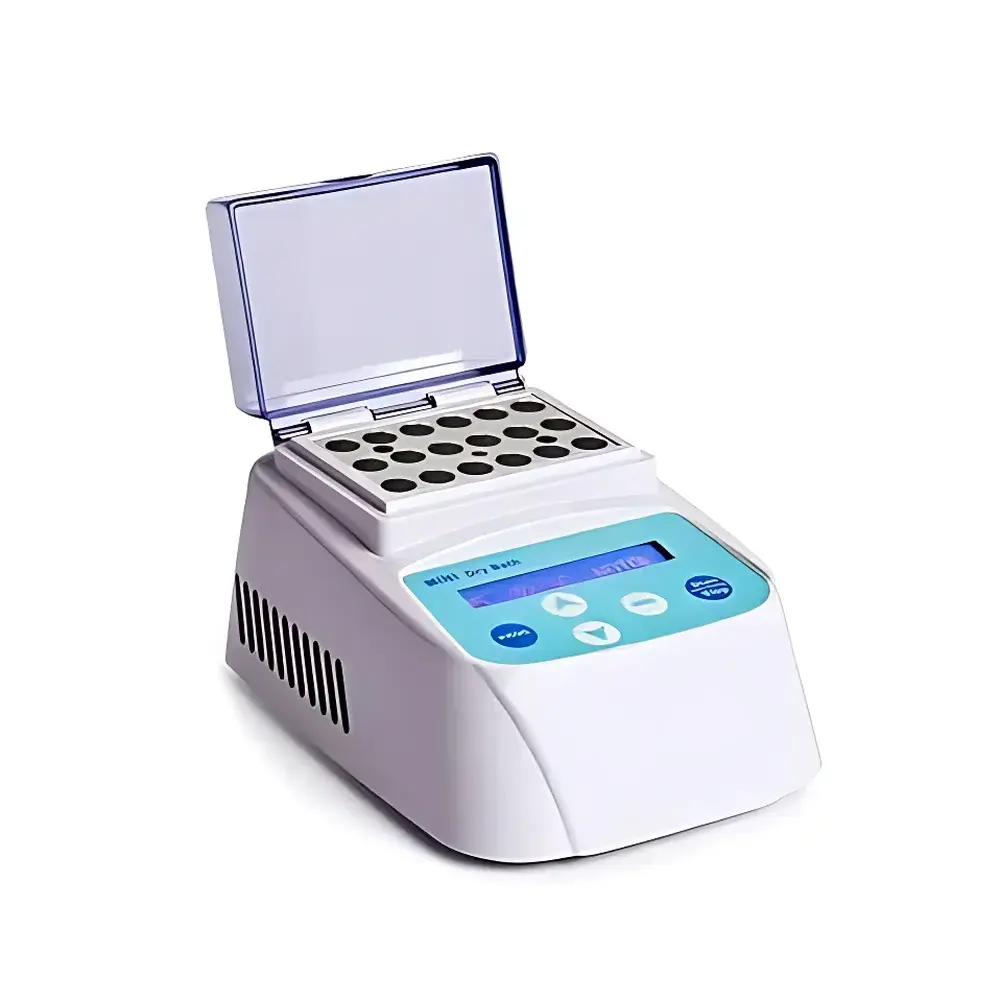
MENTS MINIC-100 Refrigerated Dry Block Heater
| Brand | MENTS |
|---|---|
| Origin | Beijing, China |
| Manufacturer Type | Direct Manufacturer |
| Product Category | Domestic |
| Model | MINIC-100 |
| Price | ¥5,700 |
| Temperature Range | −10 °C to 100 °C |
| Temperature Accuracy | ≤ ±0.5 °C |
| Heating Time | ≤15 min (20 °C → 100 °C) |
| External Dimensions | 40 cm (L × W × H unspecified |
| Net Weight | 4.5 kg |
| Cooling Time | ≤30 min (ambient −20 °C drop) |
| Temperature Uniformity | ≤ ±0.3 °C (at 40 °C ΔT across block) |
| Display Resolution | 0.1 °C |
| Max Timer Duration | 999 min |
| Max Power Consumption | 120 W |
| Input Voltage | 24 V DC |
| Safety Features | Over-temperature protection, self-diagnostic error detection with audible alarm |
| Block Modules | MINI-A (40×0.2 mL), MINI-B (24×0.5 mL), MINI-C (15×1.5 mL), MINI-D (15×2.0 mL), MINI-E (8–12.5 mm cuvette), MINI-F (4×15 mL), MINI-G (2×50 mL), MINI-H (customizable) |
| Heat Cover | Not included |
Overview
The MENTS MINIC-100 Refrigerated Dry Block Heater is a compact, microprocessor-controlled thermal management system engineered for precise temperature regulation in laboratory workflows requiring both heating and active cooling. Unlike traditional water baths or heated blocks, the MINIC-100 employs solid-state Peltier (thermoelectric) technology to achieve bidirectional thermal control — enabling stable operation from −10 °C to 100 °C without refrigerants or external chillers. Its dry-block architecture eliminates contamination risks associated with liquid media, making it suitable for molecular biology, clinical diagnostics, immunoassay preparation, and sample pre-treatment where sterility, rapid thermal response, and minimal footprint are critical. Designed for portability and field deployment, the unit operates on 24 V DC input — compatible with vehicle power systems, uninterruptible power supplies (UPS), and benchtop lab adapters — supporting decentralized or mobile laboratory environments including point-of-care testing (POCT) and field-deployed quality control.
Key Features
- Bi-directional Peltier-based temperature control delivering both heating and active cooling within a single compact housing.
- High-resolution digital display showing real-time block temperature (0.1 °C resolution) and countdown timer (0–999 min).
- Integrated temperature offset calibration function to compensate for sensor drift or module-specific thermal lag.
- Self-diagnostic system with audible alarm and on-screen error codes for over-temperature events, sensor failure, or power anomalies.
- Passive fan-assisted heat dissipation combined with optimized aluminum block geometry ensures ≤30 min cooling from ambient to −20 °C delta and ≤15 min heating from 20 °C to 100 °C.
- Modular interchangeable block system supporting eight standardized configurations (MINI-A through MINI-G) and custom fabrication (MINI-H), facilitating rapid reconfiguration between assay formats.
- UL/CE-compliant electrical architecture with dual-level over-temperature protection: hardware cutoff at 110 °C and software-enforced limit at user-defined setpoint.
Sample Compatibility & Compliance
The MINIC-100 accommodates common laboratory consumables via its standardized block inserts, including 0.2 mL PCR tubes (40-position), 0.5 mL microtubes (24-position), 1.5 mL and 2.0 mL centrifuge tubes (15-position each), square cuvettes (8–12.5 mm), and larger-volume vessels (4×15 mL or 2×50 mL). All modules are CNC-machined from anodized aluminum for chemical resistance and autoclavable compatibility (except electronic components). The device meets IEC 61010-1:2010 safety requirements for laboratory electrical equipment and complies with electromagnetic compatibility (EMC) standards per EN 61326-1. While not certified for GLP/GMP production environments, its traceable temperature accuracy (≤±0.5 °C at 100 °C), documented uniformity (≤±0.3 °C across block surface), and audit-ready parameter logging (via optional RS232/USB interface) support validation under ISO/IEC 17025-accredited quality systems.
Software & Data Management
The MINIC-100 operates as a standalone instrument with embedded firmware controlling all thermal and timing functions. Optional communication interfaces (RS232 or USB-to-serial adapter) enable integration into laboratory information management systems (LIMS) or custom data acquisition platforms. Logged parameters — including setpoint, actual block temperature, elapsed time, and fault events — can be exported as CSV files for compliance documentation. Firmware supports user-defined temperature profiles with up to three sequential segments (ramp-hold-cool), meeting basic requirements for ASTM E2926-13 (Standard Practice for Thermal Validation of Dry-Block Heaters) and USP guidelines on thermal uniformity verification. No proprietary software installation is required; configuration and monitoring are achievable via terminal emulation or Python-based serial scripting.
Applications
- Enzyme reaction incubation and thermal denaturation studies requiring sub-ambient stabilization.
- Pre-analytical sample conditioning for ELISA, lateral flow assays, and coagulation tests (e.g., serum clotting at 37 °C).
- PCR tube pre-chilling prior to master mix addition to minimize premature enzyme activation.
- Calibration standard equilibration for viscometers, spectrophotometers, and dissolved oxygen probes.
- Field-deployed QC checks in pharmaceutical distribution centers, blood banks, and veterinary clinics where AC power is unavailable.
- Rapid thawing of cryopreserved cell suspensions or reagents while avoiding thermal shock via controlled ramp rates.
FAQ
Does the MINIC-100 include a heated lid or condensation control feature?
No. The unit does not incorporate a heated lid or humidity management system. Users handling low-volume aqueous samples should consider supplemental sealing (e.g., adhesive film or silicone caps) to mitigate evaporation during extended incubations above 60 °C.
Can multiple modules be used simultaneously?
No. Only one module inserts into the heating/cooling block at a time. Module swaps require manual removal and replacement but take less than 30 seconds due to standardized dovetail mounting.
Is the device suitable for continuous operation at −10 °C?
Yes. The Peltier system is rated for indefinite operation across the full temperature range. However, sustained sub-zero operation in high ambient humidity may cause condensation on external surfaces; placement in a climate-controlled environment is recommended.
What validation documentation is provided with the instrument?
Each unit ships with a factory calibration certificate listing measured deviations at 0 °C, 37 °C, and 100 °C against NIST-traceable reference thermometers. IQ/OQ protocols and blank validation templates are available upon request.
How is temperature uniformity verified across the block surface?
Uniformity is validated using a 9-point grid measurement per ASTM E2926-13, with probe positions located at center and corners of the module cavity. Reported values reflect worst-case deviation observed during thermal equilibrium at 40 °C ΔT.



