
GRINTECH GRIN Lens – Gradient Index Optical Lens for Laser Beam Shaping and Fiber Coupling
| Brand | GRINTECH |
|---|---|
| Origin | Canada |
| Lens Type | Cylindrical Gradient-Index (GRIN) Lens |
| Numerical Aperture Options | NA ≈ 0.5 (Ag⁺-exchanged glass, λ₀.₅ = 370 nm) or NA ≤ 0.2 (Li⁺-exchanged glass, λ₀.₅ = 235 nm) |
| Material | Specialty ion-exchanged optical glass |
| Geometry | Cylindrical or square-columnar |
| Mounting | Standardized mechanical housing compatible with SM1/SM2 lens tubes and kinematic mounts |
| Compliance | ISO 10110 optical surface specifications, RoHS-compliant glass composition |
Overview
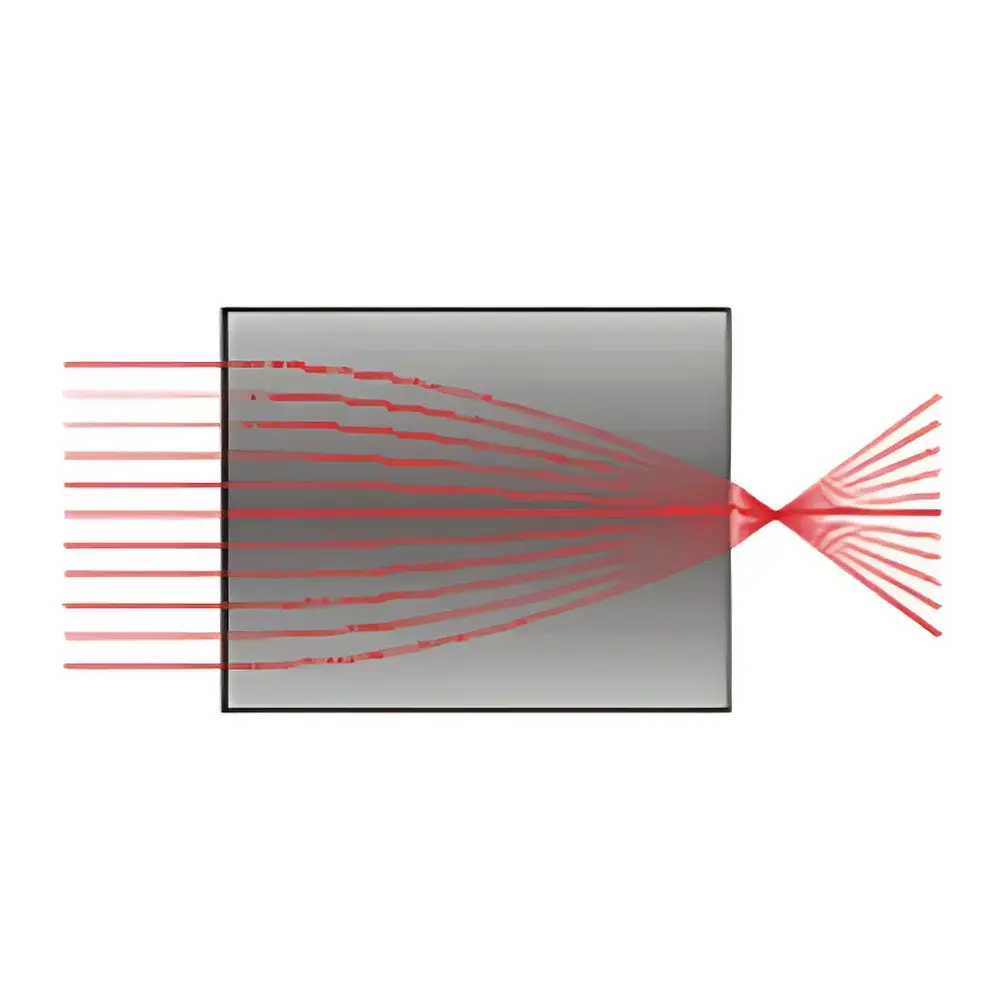
GRINTECH GRIN Lenses are precision-engineered gradient-index optical components designed for demanding laser beam manipulation tasks—including collimation, focusing, coupling into single-mode and multimode optical fibers, and high-power diode laser beam shaping. Unlike conventional homogeneous lenses, GRIN lenses feature a radially varying refractive index profile (n(r)), typically following a parabolic distribution: n(r) = n₀(1 − ½·α²·r²), where α defines the gradient strength and r is the radial distance from the optical axis. This internal index gradient enables periodic self-focusing behavior—characterized by a pitch length (P) corresponding to one full sinusoidal oscillation of a ray trajectory—and eliminates the need for curved surfaces, thereby minimizing spherical aberration and enabling compact, alignment-tolerant optical designs. These lenses operate on the principle of paraxial ray propagation in a medium with continuous index variation, making them especially valuable in space-constrained systems such as endoscopic imaging probes, fiber-pigtailed pump modules, and integrated photonic assemblies.
Key Features
- Two standardized NA variants: High-NA (≈0.5) lenses fabricated via silver-ion (Ag⁺) exchange in borosilicate glass, optimized for visible-to-near-IR operation (370–1100 nm); low-NA (≤0.2) variants using lithium-ion (Li⁺) exchange for deep-UV compatibility down to 235 nm.
- Cylindrical and square-column geometries available—enabling astigmatic correction and asymmetric beam conditioning without additional cylindrical optics.
- Monolithic construction ensures intrinsic wavefront fidelity, thermal stability, and resistance to misalignment under mechanical stress or thermal cycling.
- No surface coatings required for anti-reflection in standard configurations; optional broadband AR coatings (e.g., R<0.25% per surface from 400–1100 nm) available upon request.
- Consistent pitch tolerance (±0.5%) and axial index uniformity (<±0.0002 refractive index units) ensure repeatable focal length and beam waist positioning across production lots.
Sample Compatibility & Compliance
GRINTECH GRIN lenses are fully compatible with standard optomechanical interfaces including SM1 (1.035″-40) and SM2 (2.035″-40) threaded lens tubes, as well as kinematic mirror mounts and flexure-based alignment stages. Their solid-glass construction supports direct integration into hermetically sealed laser diode packages and fiber-coupled modules rated for continuous-wave power up to 10 W at 808 nm (dependent on surface quality and coating). All lenses comply with ISO 10110-3 (surface imperfections), ISO 10110-5 (stress birefringence <5 nm/cm), and RoHS Directive 2011/65/EU. The Ag⁺-exchanged glass formulation meets USP material safety requirements for non-toxic optical components; Li⁺-exchanged variants are certified for Class 1 laser product integration per IEC 60825-1:2014.
Software & Data Management
While GRIN lenses are passive optical elements, their integration into automated optical systems benefits from traceable metrology data provided with each unit: measured pitch length (P), effective focal length (EFL), back focal length (BFL), and transmitted wavefront error (TWE) maps (λ/10 PV @ 632.8 nm). GRINTECH supplies NIST-traceable calibration reports compliant with ISO/IEC 17025:2017. For system-level modeling, Zemax OpticStudio and CODE V support native GRIN lens definition via user-defined gradient index profiles (UDGP), enabling accurate prediction of chromatic shift, coma, and field curvature in multi-element assemblies. Lens serial numbers are logged in GRINTECH’s digital asset registry, supporting audit-ready documentation for GLP/GMP-aligned photonics manufacturing environments.
Applications
- Fiber coupling of high-brightness laser diodes (e.g., 9xx nm pump diodes into double-clad fibers for fiber lasers)
- Beam circularization and collimation in VCSEL and edge-emitting diode arrays
- Miniaturized optical coherence tomography (OCT) probe optics
- Endomicroscopy and catheter-based fluorescence imaging systems
- Free-space interconnects in quantum optics setups requiring diffraction-limited spot formation
- Industrial laser processing optics where compactness and thermal stability outweigh cost sensitivity
FAQ
What is the typical pitch length range for GRINTECH GRIN lenses?
Standard pitch lengths span 0.25P to 1.0P, with common values at 0.25P (quarter-pitch, for collimation), 0.5P (half-pitch, for 1:1 imaging), and 1.0P (full-pitch, for relay imaging). Custom pitches are available within ±5% tolerance.
Can GRIN lenses be used with pulsed lasers?
Yes—provided peak fluence remains below 0.5 J/cm² for nanosecond pulses and 100 MW/cm² for picosecond pulses. Damage threshold testing follows ISO 21254-1:2011.
Is thermal lensing a concern in high-power CW operation?
Thermal gradients induce negligible index change (dn/dT ≈ +1.2×10⁻⁶ K⁻¹ for Ag⁺-glass), resulting in focal shift <0.1% per °C—significantly lower than equivalent singlet lenses.
How is focal length defined for a GRIN lens?
Effective focal length (EFL) is calculated from pitch and NA using the paraxial approximation: EFL = P/(π·NA). It is experimentally verified via nodal slide measurement per ISO 10110-2.
Do GRIN lenses require special cleaning procedures?
Standard optical cleaning protocols apply (e.g., lint-free wipes with spectroscopic-grade isopropanol). Avoid ultrasonic baths due to potential micro-fracture propagation in ion-exchanged glass.




