
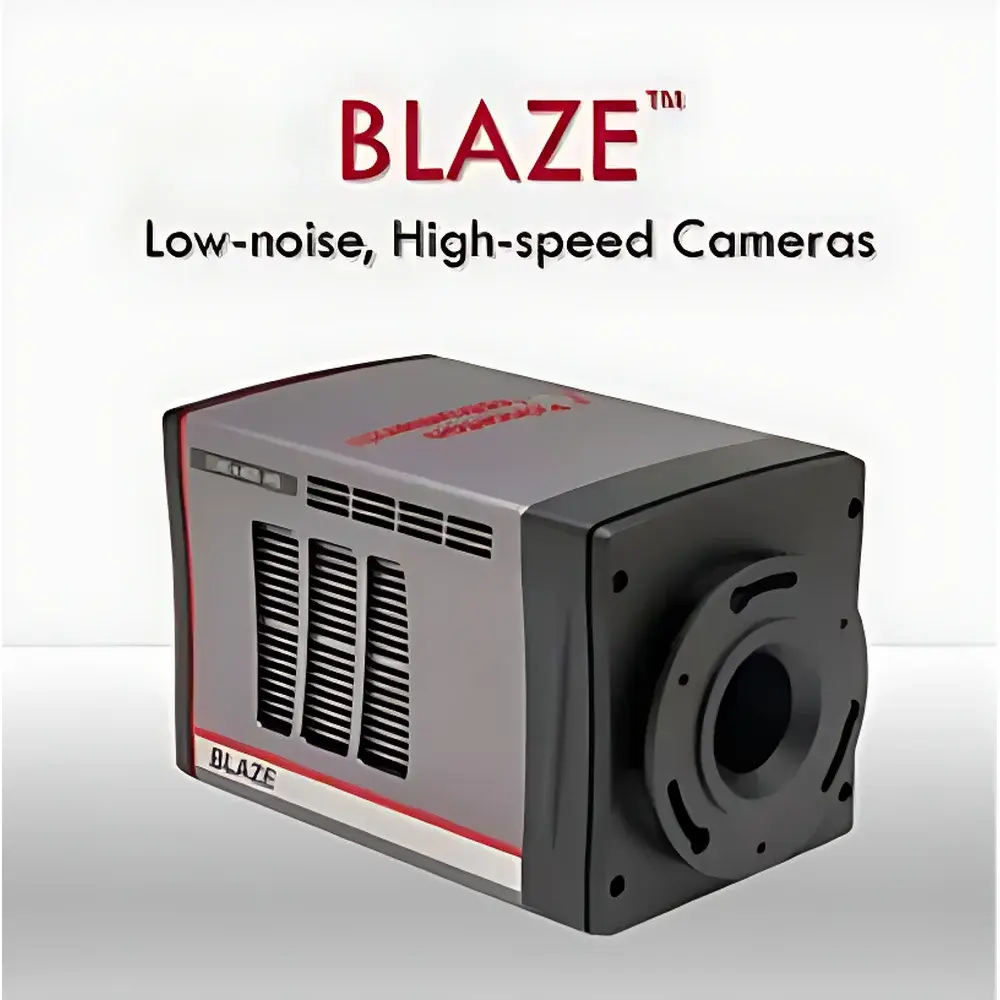
Princeton Instruments BLAZE100HR / BLAZE400HR / BLAZE100LD / BLAZE400LD High-Speed Scientific Spectral Camera
| Brand | Princeton Instruments (Teledyne) |
|---|---|
| Origin | USA |
| Sensor Type | Back-illuminated, fully depleted silicon CCD |
| Pixel Format | 1340 × 100 (HR/LD) or 1340 × 400 (HR/LD) |
| Pixel Size | 20 × 20 µm |
| QE | 75% @ 1000 nm (HR), optimized dark current < 0.0005 e⁻/pix/s (LD) |
| Readout Speed | Up to 32 MHz dual-ADC (HR), 16 MHz (LD) |
| Spectral Acquisition Rate | Up to 1650 spectra/s (continuous), 215 kHz (kinetics mode, HR only) |
| Cooling | ArcTec™ multi-stage thermoelectric cooling |
| Interface | USB 3.0 (5 Gb/s), optional fiber-optic USB extender (50 m) |
| Software | LightField 64-bit with PICAM SDK, IntelliCal wavelength & intensity calibration, LabVIEW/MATLAB/EPICS compatibility |
Overview
The Princeton Instruments BLAZE series represents a paradigm shift in scientific spectral imaging—engineered specifically for time-resolved and low-light spectroscopic applications requiring both extreme sensitivity and high temporal fidelity. Built upon two proprietary back-illuminated, fully depleted silicon CCD architectures—HR (High Resolution NIR) and LD (Low Dark current)—the BLAZE platform leverages deep-depletion physics and advanced charge-transfer clocking to eliminate fringing, suppress dark current, and maximize quantum efficiency across the visible-to-near-infrared (VIS-NIR) spectrum (350–1100 nm). Unlike conventional front-illuminated or standard back-illuminated sensors, the HR sensor achieves 75% quantum efficiency at 1000 nm—more than triple that of legacy devices—while the LD variant maintains comparable peak QE while reducing dark current by over one order of magnitude. This dual-sensor strategy enables application-specific optimization: HR for high-speed Raman and photoluminescence where signal bandwidth dominates, and LD for ultra-long integration experiments such as pump-probe transient absorption or single-molecule fluorescence where thermal noise must be suppressed below 0.0005 e⁻/pix/s.
Key Features
- Proprietary HR sensor architecture: Fully depleted, high-resistivity silicon with anti-fringing coating; delivers 75% QE at 1000 nm and eliminates etaloning artifacts common in thick-depletion NIR sensors.
- Exclusive LD sensor design: Inverted-mode operation (IMO) reduces dark current without compromising QE; validated for exposures exceeding 30 minutes at -100°C.
- Dual-ADC parallel readout: 32 MHz total bandwidth (16 MHz per channel) enables continuous spectral acquisition at up to 1650 spectra per second—critical for real-time reaction monitoring and dynamic process analysis.
- ArcTec™ multi-stage thermoelectric cooling: Custom Peltier modules integrated into an all-metal, permanently vacuum-sealed housing ensure long-term stability and reproducibility; no cryogens or external chillers required.
- SeNsR™ bidirectional on-chip clocking: Enables rapid pixel-wise charge shifting and accumulation—supporting correlated double sampling, background subtraction, and kinetic frame stacking directly on sensor.
- USB 3.0 interface with deterministic latency: 5 Gb/s throughput supports full-frame streaming without bottlenecking; optional fiber-optic USB extension kit allows remote operation up to 50 meters—ideal for synchrotron endstations or hazardous environments.
Sample Compatibility & Compliance
The BLAZE camera is designed for integration into modular optical platforms—including Fergie® zero-aberration spectrographs, custom Czerny-Turner systems, and confocal or widefield microspectroscopy setups. Its 1340-pixel horizontal array ensures full spectral coverage without spatial binning, while the 20 µm pixel pitch provides optimal sampling for typical grating resolutions (e.g., 0.1 nm/pixel with 1200 g/mm grating at 785 nm). The system complies with ISO/IEC 17025 traceability requirements when used with IntelliCal™-enabled calibration sources. LightField software supports 21 CFR Part 11-compliant audit trails, electronic signatures, and instrument qualification documentation—meeting GLP and GMP laboratory validation needs. All models are RoHS-compliant and CE-marked for use in EU-based research infrastructure.
Software & Data Management
LightField 64-bit software serves as the unified control and analysis environment for the entire Princeton Instruments ecosystem. It provides real-time spectral visualization, automated wavelength calibration via IntelliCal™ (NIST-traceable Hg/Ar/Ne line libraries), and intensity correction using onboard flat-field references. The embedded mathematical engine supports on-the-fly operations including spectral subtraction, peak fitting (Gaussian/Lorentzian), time-series normalization, and PCA-based multivariate analysis. For automation, the PICAM SDK offers native C/C++, Python, MATLAB, and LabVIEW bindings—enabling seamless integration into existing data acquisition pipelines. EPICS IOC support facilitates synchronization with accelerator timing systems in synchrotron or ultrafast laser facilities.
Applications
- Raman spectroscopy: High NIR QE enables efficient 785 nm and 1064 nm excitation detection—reducing acquisition time by >60% versus conventional EMCCDs.
- Time-resolved photoluminescence: Kinetics mode captures sub-millisecond carrier dynamics in perovskites, quantum dots, and 2D materials.
- Pump-probe spectroscopy: SeNsR™ charge-shifting enables lock-in detection at kHz modulation frequencies without external hardware.
- Nanomaterial characterization: Resolves subtle phonon modes in carbon nanotubes and strain-induced shifts in monolayer TMDs.
- Fluorescence lifetime imaging (FLIM): When coupled with time-correlated single-photon counting (TCSPC) electronics, BLAZE provides gated-integration capability for intensity-modulated decay analysis.
- Microspectroscopy: Compatible with motorized microscope stages and spectral line-scan configurations for spatially resolved chemical mapping.
FAQ
What distinguishes the HR and LD sensor variants?
The HR sensor prioritizes maximum quantum efficiency in the NIR (75% @ 1000 nm) for speed-critical applications like Raman. The LD sensor trades minor QE reduction for drastically lower dark current (1000 s at -100°C without significant thermal noise accumulation.
Is water cooling mandatory to achieve -100°C?
No—air cooling reaches -95°C. A recirculating chiller maintaining 20°C coolant inlet temperature is sufficient to reach -100°C; cryogenic chillers are unnecessary.
Can BLAZE be synchronized with pulsed lasers or external triggers?
Yes—hardware TTL trigger input supports external synchronization with jitter <10 ns; programmable exposure delay and gate width allow precise alignment with pump-probe delays.
Does LightField support batch processing of large spectral datasets?
Yes—LightField’s scripting engine (Python-based) enables automated processing of thousands of spectra, including baseline correction, peak integration, and export to HDF5 or CSV formats.
Is the vacuum seal serviceable or permanent?
The all-metal vacuum enclosure is hermetically sealed during manufacture and not user-serviceable; mean time between failures exceeds 15 years under continuous operation.




