
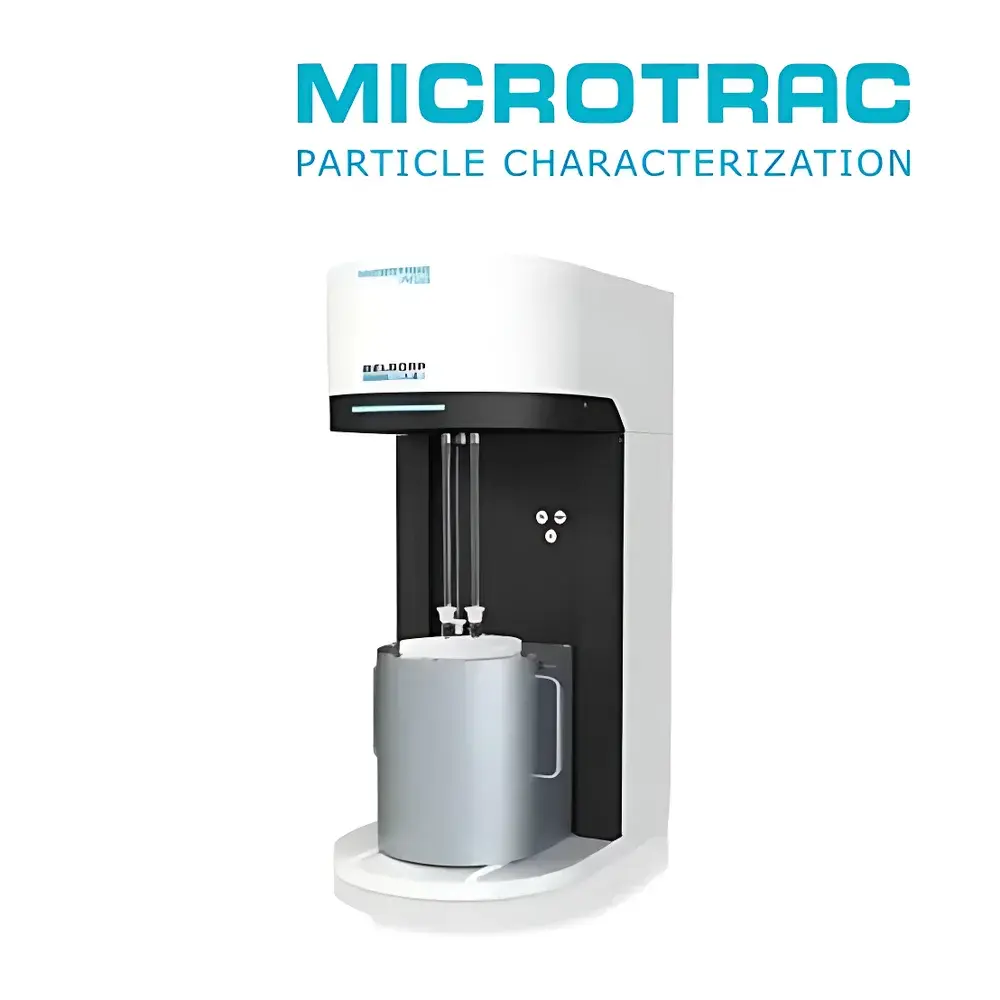
Microtrac BELSORP MAX G Automated Specific Surface Area and Pore Size Analyzer (Dynamic & Static Volumetric Method)
| Brand | Microtrac |
|---|---|
| Origin | Japan |
| Manufacturer Type | Authorized Distributor |
| Origin Category | Imported |
| Model | BELSORP MAX G |
| Instrument Type | Specific Surface Area and Pore Size Analyzer |
| Measurement Principle | Volumetric Gas Adsorption (Dynamic & Static Mode) |
| Number of Analysis Stations | 3 or 6 |
| Operating Temperature Range | 10–35 °C |
| Storage Temperature Range | 0–50 °C |
| Temperature Control Accuracy | ±1 °C |
| Vacuum System | Dual-stage rotary vane pump, ultimate vacuum ≤1 × 10⁻³ mmHg (≤0.13 Pa) |
| Pressure Sensors | 1 Torr, 10 Torr, and 1000 Torr high-precision capacitance manometers |
| Minimum Detectable Pressure Change | <1 × 10⁻⁵ Pa |
| Free Space Calibration | AFSM™ (Automatic Free Space Measurement) patented technology |
| Isotherm Range | P/P₀ = 1 × 10⁻⁷ to 0.997 at 77 K (N₂) and 87 K (Ar) |
Overview
The Microtrac BELSORP MAX G is a fully automated volumetric gas adsorption analyzer engineered for high-precision determination of specific surface area, pore volume, and pore size distribution across microporous, mesoporous, and selected macroporous materials. It operates on the fundamental principles of physical gas adsorption—primarily nitrogen at 77 K and argon at 87 K—applying both dynamic (flow-through) and static (manometric equilibrium) measurement modes within a single platform. The instrument’s core architecture integrates gravimetrically stable sample dosing, real-time pressure monitoring across three calibrated ranges (1 Torr, 10 Torr, and 1000 Torr), and an ultra-low-pressure detection capability (<1 × 10⁻⁵ Pa), enabling reliable isotherm acquisition from deep sub-monolayer coverage (P/P₀ = 1 × 10⁻⁷) up to near-saturation (P/P₀ = 0.997). Its AFSM™ (Automatic Free Space Measurement) technology eliminates manual calibration drift by performing in situ free-space volume correction prior to each adsorption step—critical for reproducible micropore analysis and accurate t-plot or DFT modeling.
Key Features
- Modular station configuration supporting either 3 or 6 independent analysis positions, with dedicated saturation pressure reference stations for enhanced thermodynamic consistency.
- Dual-mode operation: simultaneous dynamic equilibration for rapid mesopore surface area screening and static high-resolution isotherm acquisition for micropore characterization.
- GDO (Gas Dosing Optimization) algorithm automatically adjusts gas dosage and equilibration time per data point, reducing total analysis duration by up to 40% without compromising data fidelity.
- Integrated dual-stage mechanical vacuum system achieving ≤0.13 Pa base pressure, compatible with standard cryogenic cooling (liquid N₂ or Ar dewars) and optional temperature-controlled sample holders (−10 to 150 °C).
- Temperature-controlled enclosure maintains thermal stability within ±1 °C across the operating range (10–35 °C), minimizing vapor pressure drift during long-duration isotherms.
- Full compliance with ISO 9277 (surface area by BET), ISO 15901-1/2 (pore size distribution), and ASTM D3663 (catalyst surface area), supporting audit-ready reporting.
Sample Compatibility & Compliance
The BELSORP MAX G accommodates solid powders, granules, monoliths, fibers, and thin-film substrates with minimal sample mass requirements (typically 50–500 mg, depending on expected surface area). Its inert stainless-steel manifold and ultra-clean vacuum path ensure compatibility with catalysts, battery electrode materials (including sulfide-based solid electrolytes), MOFs, zeolites, activated carbons, ceramic precursors, and polymer composites. All hardware and software modules are designed to meet GLP and GMP documentation standards, including full electronic audit trails, user access control, and 21 CFR Part 11–compliant signature workflows when paired with validated LIMS integration.
Software & Data Management
BELSORP MAX G is operated via Microtrac’s proprietary BELSOFT v5.x platform—a Windows-based application delivering complete method scripting, real-time isotherm visualization, multi-model fitting (BET, Langmuir, t-plot, BJH, DH, NLDFT, QSDFT), and automated report generation in PDF or Excel formats. Raw pressure vs. time datasets are stored in vendor-neutral ASCII format with embedded metadata (date, operator ID, calibration history, sensor status). Software supports batch processing of up to 24 samples, cross-instrument data comparison, and export to third-party modeling tools (e.g., Igor Pro, MATLAB, OriginLab) via standardized .csv or .dat interfaces.
Applications
This analyzer serves as a primary characterization tool in R&D and QC laboratories across advanced materials sectors. In energy storage, it quantifies interfacial area loss in cycled cathode/anode materials and evaluates pore collapse in solid-state electrolyte membranes. For catalysis, it validates metal dispersion and support porosity changes after calcination or sulfidation. In filtration and separation science, it correlates pore throat distribution with permeability and fouling resistance in ceramic membranes and nanofiber filters. Additional use cases include surface hydrophobicity assessment in cosmetics excipients, sintering kinetics in structural ceramics, and BET surface normalization in pharmaceutical inhaler formulation development.
FAQ
What gases and temperatures are supported for adsorption analysis?
Nitrogen at 77 K and argon at 87 K are standard; krypton at 77 K is supported for low-surface-area materials (<1 m²/g). CO₂ at 273 K is available for narrow micropore analysis (0.3–0.7 nm) with optional heated manifold.
Can the instrument perform DFT/NLDFT pore size modeling?
Yes—BELSOFT includes built-in DFT kernel libraries for carbon, silica, alumina, and zeolite surfaces, with user-selectable slit/cylindrical/helical geometry assumptions and non-local density functional options.
Is remote monitoring and troubleshooting supported?
The system features integrated Ethernet connectivity, SNMP-enabled status reporting, and secure remote desktop access (with customer IT approval) for preventive maintenance alerts and real-time diagnostics.
How is free space volume calibrated between runs?
AFSM™ performs automatic helium expansion into the evacuated sample cell and reference volume, calculating dead volume with ±0.5% repeatability—no manual pycnometry required.
Does the software comply with FDA 21 CFR Part 11 requirements?
Yes—when deployed on validated Windows OS configurations with domain-level authentication, BELSOFT provides electronic signatures, immutable audit logs, and role-based permissions meeting Part 11 Subpart B criteria.



