
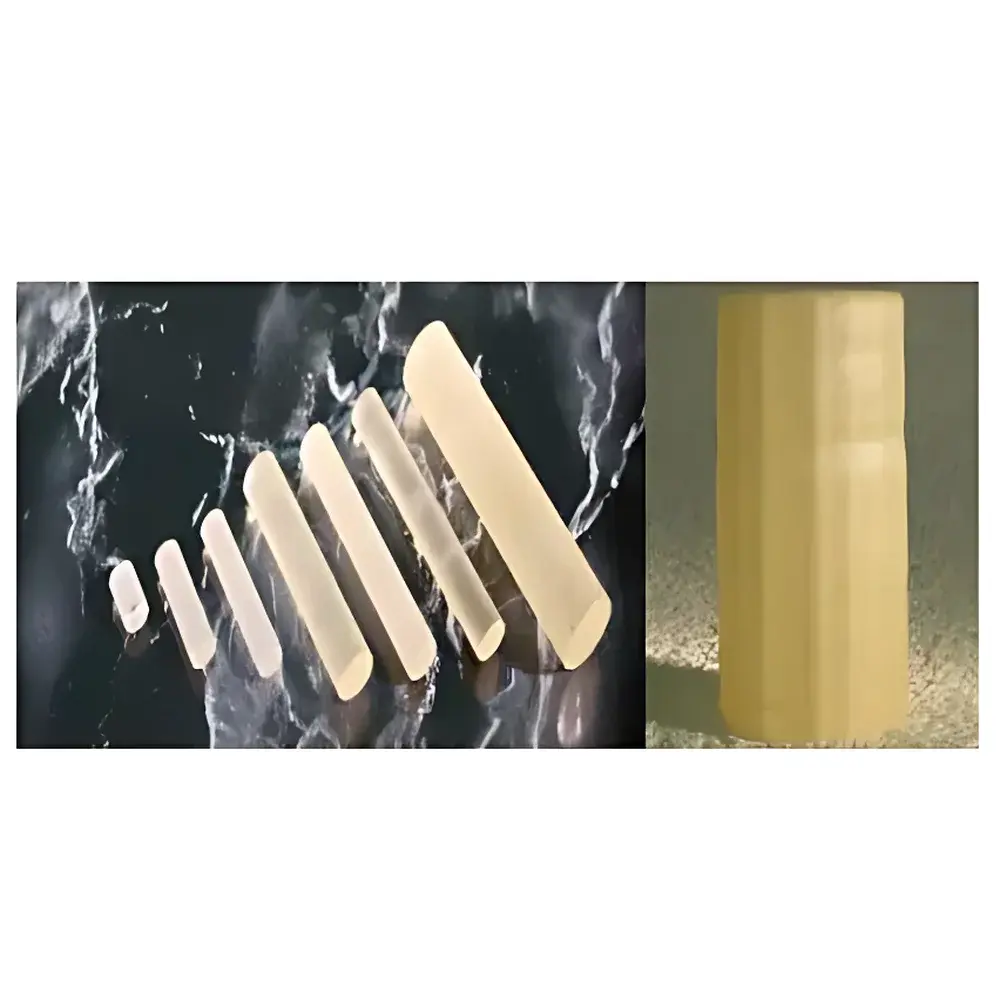
SYNOPTICS TGG Laser Crystal Rod
| [Brand | SYNOPTICS |
|---|---|
| Origin | USA |
| Manufacturer Type | Authorized Distributor |
| Import Status | Imported |
| Model | TGG |
| Price Range | USD 0–7,200 (FOB) |
| Material | Terbium Gallium Garnet (Tb₃Ga₅O₁₂) |
| Crystal Orientation | [111] ±5° |
| Diameter Tolerance | +0.000″ / −0.002″ |
| Length Tolerance | +0.010″ / −0.010″ |
| Surface Roughness (RMS) | 55 ±5 μin |
| Edge Chamfer | 0.005″ ±0.003″ @ 45° ±5° |
| Wavefront Distortion | < λ/8 per inch (large rods), < λ/8 total (small rods) @ 632 nm |
| Extinction Ratio | ≥25 dB |
| AR Coating Reflectivity | <0.25% @ 1064 nm |
| Adhesion & Durability | Compliant with MIL-C-48497A |
| Pulsed Laser Damage Threshold | 10 J/cm² (1064 nm, 10 ns, 10 Hz) |
| Faraday Rotation Coefficient (V) | 134 rad·T⁻¹·m⁻¹ @ 1064 nm |
| Absorption Coefficient (α) | 0.0015 cm⁻¹ @ 1064 nm |
| Thermal Conductivity | 7.4 W·m⁻¹·K⁻¹ |
| Refractive Index (n) | 1.95 @ 1064 nm |
| Nonlinear Refractive Index (n₂) | 8.0 × 10⁻¹³ esu |
| Figure of Merit (V/α) | 27 |
| Figure of Merit (V/n) | 58] |
Overview
The SYNOPTICS TGG Laser Crystal Rod is a high-performance magneto-optic material engineered for use in Faraday isolators and rotators within demanding continuous-wave (CW) and pulsed laser systems. Fabricated from single-crystal Terbium Gallium Garnet (Tb₃Ga₅O₁₂), this rod leverages the intrinsic magneto-optic Faraday effect—where linearly polarized light undergoes non-reciprocal rotation of its polarization plane under an applied axial magnetic field. Unlike isotropic magneto-optic glasses, TGG exhibits crystalline symmetry, superior thermal management, and significantly higher Verdet constants, making it the industry-standard solid-state medium for optical isolation above 5 W average power. Its broad transmission range (500–3000 nm), low absorption at key laser wavelengths (e.g., 1064 nm, 1319 nm, and 1550 nm), and exceptional wavefront fidelity enable stable, high-fidelity beam control in industrial, medical, defense, and ultrafast scientific laser architectures.
Key Features
- High Verdet Constant: 134 rad·T⁻¹·m⁻¹ at 1064 nm—more than double that of terbium-doped glass—enabling compact isolator designs with lower magnet requirements.
- Exceptional Thermal Management: Thermal conductivity of 7.4 W·m⁻¹·K⁻¹—over ten times greater than Tb-glass—minimizes thermally induced birefringence and depolarization under high-average-power operation.
- Low Intrinsic Absorption: α = 0.0015 cm⁻¹ @ 1064 nm ensures minimal thermal loading and preserves beam quality even at multi-kilowatt power levels.
- Precision Crystal Orientation: Cut and polished along the [111] crystallographic axis (±5° tolerance) to maximize Faraday rotation uniformity and minimize spatial walk-off.
- Optical Surface Integrity: Wavefront distortion ≤ λ/8 per inch (for rods >25.4 mm length or >3 mm diameter); ≤ λ/8 total (for smaller rods), measured at 632 nm HeNe wavelength.
- Robust AR Coating: Broadband anti-reflection coating optimized for 1064 nm (R < 0.25%) with adhesion and environmental durability certified to MIL-C-48497A.
- Laser-Induced Damage Resistance: Certified pulsed damage threshold of 10 J/cm² (1064 nm, 10 ns, 10 Hz, 1-on-1 testing), supporting integration into Q-switched and mode-locked oscillator-amplifier chains.
Sample Compatibility & Compliance
The TGG Rod is compatible with standard permanent-magnet and electromagnet-based Faraday rotator assemblies used in Nd:YAG, Yb:fiber, Er:fiber, and thin-disk laser platforms. All crystals are grown via the Czochralski method under controlled oxygen atmosphere, followed by precision orientation, multi-stage grinding/polishing, and in-house spectral and wavefront metrology. Each batch undergoes full traceable inspection per ISO 9001:2008 protocols—including interferometric surface figure verification, spectrophotometric transmittance mapping (200–4000 nm), and Verdet constant calibration against NIST-traceable reference standards. The material complies with RoHS directives and meets mechanical and environmental specifications outlined in MIL-C-48497A for coating adhesion, abrasion resistance, and humidity cycling. While not inherently FDA- or IEC 60825-certified as a standalone component, the rod supports system-level compliance when integrated into Class 4 laser products meeting EN 60825-1 and ANSI Z136.1 safety requirements.
Software & Data Management
As a passive optical component, the TGG Rod requires no embedded firmware or proprietary software. However, SYNOPTICS provides comprehensive digital documentation with each shipment: a Certificate of Conformance (CoC) listing dimensional tolerances, wavefront data, spectral transmittance curves, and Verdet coefficient measurements; a full traceability log linking crystal lot number to growth furnace run ID, polishing batch, and coating deposition parameters; and optional MTF and PSF simulation files (Zemax .ZBF or CODE V .DAT format) for system integrators performing end-to-end beam propagation modeling. All documentation is delivered in PDF/A-1b format compliant with ISO 19005-1 for long-term archival integrity.
Applications
- High-Power Laser Isolation: Core element in 1064 nm isolators for kW-class fiber lasers, slab amplifiers, and diode-pumped solid-state (DPSS) oscillators where thermal lensing suppression is critical.
- Ultrafast Amplifier Protection: Integrated into regenerative and multipass amplifier chains (e.g., Ti:sapphire, Yb:CaF₂) to prevent back-reflected seed pulses from destabilizing oscillator cavities.
- Military & Aerospace Systems: Qualified for ruggedized free-space and fiber-coupled isolators in directed energy, LIDAR, and secure optical communication terminals operating under shock, vibration, and wide-temperature-range conditions.
- Medical Laser Platforms: Used in dermatology, ophthalmology, and surgical systems (e.g., Ho:YAG, Er:YAG) requiring high extinction ratio (>25 dB) and long-term stability under repetitive pulsing.
- Scientific Instrumentation: Enables polarization-sensitive interferometry, cavity ring-down spectroscopy (CRDS), and quantum optics experiments requiring non-reciprocal phase control without reciprocal compensation artifacts.
FAQ
What is the maximum recommended average power for a 3 mm diameter × 25 mm length TGG rod at 1064 nm?
For standard AR-coated rods with water-cooled magnetic yokes, the practical limit is ~250 W CW—dependent on thermal interface design, coolant flow rate, and ambient temperature. System-level thermal modeling using the provided thermal conductivity (7.4 W·m⁻¹·K⁻¹) and absorption coefficient (0.0015 cm⁻¹) is strongly advised prior to deployment.
Can SYNOPTICS supply custom-diameter or custom-length TGG rods?
Yes. Standard diameters range from 1.0 mm to 10.0 mm; lengths from 5 mm to 50 mm. Custom orientations (e.g., [100], [110]) and dual-wavelength AR coatings (e.g., 1064/1319 nm) are available upon request with extended lead time and qualification testing.
Is the Verdet coefficient temperature-dependent?
Yes. The Verdet constant of TGG decreases by approximately −0.03%/°C near room temperature. For applications requiring sub-0.1% rotation stability over ±10°C, active temperature stabilization of the crystal mount is recommended.
How does TGG compare to TSAG (Terbium Scandium Aluminum Garnet) for high-power isolation?
TSAG offers marginally higher Verdet constant (~145 rad·T⁻¹·m⁻¹ @ 1064 nm) but significantly lower thermal conductivity (~3.5 W·m⁻¹·K⁻¹) and greater susceptibility to color center formation under UV exposure. TGG remains preferred for >100 W average-power applications due to its superior thermo-optic balance.
Do you provide test reports for individual rods?
Yes. Every shipped rod includes a unique serial-numbered CoC with measured wavefront distortion (interferogram summary), spectral transmittance plot (200–4000 nm), and Verdet coefficient verification at 1064 nm and 632 nm. Full raw metrology datasets are available upon request for qualified OEM partners.



