
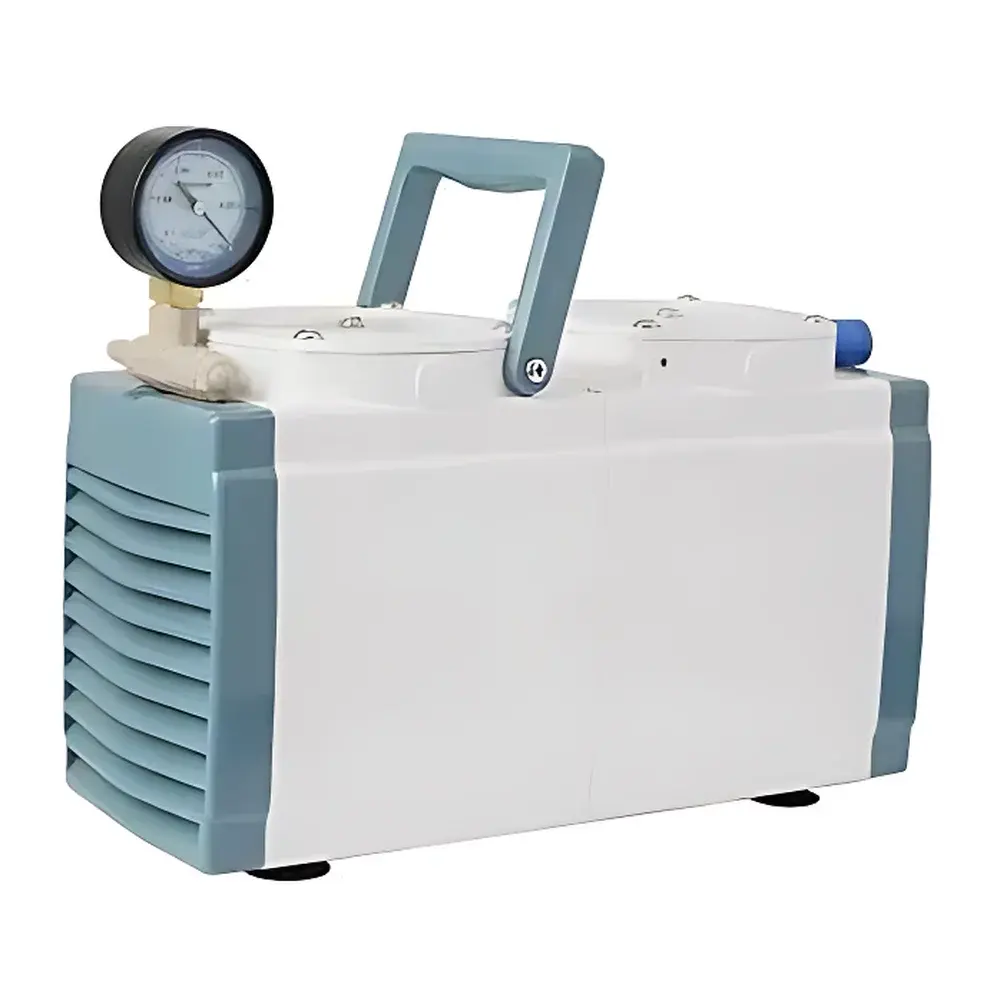
JINTENG GM-0.33B Diaphragm Vacuum Pump
| Brand | JINTENG |
|---|---|
| Origin | Tianjin, China |
| Model | GM-0.33B |
| Pump Type | Oil-Free Diaphragm Vacuum Pump |
| Ultimate Vacuum | 50 mbar (abs) |
| Pumping Speed | 20 L/min |
| Motor Power | 160 W |
| Dimensions (L×W×H) | 282 × 130 × 210 mm |
| Weight | 10 kg |
| Operating Temperature Range | 7–40 °C |
| Maximum Case Temperature | <55 °C |
| Noise Level | <50 dB(A) |
| Inlet Port Diameter | Ø6 mm |
| Construction | Aluminum Alloy Housing with Epoxy-Polyester Coating & PTFE-Coated Diaphragm Chamber |
Overview
The JINTENG GM-0.33B Diaphragm Vacuum Pump is an oil-free, corrosion-resistant laboratory vacuum source engineered for reliable, maintenance-light operation in analytical and preparative workflows. It operates on the principle of positive displacement via a reciprocating PTFE-coated diaphragm driven by an eccentric cam mechanism—eliminating lubricants, hydrocarbon contamination, and vapor backstreaming. With an ultimate vacuum of 50 mbar (abs) and a nominal pumping speed of 20 L/min at atmospheric pressure, it delivers stable negative pressure suitable for rotary evaporation, vacuum filtration, solvent removal, degassing, and sample concentration. Its compact footprint (282 × 130 × 210 mm), lightweight aluminum alloy housing (10 kg), and low acoustic signature (<50 dB[A]) make it ideal for benchtop integration in QC labs, university teaching facilities, and R&D environments where space, safety, and chemical compatibility are critical.
Key Features
- Oil-free operation ensures clean vacuum generation—no risk of oil mist ingress into sensitive samples or downstream instrumentation such as GC inlets or mass spectrometer interfaces.
- PTFE-coated diaphragm chamber and chemically resistant internal gas path provide enhanced durability against acidic vapors, solvents, and reactive gases encountered in pharmaceutical synthesis, environmental analysis, and forensic chemistry.
- Aluminum alloy die-cast housing with epoxy-polyester powder coating offers structural rigidity, thermal stability, and resistance to abrasion and ambient corrosion.
- Thermally optimized motor (160 W) maintains continuous duty cycle performance while limiting surface temperature to <55 °C—reducing heat transfer to adjacent equipment and minimizing thermal drift in temperature-sensitive applications.
- Integrated dual-head configuration improves volumetric efficiency and extends service life by distributing mechanical load across two synchronized diaphragm assemblies.
- Standard Ø6 mm inlet port enables rapid connection to common lab tubing (e.g., silicone, Viton, or PTFE) and compatibility with standard vacuum manifolds, traps, and adapters used with rotary evaporators and filtration assemblies.
Sample Compatibility & Compliance
The GM-0.33B is designed for use with non-explosive, non-condensable, and moderately aggressive vapors typical in routine laboratory processes—including aqueous solutions, alcohols, acetone, ethyl acetate, and dilute organic acids. It is not rated for explosive, highly corrosive (e.g., concentrated halogens, fuming nitric acid), or particulate-laden streams without upstream filtration. While not certified to IEC 61000-6-3 (EMC) or UL/CSA safety standards out-of-the-box, its construction adheres to general-purpose industrial design principles aligned with ISO 8573-1 (compressed air purity classes) for oil-free vacuum systems. Users deploying this pump in regulated environments (e.g., GLP-compliant QA/QC labs) should document operational parameters—including vacuum level verification, maintenance intervals, and calibration traceability—as part of their instrument qualification protocol.
Software & Data Management
The GM-0.33B operates as a standalone analog device with no embedded microcontroller, digital interface, or data logging capability. Its control is purely manual via integrated on/off switch and mechanical pressure regulation (if equipped with optional vacuum regulator). This architecture eliminates firmware dependencies, cybersecurity exposure, or software validation requirements—making it inherently compliant with FDA 21 CFR Part 11 Annex 11 expectations for “non-automated” equipment in GMP settings. For labs requiring vacuum monitoring or process integration, external analog pressure transducers (0–10 V or 4–20 mA output) can be installed downstream and interfaced with third-party DAQ systems or LIMS platforms.
Applications
- Rotary evaporation support for solvent recovery in natural product isolation and synthetic chemistry.
- Vacuum-assisted filtration in microbiological assays, HPLC sample preparation, and environmental water testing (e.g., EPA Method 1664).
- Degassing of resins, adhesives, and casting materials prior to curing in materials science labs.
- Sample concentration under reduced pressure for LC-MS and GC-MS sample prep workflows.
- Evacuation of desiccators and glove boxes used in moisture-sensitive handling of hygroscopic reagents or battery electrode materials.
- Forensic evidence processing—including vacuum drying of latent fingerprint development reagents and controlled atmosphere storage of trace evidence.
FAQ
Is the GM-0.33B suitable for use with aggressive solvents like chloroform or THF?
Yes—provided vapors are not condensed within the pump head. Use a cold trap or inline condenser to prevent solvent condensation; PTFE diaphragm and coated chamber resist short-term exposure.
What is the recommended maintenance interval for the diaphragm assembly?
Under continuous operation at ≤70% of maximum duty cycle, replace the diaphragm and valve set every 6,000–8,000 operating hours or annually—whichever occurs first.
Can this pump achieve high vacuum (<1 mbar)?
No—it is designed for rough vacuum applications only. Its ultimate pressure is 50 mbar (abs); for high-vacuum needs, pair with a secondary pump (e.g., turbomolecular or diffusion pump) or select a multi-stage diaphragm model.
Does the pump include a built-in vacuum gauge?
No—vacuum measurement requires an external analog or digital gauge connected to the inlet line.
Is the GM-0.33B compatible with ISO-KF or NW16 vacuum flanges?
Not natively—the standard Ø6 mm hose barb requires adapter fittings for KF/NW connections; custom flange kits are available from authorized JINTENG distributors.
Related Products



