
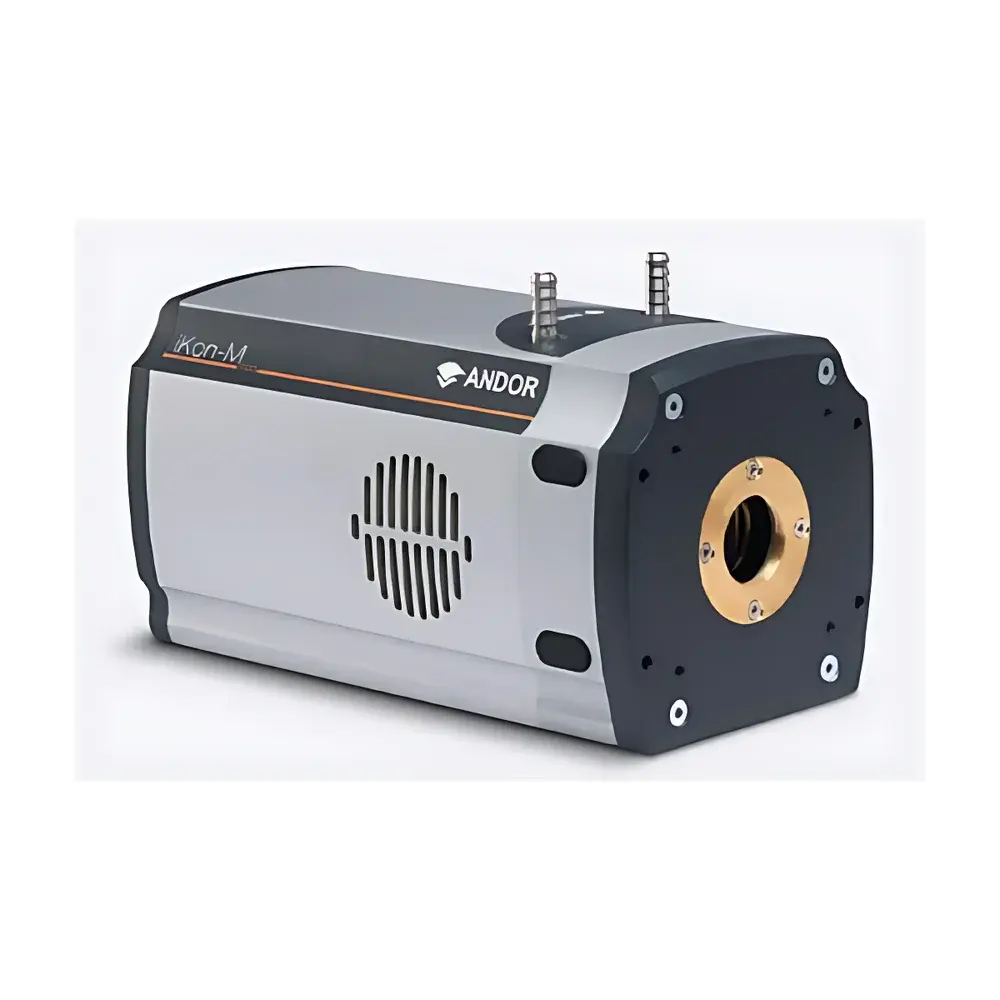
Andor iDus and Newton Series UV-NIR/SWIR Spectral Imaging Cameras
| Brand | Andor |
|---|---|
| Origin | United Kingdom |
| Model | iDus, Newton |
| Pixel Size | 26 µm or 50 µm |
| Sensor Types | CCD, EMCCD, InGaAs (1.7 µm & 2.2 µm) |
| Cooling | Down to –100 °C (UltraVac™) |
| QE Peak | Up to 95% (VIS/NIR) |
| Dark Current | As low as 0.00007 e⁻/pix/s |
| Read Noise | As low as <1 e⁻ (EM mode) |
| Full-Well Capacity | Up to 170 M e⁻ |
| Spectral Acquisition Rate | Up to 193 spectra per second |
Overview
The Andor iDus and Newton series represent a family of high-performance, thermoelectrically cooled scientific cameras engineered for demanding spectral acquisition across the ultraviolet (UV), visible (VIS), near-infrared (NIR), and short-wave infrared (SWIR) ranges — extending from 200 nm to 2.2 µm. These cameras employ front-illuminated and back-illuminated CCD, EMCCD, and InGaAs sensor architectures optimized for photon-starved spectroscopic applications. Built upon Andor’s proprietary UltraVac™ vacuum technology, the iDus and Newton platforms achieve deep cooling down to –100 °C, enabling ultra-low dark current and exceptional signal-to-noise ratio (SNR) over extended integration times. Their modular optical interface supports standard C-mount, F-mount, and fiber-optic coupling (including multi-fiber arrays), making them suitable for benchtop spectrometers, imaging spectrographs, and custom optical setups in research and industrial environments.
Key Features
- Multi-sensor platform architecture supporting UV-VIS-NIR (iDus CCD/EMCCD) and SWIR (iDus/Newton InGaAs up to 2.2 µm)
- UltraVac™ vacuum sealing with cryogenic cooling to –100 °C (CCD/EMCCD) or –90 °C (InGaAs), ensuring thermal stability and minimal dark current drift
- Back-illuminated CCD sensors with quantum efficiency (QE) exceeding 95% in VIS/NIR; InGaAs variants deliver 85% QE at 1.3 µm and 70% at 1.8 µm
- Pixel formats ranging from 1024 × 128 to 2048 × 512, with pixel sizes selectable between 13.5 µm, 16 µm, 25 µm, and 50 µm to balance resolution, sensitivity, and field-of-view
- Read noise as low as <1 e⁻ in electron-multiplying (EM) mode (Newton EM), enabling single-photon detection without intensifiers
- Full-well capacities up to 170 million electrons (InGaAs), supporting high-dynamic-range spectral quantification in heterogeneous intensity environments
- Real-time spectral acquisition rates up to 193 spectra per second (spc/s), compatible with rapid kinetic studies and process monitoring
- Firmware-upgradable architecture with hardware-level trigger synchronization (TTL, LVDS) for precise timing in pump-probe or time-resolved experiments
Sample Compatibility & Compliance
The iDus and Newton cameras are routinely deployed in laboratories adhering to GLP, GMP, and ISO/IEC 17025 quality frameworks. Their stable thermal performance and reproducible gain calibration support traceable quantitative spectral analysis compliant with ASTM E131 (Standard Terminology Relating to Molecular Spectroscopy) and ISO 17025 clause 5.9 (Assessment of measurement uncertainty). The vacuum-sealed sensor housing eliminates condensation and outgassing risks during long-duration acquisitions — critical for vacuum-compatible spectrometers and synchrotron beamlines. All models meet CE marking requirements for electromagnetic compatibility (EMC Directive 2014/30/EU) and low-voltage safety (LVD Directive 2014/35/EU). Optional FDA 21 CFR Part 11–compliant software audit trails are available via Andor’s Solis platform for regulated pharmaceutical and clinical research environments.
Software & Data Management
Cameras are fully supported by Andor’s Solis for Spectroscopy software — a modular, scriptable application offering real-time spectral visualization, multi-region-of-interest (ROI) extraction, background subtraction, wavelength calibration (polynomial or spline-based), and export to HDF5, FITS, CSV, and MATLAB-native formats. Solis includes built-in compliance tools: electronic signatures, audit trail logging, and user-access-level controls aligned with ALCOA+ principles (Attributable, Legible, Contemporaneous, Original, Accurate, Complete, Consistent, Enduring, Available). Third-party integration is enabled via native LabVIEW VIs, Python (PyAndor SDK), MATLAB Instrument Control Toolbox, and .NET APIs. Raw data retention policies can be configured to comply with institutional data governance standards (e.g., NIH Data Management and Sharing Policy).
Applications
- Raman spectroscopy — high-sensitivity detection of weak Stokes/anti-Stokes bands under low-laser-power conditions
- Photoluminescence and electroluminescence mapping of quantum dots, perovskites, and 2D materials
- LIBS (Laser-Induced Breakdown Spectroscopy) for elemental analysis in metallurgy and environmental monitoring
- Hyperspectral imaging in microscopy and macro-scale material inspection (e.g., semiconductor wafer defect analysis)
- Time-resolved spectroscopy including TCSPC-compatible gating (via ICCD variants) and pump-probe delay scanning
- Plasma diagnostics in fusion research, where broad-band emission profiling from UV to SWIR is required
- Absorption, transmission, and reflectance measurements across catalytic, polymer, and thin-film systems
- Nonlinear optical characterization (e.g., SHG, SFG) requiring sub-pixel spatial registration and high dynamic range
FAQ
What spectral range does the Newton InGaAs-2.2 model cover?
The Newton InGaAs-2.2 camera operates from approximately 900 nm to 2200 nm, with peak responsivity between 1500–1700 nm and usable quantum efficiency up to 2.2 µm.
Can the iDus CCD be used for UV resonance Raman spectroscopy below 220 nm?
Yes — when paired with a quartz-window or fused-silica vacuum interface and deep-UV optimized coatings, select iDus models achieve >30% QE at 200 nm.
Is hardware binning supported for increased frame rate at the expense of spatial resolution?
Yes — both vertical and horizontal hardware binning modes are configurable via firmware, preserving full well depth scaling and minimizing read noise penalty.
How is calibration traceability maintained across temperature and exposure time variations?
Each camera undergoes factory-based pixel-response uniformity (PRNU) and dark-current characterization across its operational temperature and exposure range; calibration files are embedded and auto-applied in Solis.
Does the system support external triggering for synchronized multi-camera or multi-laser experiments?
Yes — all models feature dual programmable TTL/LVDS inputs and outputs for master-slave triggering, gate delay control, and pulse-width modulation synchronization.




