
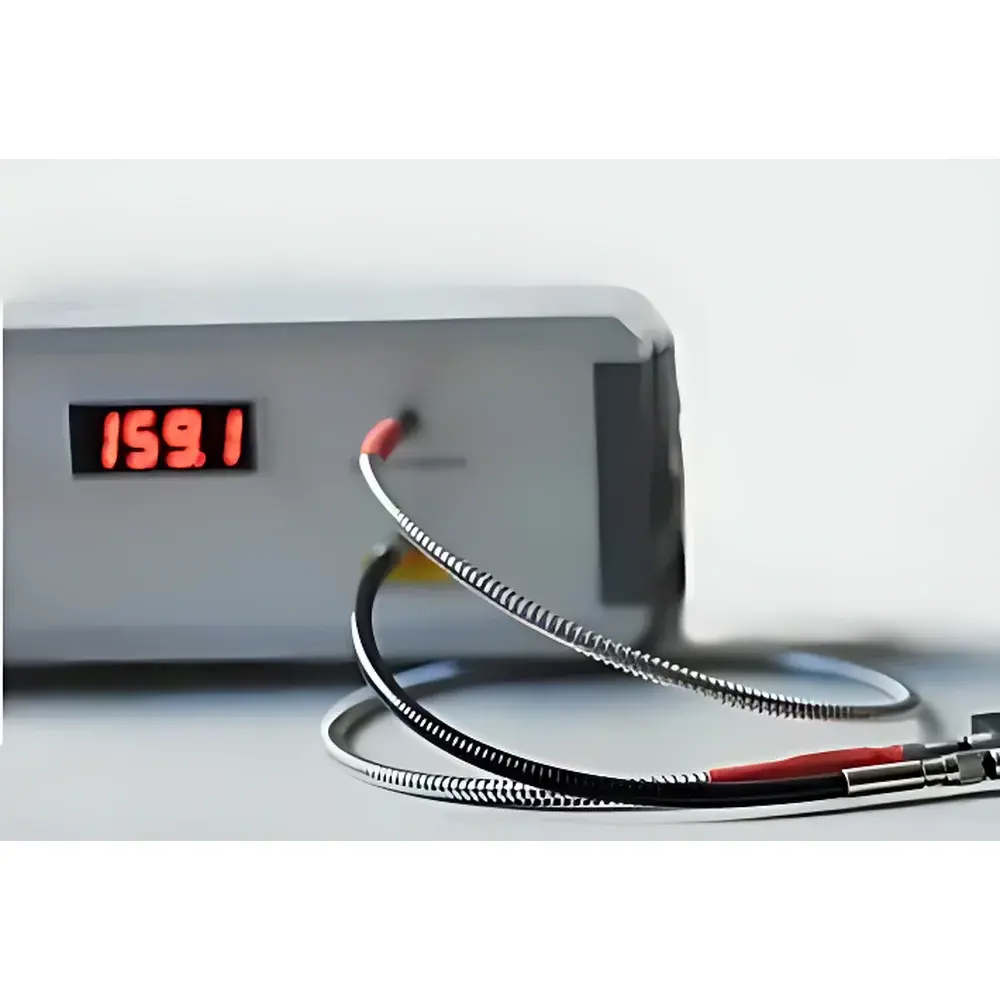
SPL-FL-405 Laser-Induced Fluorescence Spectrometer System
| Brand | SPL |
|---|---|
| Origin | Hong Kong, China |
| Manufacturer Type | Authorized Distributor |
| Product Origin | Mainland China |
| Model | SPL-FL-405 |
| Price | USD 6,950 (FOB HK) |
| Dispersion Element | Holographic Grating + Bandpass Filter |
| Excitation Wavelength | 405 nm (Stabilized Semiconductor Diode Laser) |
| Detection Range | 400–1000 nm |
| Optical Resolution | ~2.5 nm (FWHM) |
| Fiber-Coupled Probe | SMA905, Stainless Steel Housing, UV-Vis Optimized |
Overview
The SPL-FL-405 Laser-Induced Fluorescence (LIF) Spectrometer System is an integrated, portable analytical platform engineered for quantitative and qualitative molecular fluorescence detection across research, industrial process monitoring, and field-deployable environmental or agricultural applications. It employs a temperature- and current-stabilized 405 nm semiconductor diode laser as the excitation source—ensuring consistent photon flux and spectral purity essential for reproducible fluorescence intensity measurements. Fluorescence emission is collected via a ruggedized, fiber-optic probe (SMA905 interface) and dispersed using a high-efficiency holographic grating combined with precision bandpass filters to suppress Rayleigh and Raman scattering artifacts. The system’s compact optical bench and embedded miniature CCD-based spectrometer (400–1000 nm range) enable real-time spectral acquisition with typical integration times from 1 ms to 10 s, supporting both kinetic and steady-state fluorescence analysis.
Key Features
- Stabilized 405 nm laser source with <±0.1 nm wavelength drift and <±1% power fluctuation over 8 hours—critical for quantitative LIF calibration and long-term assay reliability.
- Fiber-coupled, UV-grade quartz probe optimized for 400–1000 nm transmission; chemically resistant stainless-steel housing rated IP65 for operation in humid or particulate environments.
- High signal-to-noise ratio (SNR > 600:1 at full well) CCD detector with thermoelectric cooling (−5 °C), minimizing dark current in low-light biofluorescence or trace hydrocarbon detection.
- Modular optical path design allowing interchangeable gratings (e.g., 300, 600, or 1200 grooves/mm) and filter sets—enabling customization for specific fluorophore bandwidths or multi-excitation configurations.
- Embedded firmware supports USB 2.0 and TTL-triggered acquisition; compatible with Windows/Linux via SDK (C/C++, Python, MATLAB APIs) for automated measurement sequences and integration into OEM platforms.
Sample Compatibility & Compliance
The SPL-FL-405 accommodates liquid, semi-solid, and surface-bound samples—including aqueous suspensions of quantum dot bioconjugates (e.g., CdSe/ZnS@PEG), crude oil fractions, fruit pericarp tissue, and enzymatic reaction mixtures. Its non-destructive, contactless (or minimally invasive) sampling mode meets requirements for GLP-compliant screening protocols where sample integrity must be preserved. While not certified as a medical device, the system adheres to IEC 61000-6-3 (EMC emission standards) and IEC 60825-1:2014 Class 3R laser safety specifications. Spectral data output conforms to ASTM E131-22 (Standard Terminology Relating to Molecular Spectroscopy) and supports traceability under ISO/IEC 17025:2017 for laboratory-developed methods involving fluorescence intensity calibration curves.
Software & Data Management
Bundled SPL-SpectraView software provides real-time spectral visualization, peak identification (with centroid and FWHM calculation), background subtraction (polynomial or morphological), and multivariate regression modeling (PLS, MLR). All raw spectra are stored in HDF5 format with embedded metadata (timestamp, laser power, integration time, probe ID), ensuring audit readiness for FDA 21 CFR Part 11–aligned workflows when paired with optional electronic signature modules. Batch processing scripts support automated quantification of multiple analytes—such as parathion detection via QD-enzyme conjugate quenching kinetics or Brix prediction in kiwifruit using 12-wavelength MLR models (Rp = 0.823, RMSEP = 0.56 °Brix).
Applications
- Quantum Dot Biosensing: Real-time tracking of multiplexed biomolecular interactions using size-tunable QDs (2–10 nm diameter); enables simultaneous monitoring of ≥3 target receptors on live-cell membranes with sub-nanomolar LODs.
- Pesticide Residue Screening: Detection of organophosphates (e.g., paraoxon) via enzymatic hydrolysis-induced fluorescence recovery in QD-organophosphorus hydrolase conjugates (LOD: 1 × 10⁻⁸ mol/L).
- Non-Destructive Fruit Quality Assessment: In-field sugar content (°Brix) prediction in kiwifruit, citrus, and grapes using LIF spectral fingerprints (400–750 nm region) and chemometric calibration transfer.
- Petroleum Hydrocarbon Profiling: Discrimination of fuel types (gasoline, diesel, aviation kerosene, lubricants) and crude oils based on characteristic PAH emission signatures (e.g., 432 nm, 486 nm, 524 nm peaks) and relative intensity ratios.
- Environmental Contaminant Monitoring: On-site detection of polycyclic aromatic hydrocarbons (PAHs) in soil leachates or water bodies using solid-phase extraction coupled with fiber-optic LIF interrogation.
FAQ
What is the typical spectral resolution of the SPL-FL-405 system?
The system achieves ~2.5 nm full-width-at-half-maximum (FWHM) resolution across the 400–1000 nm range when configured with the standard 600 grooves/mm grating.
Can the 405 nm laser be replaced with other excitation wavelengths?
The optical module is mechanically and electronically designed for 405 nm diode lasers; substitution requires recalibration of dispersion alignment and detector sensitivity mapping—contact SPL technical support for OEM wavelength-flexible variants.
Is the system compliant with FDA 21 CFR Part 11 for regulated laboratories?
The base hardware and firmware meet foundational data integrity requirements; full Part 11 compliance (audit trail, electronic signatures, role-based access) requires deployment of validated third-party LIMS or SPL’s optional SpectraSecure add-on package.
What sample volumes or geometries are suitable for measurement?
Liquid samples require ≥100 µL in standard 1 cm pathlength cuvettes or microfluidic flow cells; surface measurements (e.g., fruit skin, filter paper) use standoff distances of 2–10 mm with spot size ~1.2 mm diameter.
Does the system support time-resolved fluorescence decay measurements?
No—the SPL-FL-405 is optimized for steady-state intensity-based analysis; time-resolved capability (ns–µs lifetimes) requires pulsed laser sources and TCSPC electronics, available in SPL’s FL-Tau series.





