SPL SPL-2000 Split-Configuration Ruby Fluorescence Pressure Calibration System
| Brand | SPL |
|---|---|
| Origin | Zhejiang, China |
| Manufacturer Type | Authorized Distributor |
| Product Category | Domestic |
| Model | SPL-2000 |
| Price Range | USD 14,000–43,000 (FOB) |
| Component Type | Optical Instrument Subsystem |
| Excitation Wavelength | 405 nm |
| Pressure Range (RT) | 0–100 GPa |
| Pressure Resolution | 0.1 GPa |
| Objective Lens | 10× (WD: 34 mm) |
| Detection Sensor | 1/2″ CMOS Color CCD (2048 × 1536, 3 MP) |
| Data Acquisition | Integrated Spectral & CCD Imaging Interface |
| Calibration Equations | P = 2.74(λ − λ₀) for P < 20 GPa |
| Fiber-Coupled Architecture | Dual SMA-905 optical fibers (laser input + signal return) |
Overview
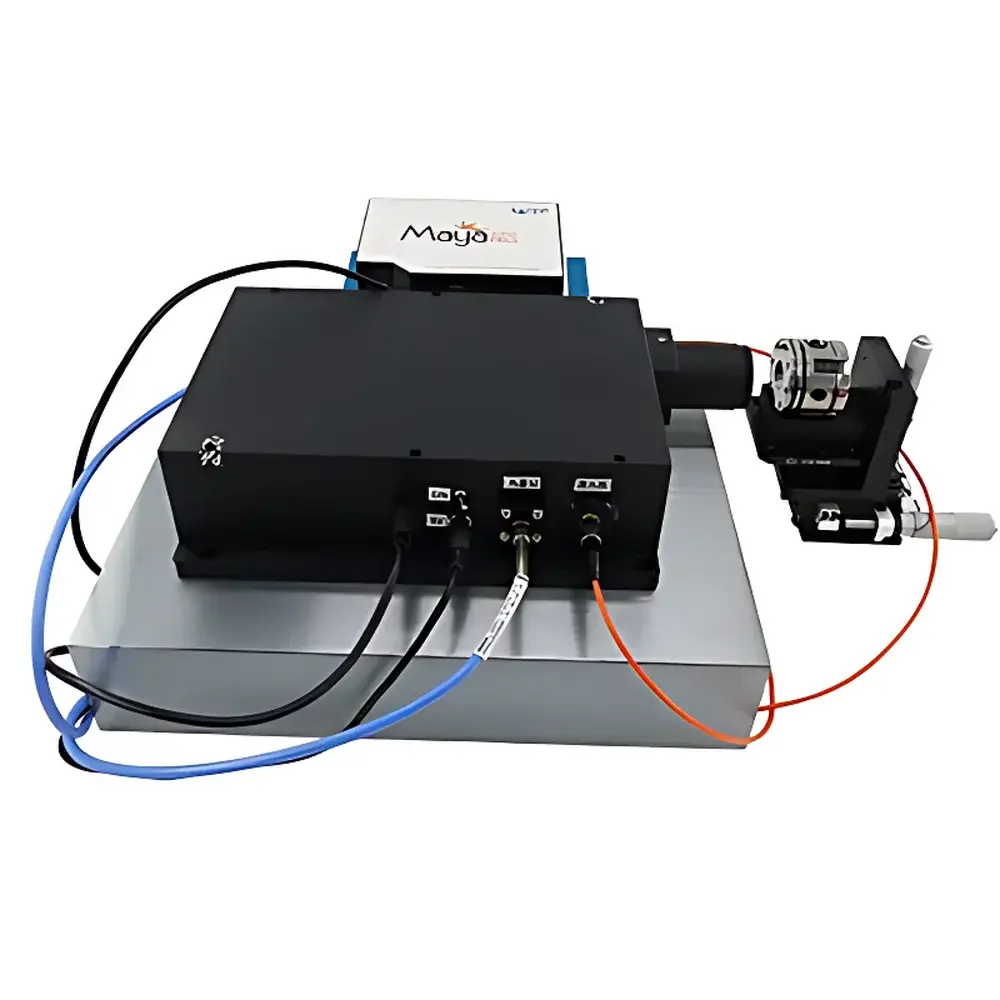
The SPL SPL-2000 Split-Configuration Ruby Fluorescence Pressure Calibration System is a precision optical instrumentation platform engineered for high-pressure metrology in diamond anvil cell (DAC) experiments and static high-pressure research laboratories. It operates on the well-established ruby fluorescence pressure scale, leveraging the pressure-dependent spectral shift of the R₁ fluorescence line (⁴A₂ → ²E transition) in Cr³⁺-doped Al₂O₃. At ambient conditions, the R₁ line is centered at 694.3 nm; under hydrostatic or quasi-hydrostatic compression, its wavelength red-shifts monotonically and reproducibly—enabling non-invasive, in situ pressure determination with traceable accuracy. The SPL-2000 implements a modular, fiber-coupled architecture: the 405 nm excitation laser, spectrometer, and collection optics are physically decoupled and interconnected via two high-transmission, low-autofluorescence SMA-905 optical fibers. This design preserves spectral fidelity while enabling full hardware interchangeability—researchers may integrate legacy or third-party spectrometers (e.g., Ocean Insight HDX, Hamamatsu C12669, or Princeton Instruments IsoPlane systems) and laser sources (including 450 nm or 532 nm variants for specialized applications), thereby extending laboratory infrastructure longevity and reducing total cost of ownership.
Key Features
- Fiber-optic decoupling of excitation source, spectrometer, and collection path—enables independent optimization and replacement of core subsystems without mechanical realignment.
- Integrated dual-acquisition software interface supporting simultaneous spectral acquisition (R₁ peak detection) and real-time CCD imaging—facilitates precise spatial registration of fluorescence origin within the DAC gasket region.
- Automated R₁ peak search algorithm with manual override capability; peak fitting employs Gaussian-Lorentzian convolution for robust sub-pixel centroiding under low-SNR conditions typical in high-pressure fluorescence.
- Built-in pressure calculation engine implementing both the linear (Dewaele et al., 2004) and fifth-power polynomial (Mao et al., 1986) calibration equations—user-selectable based on target pressure regime and hydrostaticity assessment.
- Optimized optical train featuring 10× long-working-distance objective (34 mm WD) with minimal chromatic aberration across 650–750 nm detection band—ensures high collection efficiency and spatial resolution for micron-scale DAC chambers.
- CMOS color sensor (2048 × 1536, 3 MP) provides contextual imaging for sample alignment, gasket deformation monitoring, and fluorescence localization—critical for interpreting non-hydrostatic stress states.
Sample Compatibility & Compliance
The SPL-2000 is compatible with standard symmetric and asymmetric diamond anvil cells using single-crystal or polycrystalline ruby chips (typically 10–50 µm diameter) embedded in the pressure medium (e.g., NaCl, silicone oil, or methanol-ethanol mixtures). It supports both room-temperature and cryogenic DAC configurations when integrated with closed-cycle refrigerators or liquid nitrogen cryostats—provided optical access paths remain unobstructed. While the system itself does not carry formal ISO/IEC 17025 certification, its measurement methodology adheres to internationally accepted ruby pressure scale protocols defined in Journal of Applied Physics (Vol. 98, 033503, 2005) and reviewed by the International Union of Pure and Applied Physics (IUPAP) Working Group on High-Pressure Standards. All calibration parameters—including user-input λ₀ reference value—are logged with timestamp and operator ID, supporting GLP-compliant documentation workflows.
Software & Data Management
The proprietary SPL Pressure Analysis Suite runs on Windows 10/11 (64-bit) and provides a unified GUI for spectral acquisition, image capture, and pressure computation. Raw spectra are saved in HDF5 format with embedded metadata (laser power, integration time, grating position, detector temperature), ensuring FAIR (Findable, Accessible, Interoperable, Reusable) data principles. Software supports audit-trail logging per FDA 21 CFR Part 11 requirements when configured with network authentication and electronic signature modules. Export options include CSV (peak position, FWHM, SNR, computed P), PNG/TIFF (annotated spectra + overlay images), and MATLAB-compatible .mat files. Batch processing mode enables post-experiment recalibration using updated λ₀ values or alternative equations—essential for cross-laboratory intercomparison studies.
Applications
- In situ pressure calibration during synchrotron X-ray diffraction and X-ray absorption spectroscopy experiments at beamlines (e.g., APS 16-BM, ESRF ID27, SPring-8 BL10XU).
- Thermodynamic equation-of-state validation for novel materials (e.g., hydrogen-rich superconductors, transition-metal hydrides, amorphous carbon phases) under multi-Mbar conditions.
- Development and verification of alternative pressure standards (e.g., Si, Pt, or Au scales) via cross-calibration against ruby fluorescence.
- Dynamic pressure mapping in radial diamond anvil cells or double-stage DACs requiring spatially resolved fluorescence collection.
- Integration with micro-Raman modules for concurrent structural and pressure diagnostics—particularly valuable in geophysics and planetary science simulations.
FAQ
Can the SPL-2000 be used with a 532 nm excitation laser?
Yes—the optical coupling design supports interchangeable laser modules; 532 nm operation requires optional notch filters and spectrometer grating reconfiguration to suppress Rayleigh scatter.
Is λ₀ required to be measured in situ for each experiment?
No—λ₀ may be determined once per ruby chip using a calibrated zero-pressure reference cell, then entered manually; however, best practice recommends verifying λ₀ before and after high-pressure runs to assess thermal drift or chip degradation.
Does the system support automated pressure mapping over XY stages?
Not natively—but the software exposes COM/ActiveX interfaces, enabling integration with third-party motion controllers (e.g., Thorlabs Kinesis, Prior ProScan) for scripted raster scans.
What spectral resolution is achievable with typical spectrometers paired to the SPL-2000?
Depends on the connected spectrometer; with a 1200 g/mm grating and 25 µm slit, resolution ≤ 0.15 nm FWHM is attainable—sufficient to resolve R₁/R₂ splitting above ~30 GPa.
Is remote operation supported for synchrotron or high-radiation environments?
Yes—fiber-coupled architecture allows placement of sensitive electronics outside radiation zones; all control and data transfer occur via Ethernet, with optional fiber-optic USB extenders for >10 m separation.