
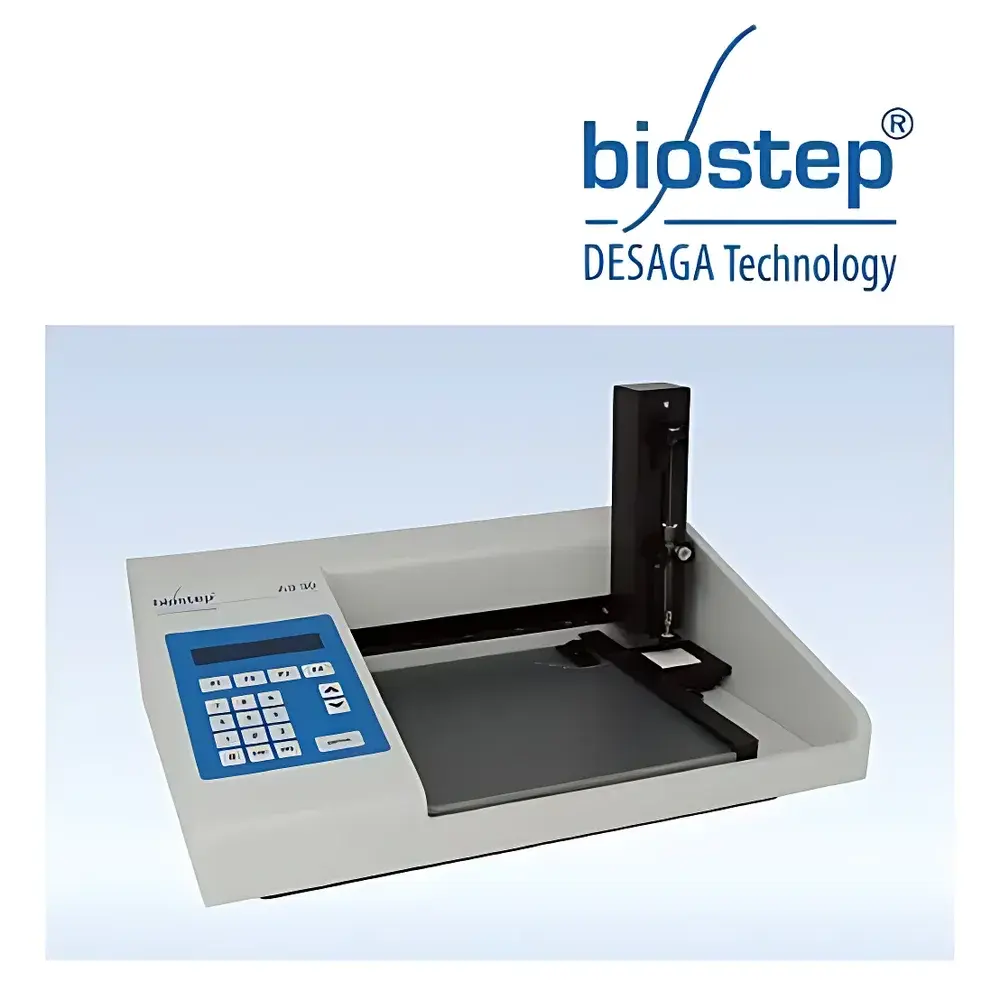
Biostep AS30 Automated TLC Sample Spotter
| Brand | Biostep |
|---|---|
| Origin | Germany |
| Model | AS30 |
| Instrument Type | Thin-Layer Chromatography (TLC) Sample Spotter |
| Spotting Method | Non-contact spray spotting with programmable overlap capability |
| Wavelength Accuracy | ±0.5 nm |
| Wavelength Repeatability | <0.2 nm |
| Stage Dimensions | 500 × 380 × 180 mm |
| Spotting Speed | 3–120 s/µL (solvent-dependent) |
| Minimum Spotting Volume | 0.1 µL |
| Volume Range Options | 0.1–10 µL and 0.1–100 µL |
| Spotting Precision | ±0.5 nL |
| Programmable Methods | Up to 10 stored protocols |
| Sample Capacity (optional autosampler) | 144 vials |
Overview
The Biostep AS30 Automated TLC Sample Spotter is a precision-engineered instrument designed for reproducible, non-contact sample deposition onto thin-layer chromatography (TLC) plates. Developed by Biostep—a German manufacturer with decades of specialization in planar chromatography instrumentation—the AS30 implements piezoelectric-driven microdispensing technology to deliver controlled, solvent-optimized aerosolized sample deposition without physical contact between nozzle and plate. This eliminates carryover, plate damage, and edge effects common in capillary or contact-based spotting. The system supports both discrete spot and continuous band application geometries, enabling flexible method development for qualitative screening, quantitative densitometric analysis, and preparative TLC workflows. Its integration-ready architecture allows synchronized operation with Biostep’s line of TLC scanners (e.g., CD60, DC40), facilitating end-to-end automation from sample application through digital image acquisition and quantitation.
Key Features
- Non-contact piezoelectric spray spotting ensures zero cross-contamination and preserves plate integrity across repeated runs.
- Programmable multi-layer spotting: up to 10 overlapping deposits per location to enhance detection sensitivity for low-abundance analytes.
- Dual-volume dispensing modules support precise delivery across two dynamic ranges: 0.1–10 µL and 0.1–100 µL—ideal for both trace-level screening and preparative loading.
- Real-time adaptive gap control: motorized Z-axis positioning dynamically adjusts nozzle-to-plate distance based on plate thickness and surface topography, maintaining consistent droplet impact morphology.
- Intuitive front-panel interface with dedicated function keys enables rapid method setup, parameter review, and on-the-fly editing without PC dependency.
- Optional 144-position autosampler compatible with standard 1.5 mL HPLC vials, supporting unattended overnight batch processing.
- Integrated synchronization protocol allows coordinated triggering between spotting and scanning modules, ensuring strict temporal alignment of application and data capture events.
Sample Compatibility & Compliance
The AS30 accommodates all commercially available silica gel, alumina, cellulose, and reversed-phase TLC plates (including pre-coated, UV-active, and fluorescent indicator layers) with dimensions up to 20 × 20 cm. Its solvent-tolerant fluidics pathway handles common TLC solvents—including chloroform, ethyl acetate, methanol, hexane, and aqueous buffers—without clogging or degradation. All hardware components comply with CE marking requirements under the EU Machinery Directive 2006/42/EC and Electromagnetic Compatibility Directive 2014/30/EU. When operated within validated laboratory workflows, the AS30 supports adherence to GLP principles and facilitates audit-ready documentation when paired with Biostep’s compliant software suite (v5.2+), which includes electronic signatures, user access logs, and 21 CFR Part 11–compliant audit trails.
Software & Data Management
The AS30 operates standalone via its embedded controller or integrates seamlessly with Biostep’s ChromStar® software platform. ChromStar v5.2 provides full method definition—including coordinate mapping, volume gradients, repeat cycles, and solvent-specific dwell times—as well as bidirectional communication with connected scanners. All spotting events are timestamped and logged with metadata (operator ID, plate ID, program name, environmental temperature/humidity if external sensors are attached). Export formats include CSV, XML, and native .csd files for LIMS integration. Raw spotting log files retain full traceability for regulatory submissions and internal QA/QC review. No proprietary drivers or runtime dependencies are required; the system communicates via standard USB 2.0 and RS-232 interfaces.
Applications
- Routine pharmaceutical QC: uniform application of active pharmaceutical ingredients (APIs), excipients, and degradation products onto TLC plates for identity confirmation per USP and Ph. Eur. 2.2.27.
- Natural product profiling: high-resolution band spotting for fingerprinting of plant extracts, essential oils, and fermentation broths prior to densitometric quantification.
- Environmental monitoring: multi-analyte deposition for pesticide residue screening in soil/water extracts using multi-solvent gradient development.
- Academic research: method development for chiral separations on derivatized silica plates, where precise band width and loading consistency directly impact resolution.
- Forensic toxicology: parallel spotting of biological matrices (urine, blood extracts) for rapid immunoassay cross-validation and confirmatory testing.
FAQ
What is the minimum detectable spotting volume and how is accuracy verified?
The AS30 achieves a minimum dispensed volume of 0.1 µL with a stated precision of ±0.5 nL, verified using gravimetric calibration with certified reference standards traceable to PTB (Physikalisch-Technische Bundesanstalt). Routine verification is performed using dye-dilution assays monitored by UV-Vis spectrophotometry.
Can the AS30 be used with glass-backed or flexible polymer TLC plates?
Yes—the adjustable Z-axis stage accommodates plate thicknesses from 0.2 mm (flexible polyester-backed layers) to 3.0 mm (rigid glass-supported plates), with automatic surface detection via capacitive sensing.
Is method transfer possible between different Biostep spotting instruments?
ChromStar method files (.csd) are fully portable across the AS20, AS30, and AS60 platforms, though physical parameters (e.g., maximum plate size, autosampler capacity) are enforced at runtime to prevent invalid configurations.
Does the system support GMP-compliant electronic records?
When configured with ChromStar v5.2+ and enabled audit-trail settings, the AS30 generates ALCOA+ compliant data packages—including immutable event logs, user authentication, and change history—meeting FDA expectations for regulated environments.
How is solvent evaporation managed during extended spotting sequences?
The AS30 incorporates programmable pause intervals between spots and optional environmental enclosure integration (humidity-controlled chamber, optional accessory) to minimize premature solvent loss in volatile systems such as chloroform/methanol mixtures.





