
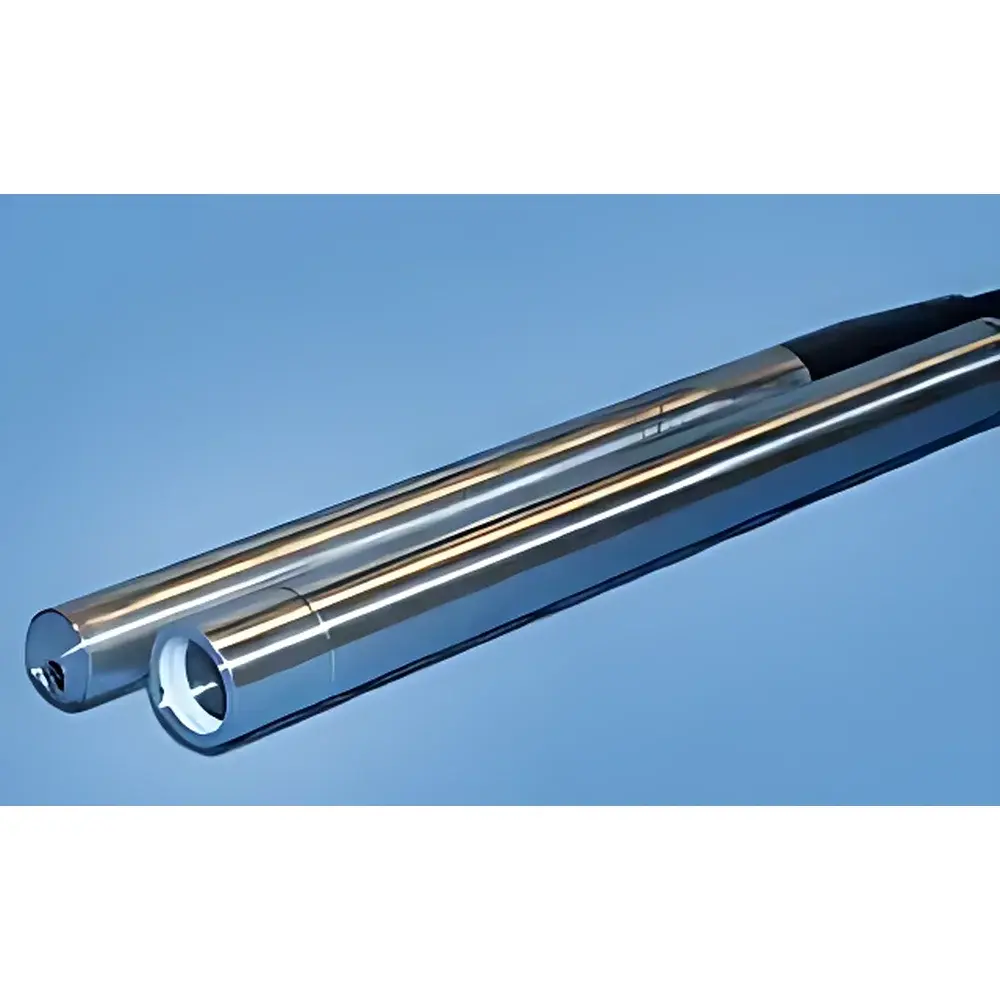
SPL RamanProbe II Immersion-Grade Fiber-Optic Raman Probe
| Brand | SPL |
|---|---|
| Origin | USA |
| Manufacturer Type | Authorized Distributor |
| Product Category | Imported Instrument Component |
| Model | RamanProbe II |
| Instrument Type | Raman Spectroscopy Accessory |
| Excitation Wavelengths | 514, 532, 632, 670, 785, 830 nm (custom wavelengths available) |
| Spectral Range | 250–3900 cm⁻¹ (Stokes) |
| Probe Body Dimensions | Ø15.8 mm × 230 mm (5/8″ × 8″) |
| Working Distance | Adjustable per sample viscosity and refractive index |
| Fiber Configuration | Fixed 105 µm excitation fiber + 200 µm collection fiber, NA 0.22 |
| Optical Density of Notch Filters | >8 OD @ laser wavelength |
| Max Operating Temperature | 200 °C |
| Window Material | Sapphire (standard), optional fused silica for 633/670 nm |
| Standard Fiber Length | 5 m (configurable up to 200 m) |
| Connector | FC or SMA 905 (standard) |
| Safety Class | IEC 60825-1 Class I (with integrated emission indicator) |
Overview
The SPL RamanProbe II is an immersion-optimized, fiber-coupled Raman probe engineered for real-time, in-situ molecular characterization of liquid-phase samples under process or laboratory conditions. Unlike conventional benchtop Raman spectrometers requiring sample extraction and cuvette loading, the RamanProbe II enables direct optical interrogation within reactors, bioreactors, flow cells, or storage vessels—eliminating sampling bias, contamination risk, and time delays associated with offline analysis. Its optical architecture leverages high-efficiency notch filtering and optimized fiber coupling to suppress Rayleigh scattering by >8 OD at the excitation wavelength while preserving Stokes-shifted Raman signals across a broad spectral window (250–3900 cm⁻¹). The probe operates on standard visible and NIR laser lines (514–830 nm), with modular compatibility for integration into OEM spectroscopic systems or turnkey Raman platforms.
Key Features
- True immersion capability with removable stainless-steel outer sheath (Ø15.8 mm × 230 mm), enabling both submerged liquid analysis and post-sheath removal for solid or cuvette-based measurements
- Adjustable working distance optimized for varying solution viscosities and refractive indices—critical for minimizing signal distortion in heterogeneous or particulate-laden media
- Hermetically sealed sapphire window (standard) rated for continuous operation up to 200 °C; optional fused silica windows available for enhanced transmission at 633 nm and 670 nm excitation
- Integrated dual-fiber configuration: 105 µm core excitation fiber and 200 µm core collection fiber, both with NA 0.22, pre-aligned and permanently fixed to ensure long-term alignment stability and reproducible signal coupling
- Patented multi-stage notch filter design achieving >8 optical density rejection of Rayleigh line and silica Raman background from both input and output fibers—enabling high signal-to-noise ratio detection even near the laser line
- Class I laser safety compliance with built-in emission indicator; FC or SMA 905 connector standard; fiber length configurable from 5 m (standard) to 200 m for remote deployment
Sample Compatibility & Compliance
The RamanProbe II supports direct optical access to aqueous, organic, and corrosive liquid matrices—including acidic or alkaline solutions—when used with appropriate sheath materials and sealing protocols. Its stainless-steel construction and sapphire window meet ASTM F86 surface finish standards for implantable device testing and are compatible with ISO 13485 cleanroom handling procedures. For regulated environments (e.g., pharmaceutical manufacturing or QC labs), the probe’s passive optical design requires no electrical components in the wet zone, simplifying qualification under FDA 21 CFR Part 11 and EU Annex 11 requirements. While the probe itself does not generate electronic audit trails, its stable mechanical and optical performance supports GMP-compliant validation protocols when paired with compliant spectrometers and data acquisition software.
Software & Data Management
As a hardware accessory, the RamanProbe II interfaces transparently with third-party spectroscopic control software (e.g., OceanInsight OceanView, Thermo Fisher OMNIC, or Horiba LabSpec). It introduces no proprietary drivers or firmware dependencies. Spectral calibration is performed externally using NIST-traceable polystyrene or cyclohexane standards; wavelength accuracy remains governed by the host spectrometer’s grating and detector calibration. When deployed in automated process analytical technology (PAT) frameworks, the probe’s consistent coupling efficiency and thermal stability support repeatable spectral acquisition across shifts and batches—facilitating multivariate modeling (e.g., PLS regression) for concentration monitoring or polymorph identification. Raw intensity data is retained in vendor-neutral formats (e.g., .csv or .spc), ensuring interoperability with LIMS and ELN systems.
Applications
- In-line monitoring of chemical reaction kinetics in jacketed glass or stainless-steel reactors
- Real-time quantification of active pharmaceutical ingredient (API) concentration during crystallization or dissolution
- Bioprocess monitoring of glucose, lactate, and biomass in mammalian or microbial fermentation
- Quality assurance of polymer composition and crosslinking density in solvent-based coatings
- Environmental analysis of hydrocarbon contaminants in water or soil leachates
- Material science studies of phase transitions, solvation shells, and hydrogen-bonding dynamics in ionic liquids
FAQ
Can the RamanProbe II be used with 1064 nm excitation lasers?
Yes—custom configurations are available upon request; however, optical filter redesign and fiber selection (e.g., low-OH silica) are required to maintain signal fidelity and minimize fluorescence interference.
Is the probe compatible with high-pressure reactor systems?
The standard version is rated for ambient pressure only; high-pressure variants (up to 10 MPa) with reinforced housings and metal-sealed windows can be supplied as engineered options.
Does the probe require recalibration after repeated thermal cycling?
No—its all-metal mechanical structure and monolithic optical path eliminate drift induced by thermal expansion; spectral alignment remains stable across repeated 25–200 °C cycles.
Can multiple RamanProbe II units be multiplexed on a single spectrometer?
Yes—using fiber-optic switch modules (e.g., 1×4 or 1×8) compatible with SMA 905 connectors; insertion loss and timing synchronization must be validated per application.
What documentation is provided for IQ/OQ validation?
SPL supplies dimensional drawings, material certifications (EN 10204 3.1), optical test reports (including OD spectra and throughput curves), and a traceable calibration certificate against NIST SRM 2241.






