
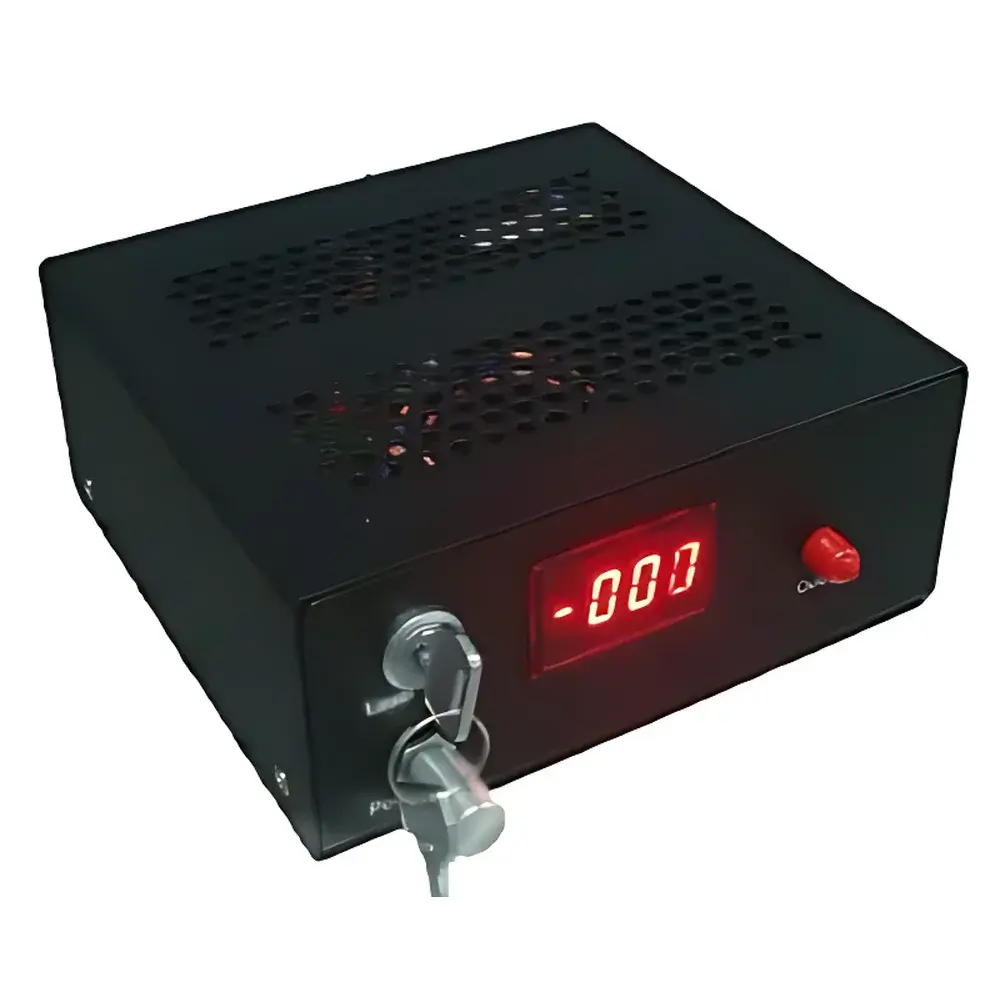
SPL Continuous-Wave Raman and Fluorescence Laser Systems
| Brand | SPL Photonics |
|---|---|
| Origin | Zhejiang, China |
| Manufacturer Type | Authorized Distributor |
| Product Category | Domestic |
| Model | SPL CW Raman & Fluorescence Laser Series |
| Key Components | Solid-State Laser Modules |
| Wavelength Options | 488 nm, 532 nm, 658 nm, 780 nm, 785 nm, 830 nm |
| Output Modes | Free-Space (SL) or Fiber-Coupled (FC/PC or SMA 905) |
| Power Options | Up to 500 mW (CW) |
| Spectral Linewidth | ≤0.2 nm (typ., 785 nm) |
| Wavelength Stability | <0.005 nm/°C (typ.) |
| Intensity Stability | <1% RMS (8 h, 10 Hz–100 MHz) |
| Warm-up Time | 15 min |
| Operating Temperature | –10 °C to +45 °C |
| Humidity Range | 5–95% RH (non-condensing) |
| Lifetime | ≥10,000 h |
| Power Supply | 5 VDC @ 3.0 A (INT-5V) or 220 VAC input (INT-220V) |
| Modulation | TTL-compatible (0–100 kHz) |
| Fiber Coupling | Standard 105 µm, NA 0.22 (≥75% coupling efficiency) |
| Customization | OEM modules, wavelength-specific packaging, fiber type, connector (SMA 905 / FC), thermal management, and control interface |
Overview
The SPL Continuous-Wave Raman and Fluorescence Laser Systems are engineered solid-state laser sources designed for high-fidelity spectroscopic applications requiring spectral purity, long-term power stability, and narrow linewidth performance. These lasers operate on diode-pumped solid-state (DPSS) or frequency-doubled semiconductor principles—depending on wavelength—and are optimized for use in benchtop and integrated Raman spectrometers, fluorescence lifetime imaging (FLIM), confocal microscopy, and quantum optics setups. Unlike pulsed or broadband excitation sources, SPL CW lasers deliver consistent photon flux with minimal temporal noise, enabling quantitative intensity-based measurements and high signal-to-noise ratio (SNR) spectral acquisition. Each system integrates a thermoelectric cooler (TEC) with closed-loop temperature control and photodiode (PD)-based power feedback, ensuring robust wavelength anchoring and sub-percent intensity drift over multi-hour experiments—critical for compliance with ISO/IEC 17025-accredited analytical workflows.
Key Features
- Multi-wavelength platform supporting 488 nm, 532 nm, 658 nm, 780 nm, 785 nm, and 830 nm emission—covering key Raman excitation bands and common fluorophore absorption maxima.
- Narrow spectral linewidth: ≤0.2 nm (785 nm), <0.1 nm (532 nm), enabling high-resolution vibrational mode discrimination in Raman spectroscopy.
- Exceptional short- and long-term stability: <1% RMS intensity variation over 8 hours; wavelength drift <0.005 nm/°C under ambient thermal fluctuations.
- Dual output configurations: Free-space collimated beam (SL) or fiber-coupled output (FC/PC or SMA 905), with standard 105 µm, NA 0.22 multimode fiber offering >75% coupling efficiency.
- Modular architecture supporting OEM integration: Available in bare-module (OEM), 5 VDC-integrated (INT-5V), or 220 VAC-integrated (INT-220V) packages with adjustable output power and TTL modulation (0–100 kHz).
- Industrial-grade reliability: Rated for ≥10,000 hours MTBF, operating across –10 °C to +45 °C with humidity tolerance up to 95% RH (non-condensing).
Sample Compatibility & Compliance
SPL CW lasers are compatible with standard Raman probe heads, fiber-optic spectrometers (e.g., Ocean Insight, Hamamatsu), and fluorescence detection modules used in QC labs and academic research facilities. Their stable single-frequency output meets the optical requirements of ASTM E1840 (Standard Guide for Raman Shift Standards), ISO 8573-9 (spectral purity in analytical instrumentation), and USP (laser-based pharmaceutical analysis). While not certified for IEC 61000-6-3 EMC or FDA 21 CFR Part 11 out-of-the-box, the INT-5V and INT-220V variants support external audit trail logging when paired with compliant data acquisition software—facilitating GLP/GMP-aligned validation protocols in regulated environments.
Software & Data Management
These lasers do not include embedded firmware or proprietary GUIs. Instead, they interface via analog voltage control (0–5 V) and TTL digital modulation inputs—ensuring seamless integration with third-party platforms such as LabVIEW, MATLAB Instrument Control Toolbox, Python (PyVISA), or commercial spectroscopy suites (e.g., Thermo Fisher OMNIC, Horiba LabSpec). Power ramping, on/off sequencing, and synchronization with detector gating are fully programmable. For traceable calibration, users may log laser status (on/off, setpoint, actual PD reading) alongside spectral acquisitions using timestamped CSV or HDF5 exports—supporting full metadata retention per ISO/IEC 17025 Clause 7.5.2.
Applications
- Raman spectroscopy: Excitation at 785 nm minimizes fluorescence interference in organic and biological samples; 532 nm enables higher Raman cross-section for inorganic crystals and nanomaterials.
- Fluorescence spectroscopy: 488 nm and 658 nm lines match common dye families (FITC, Alexa Fluor 488, Cy5), supporting multiplexed assays and flow cytometry alignment.
- Process analytical technology (PAT): Integrated into inline or at-line monitoring systems for real-time chemical composition tracking in pharma and fine chemical manufacturing.
- Quantum sensing: Used as pump sources in stimulated Raman scattering (SRS) microscopy and cavity-enhanced absorption setups demanding low phase noise.
- Calibration standards: Serve as stable reference sources for wavelength and intensity calibration of grating spectrometers and photodetector arrays.
FAQ
What is the typical spectral linewidth for the 785 nm model?
The nominal spectral linewidth is ≤0.2 nm (FWHM), measured under stabilized thermal and current conditions.
Can the laser be modulated at frequencies above 100 kHz?
The standard TTL interface supports up to 100 kHz square-wave modulation; higher-frequency analog modulation requires custom driver electronics and is subject to optical rise time limitations (<500 ms).
Is fiber coupling efficiency guaranteed across all power levels?
Coupling efficiency ≥75% is specified for the standard 105 µm, NA 0.22 fiber at rated output power; efficiency may decrease slightly at maximum power due to thermal lensing in the coupling optics.
Does the laser comply with laser safety Class 3B requirements?
Yes—models delivering >5 mW output are classified as Class 3B per IEC 60825-1:2014 and require appropriate interlocks, labeling, and operator training per local regulatory frameworks.
What documentation is provided for installation qualification (IQ) and operational qualification (OQ)?
SPL supplies factory test reports including wavelength verification (using NIST-traceable wavemeter), power stability logs (8-hour RMS), and thermal drift characterization—sufficient for IQ/OQ protocol development by end users.



