
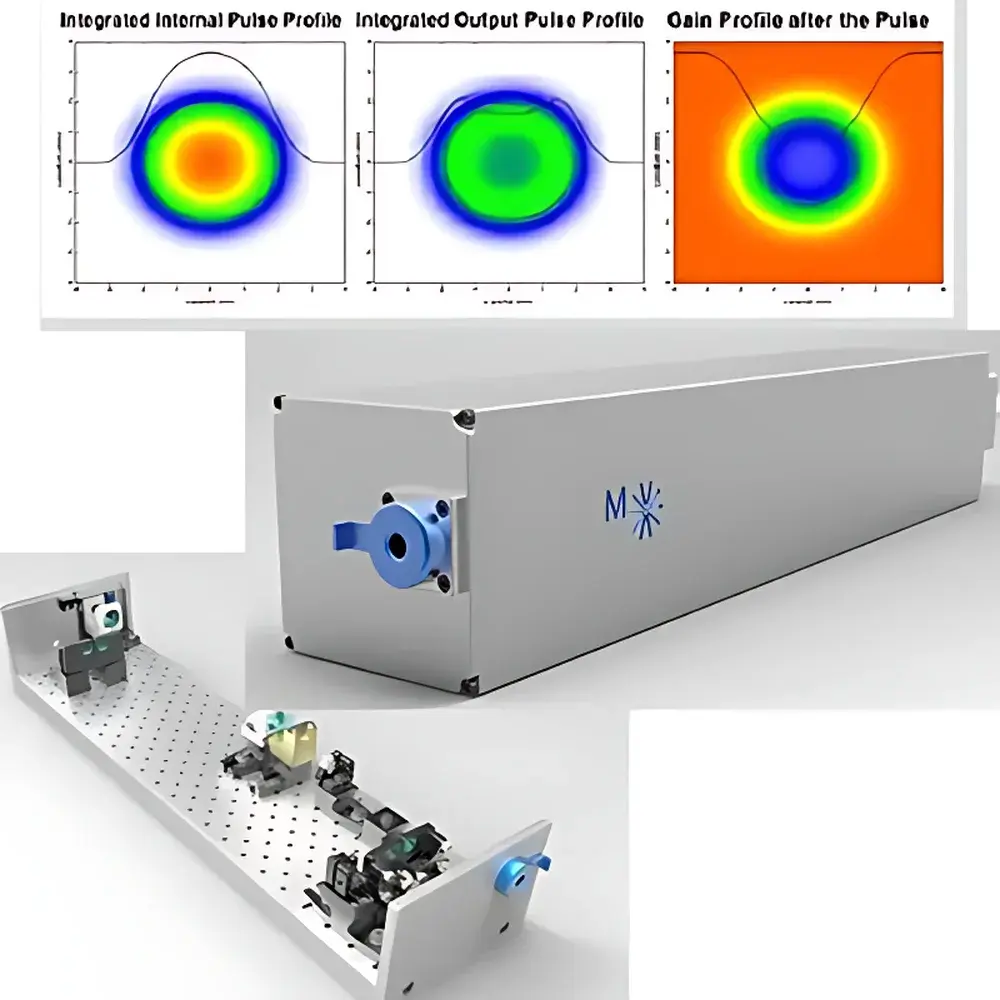
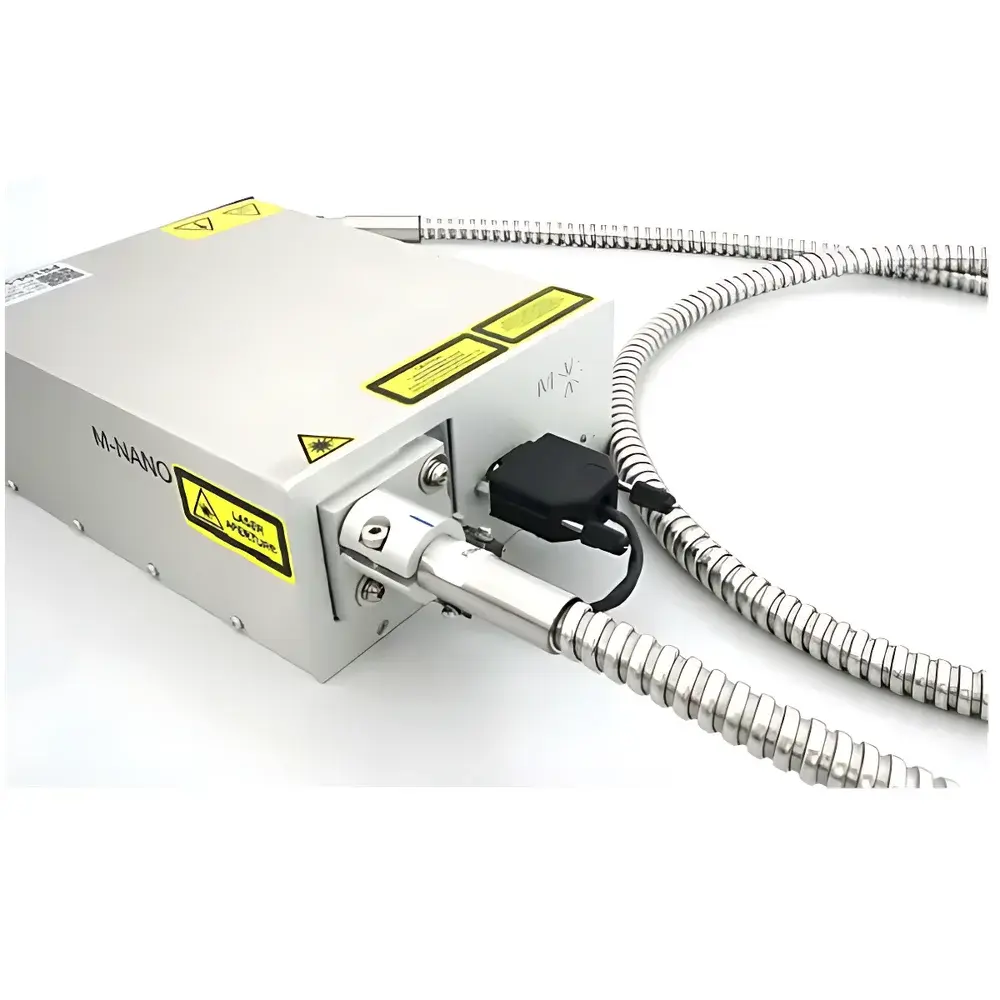
Montfort M-NANO-Nd:YAG Ultra-Compact Nanosecond Pulsed Laser System
| Brand | Montfort |
|---|---|
| Origin | Austria |
| Laser Type | Diode-Pumped Solid-State (DPSS) Nd:YAG |
| Wavelength | 1064 nm (fundamental), optional 532 nm SHG |
| Pulse Energy | up to 120 mJ |
| Pulse Width | 6–10 ns (FWHM) |
| Repetition Rate | 1–100 Hz |
| Beam Quality | M² < 3 |
| Operating Voltage | 24 V DC |
| Cooling | Conduction-cooled, no water required |
| Dimensions (L×W×H) | 139 × 132 × 64 mm (M-NANO base unit) |
| Weight | ≤ 4 kg (fully integrated) |
| Lifetime | >1 billion pulses |
| Pulse Delay Range | –1.5 µs to +4 µs (relative to trigger) |
| dual-pulse interval | 0 ms to –300 ms |
| Energy Stability | < 0.9% RMS (over 1 hr) |
| Beam Pointing Stability | < 5 µrad (over 8 hrs) |
| Compliance | CE, RoHS, IEC 60825-1:2014 Class 4 Laser Product |
Overview
The Montfort M-NANO-Nd:YAG is an ultra-compact, conduction-cooled, diode-pumped solid-state (DPSS) nanosecond pulsed laser system engineered for high-reliability field deployment and integration into demanding optical instrumentation platforms. Based on a monolithic Nd:YAG crystal architecture and optimized semiconductor pump diode design, it delivers stable, diffraction-limited nanosecond pulses at 1064 nm (and optionally frequency-doubled 532 nm) with pulse widths of 6–10 ns (FWHM), repetition rates from 1 to 100 Hz, and pulse energies scalable from 20 mJ to 120 mJ. Its all-metal, passively cooled mechanical housing eliminates the need for external chillers or forced-air systems—enabling operation in ambient temperatures ranging from 15 °C to 40 °C without thermal drift compensation. Designed by the founding team of High Q Laser, the M-NANO series leverages over two decades of DPSS laser engineering expertise to achieve exceptional beam pointing stability (< 5 µrad), energy stability (1 billion pulses rated lifetime). The system operates from a single 24 V DC input, making it uniquely suited for battery-powered mobile platforms, airborne LIDAR payloads, portable LIBS analyzers, and benchtop nonlinear optics setups where size, weight, power, and reliability (SWaP-R) are critical constraints.
Key Features
- Ultra-compact footprint: Base unit measures only 139 × 132 × 64 mm; fully integrated versions—including controller, harmonic generator, and beam delivery optics—remain under 326 × 178 × 64.5 mm.
- Conduction-cooled architecture: No water cooling, no fans—ideal for vibration-sensitive environments and sealed enclosures.
- 24 V DC operation: Compatible with standard industrial power supplies and field-deployable battery packs (e.g., LiFePO₄).
- Precision pulse timing: Adjustable delay between external trigger and laser emission (–1.5 µs to +4 µs), plus programmable dual-pulse separation (0 ms to –300 ms) for PIV and pump-probe applications.
- High beam quality: M² < 3 across full energy and repetition rate range—ensuring efficient coupling into fibers, OPOs, and nonlinear crystals.
- Modular wavelength options: Standard 1064 nm output; optional intracavity or external SHG modules deliver 532 nm with >50% conversion efficiency.
- Industrial-grade electronics: FPGA-based controller with analog/digital I/O, RS-232/USB interface, and real-time pulse monitoring (energy, timing, status flags).
Sample Compatibility & Compliance
The M-NANO-Nd:YAG is compatible with a broad spectrum of optical materials and experimental configurations, including fused silica, CaF₂, BBO, LBO, and KTP crystals for nonlinear frequency conversion; multimode and single-mode optical fibers (with optional fiber-coupled variants); and reflective or transmissive beam delivery optics used in LIBS, PIV, and photoacoustic imaging systems. All units comply with IEC 60825-1:2014 Class 4 laser safety requirements and carry CE marking per EU Machinery and EMC Directives. The embedded firmware supports audit-trail-capable logging (timestamped pulse count, energy readback, temperature, error codes) aligned with GLP and ISO/IEC 17025 documentation practices. While not pre-certified for FDA 21 CFR Part 11, the system’s deterministic timing architecture and non-volatile event logging enable straightforward validation for regulated analytical workflows.
Software & Data Management
Montfort provides the NanoControl Suite—a cross-platform (Windows/macOS/Linux) application built on Qt and libusb—for configuration, diagnostics, and synchronization. It enables remote setting of repetition rate, pulse delay, burst mode parameters, and real-time plotting of pulse energy history. Command-line interface (CLI) and SCPI-compatible protocol support allow seamless integration into LabVIEW, Python (PyVISA), MATLAB, or custom C/C++ acquisition software. All communication is ASCII-based with CRC-16 error checking. Pulse energy calibration data is stored onboard EEPROM and automatically applied during operation. Firmware updates are performed via signed binary packages with SHA-256 verification. Raw pulse timing and energy logs can be exported in CSV or HDF5 format for traceability and post-acquisition statistical analysis (e.g., Allan deviation, jitter spectra).
Applications
- Laser-Induced Breakdown Spectroscopy (LIBS): Stable, high-energy nanosecond pulses enable reproducible plasma generation on metallic, geological, and biological samples—even under low-pressure or vacuum conditions.
- Particle Image Velocimetry (PIV): Dual-pulse capability with sub-microsecond jitter supports high-resolution flow field mapping in wind tunnels and combustion chambers.
- Light Detection and Ranging (LIDAR): Compact size and 24 V operation make the M-NANO ideal for UAV-mounted atmospheric sensing and topographic mapping systems.
- Photoacoustic Imaging (PAI): Used as excitation source in preclinical PA tomography systems (e.g., mouse organ imaging, sentinel lymph node detection, radiopharmaceutical tracking) due to high pulse-to-pulse stability and precise temporal control.
- Nonlinear Optics Pump Source: Serves as robust seed or pump laser for optical parametric oscillators (OPOs), terahertz generation (via DAST or GaSe), and supercontinuum generation in photonic crystal fibers.
- Laser Damage Threshold (LDT) Testing: Certified for ISO 21254-compliant testing of coatings, mirrors, and thin-film optics at 1064 nm and 532 nm.
- Ultrafast Micro-Machining & Ablation: Enables precision ablation of polymers, ceramics, and thin metals without significant heat-affected zones when combined with scanning galvanometers.
FAQ
Is the M-NANO-Nd:YAG suitable for battery-powered field operation?
Yes. Its 24 V DC input, conduction-cooled design, and sub-4 kg mass make it compatible with portable lithium battery packs (e.g., 20 Ah LiFePO₄), supporting continuous operation for >4 hours at 10 Hz/50 mJ.
Can I integrate this laser into a custom optical setup requiring precise external triggering?
Absolutely. The system features TTL-compatible trigger input with <10 ns jitter, programmable delay (–1.5 µs to +4 µs), and dual-pulse synchronization—validated for pump-probe delays down to 100 ps resolution using external timing electronics.
Does Montfort provide OEM support for volume integration or wavelength customization?
Yes. Montfort offers full OEM services including mechanical redesign (e.g., flange-mounting, custom heatsinking), wavelength extension (355 nm, 266 nm via harmonic generation), fiber coupling (FC/APC, SMA905), and firmware white-labeling with custom command sets.
What maintenance is required over its rated lifetime?
None beyond periodic optical inspection. The diode pump stack is rated for >20,000 hours; the Nd:YAG rod exhibits negligible degradation below 1 billion pulses. No consumables or alignment adjustments are specified in the maintenance manual.
How is beam quality verified and documented for each unit?
Each laser undergoes M² measurement per ISO 11146-1 using a scanning-slit profiler. Full beam parameter product (BPP), divergence, and focusability data are included in the factory test report shipped with the unit.





