SPL SPL Mini LED Photometric, Radiometric & Electrometric Measurement System
| Brand | SPL |
|---|---|
| Origin | USA |
| Manufacturer Type | Authorized Distributor |
| Product Category | Imported Instrument |
| Model | SPL Mini LED Photometric, Radiometric & Electrometric Measurement System |
| Pricing | Upon Request |
Overview
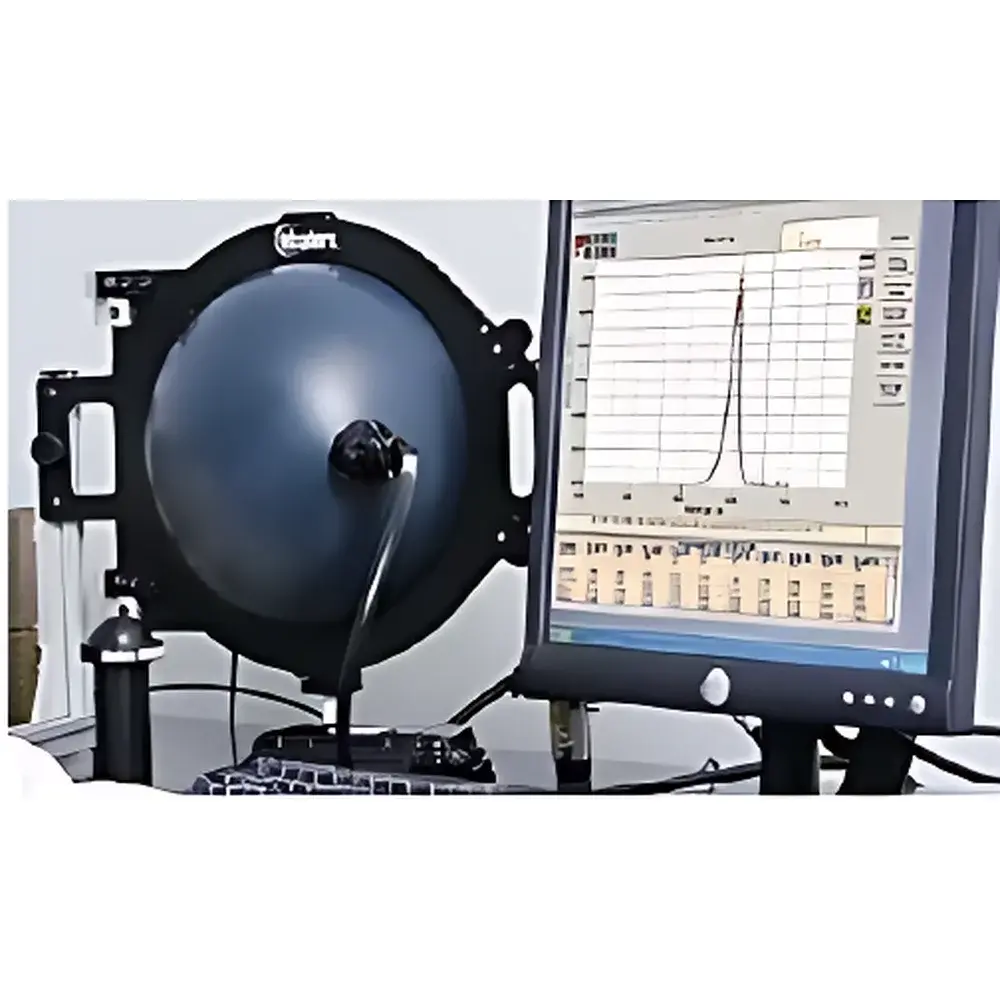
The SPL Mini LED Photometric, Radiometric & Electrometric Measurement System is a compact, integrated optical characterization platform engineered for precision measurement of light-emitting diodes (LEDs) and small-area light sources. Based on the fundamental principles of spectroradiometry and photometry, the system combines a thermoelectrically cooled CCD spectrometer with a calibrated integrating sphere (4π or 2π configuration), NIST-traceable reference standards, programmable DC power supply, and auxiliary correction lamps to deliver traceable, repeatable measurements across photometric (luminous flux, illuminance, luminous intensity), radiometric (radiant flux, spectral irradiance), colorimetric (CIE 1931 xy chromaticity, CCT, CRI, Duv, spectral purity, dominant wavelength, peak wavelength, FWHM), and electrical domains (forward voltage, forward current, reverse leakage current). Designed in full compliance with CIE Publication 127:2007 — “Measurement of LEDs” — the system supports both center-mounted (4π total flux) and wall-mounted (2π directional flux) sample configurations, enabling conformance with IES LM-79, ENERGY STAR, and DOE CALiPER testing protocols.
Key Features
- Thermoelectrically cooled (TE-cooled) back-illuminated CCD spectrometer with high signal-to-noise ratio and low dark current, ensuring spectral stability over extended acquisition periods.
- NIST-traceable spectral irradiance and luminous flux calibration, with documented uncertainty budgets per ISO/IEC 17025 requirements; factory calibration certificate included.
- Integrated dual-mode integrating sphere (standard 100 mm or optional 300 mm) featuring Spectralon® coating (>99% reflectance, 250–2500 nm), optimized for both 4π total flux and 2π directional measurements.
- On-site self-validation and recalibration capability: users can perform routine verification using built-in standard lamp and auxiliary absorption-corrected reference source — no return-to-factory required.
- Real-time spectral acquisition and visualization: full spectral power distribution (SPD) displayed within <500 ms; dynamic update of photometric and colorimetric metrics during measurement.
- Modular probe interface supporting fiber-coupled, cosine-corrected, and collimated input options for flexible integration into production lines or R&D benches.
Sample Compatibility & Compliance
The system accommodates discrete single-die LEDs, SMD packages (e.g., 2835, 3030, 5050), LED arrays up to 25 mm × 25 mm, and miniature OLED or micro-LED test chips. Sample mounting is facilitated via adjustable XYZ stage with thermal isolation base to minimize self-heating artifacts. All optical and electrical measurements adhere to internationally recognized standards: CIE 127:2007 (LED measurement geometry), CIE 15:2018 (colorimetry), IES TM-30-20 (color fidelity and gamut), ISO/CIE 11664 (CIE colorimetric observers), and ANSI C78.377 (chromaticity specifications for solid-state lighting). Electrical parameter acquisition complies with IEC 62384 and EN 62384 for DC-driven LED modules.
Software & Data Management
The bundled SPL SpectraView Pro software provides a validated, audit-ready environment for instrument control, data acquisition, and report generation. It supports multi-parameter synchronized logging (optical + electrical), automated pass/fail thresholding per user-defined specification limits, and export to CSV, XML, and PDF formats compliant with GLP/GMP documentation workflows. The software includes built-in algorithms for CRI (R1–R15), TM-30-20 (Rf, Rg), CIEDE2000 ΔE₀₀, and spectral centroid calculation. Audit trail functionality logs all user actions, calibration events, and parameter changes in accordance with FDA 21 CFR Part 11 requirements for electronic records and signatures.
Applications
This system is routinely deployed in LED package development labs, QC/QA departments of lighting manufacturers, third-party certification bodies (e.g., UL, TÜV, CSA), and university optoelectronics research groups. Typical use cases include: binning validation of LED wafers and packaged devices; luminous efficacy (lm/W) mapping across drive current sweeps; thermal roll-off analysis under pulsed or DC bias; spectral shift quantification during aging tests; chromaticity consistency verification for tunable white and RGB systems; and compliance testing for Energy Star V2.1, DLC Premium, and CE/EN 62471 (photobiological safety) Annex A spectral weighting.
FAQ
What standards does this system support for LED testing?
CIE 127:2007, IES LM-79-19, ISO/CIE 11664, ANSI C78.377, IEC 62384, and EN 62471 Annex A.
Can the system measure both 4π and 2π geometries without hardware modification?
Yes — the integrating sphere includes dual-port optical design and software-selectable measurement mode; sample position is manually adjusted per CIE 127 geometric definitions.
Is NIST traceability provided with each unit?
Yes — each system ships with a NIST-traceable calibration certificate covering spectral responsivity, luminous flux, and irradiance scales, with uncertainty values reported per ISO/IEC 17025.
Does the software support automated reporting for regulatory submissions?
Yes — SPL SpectraView Pro generates fully customizable, timestamped PDF reports with embedded metadata, calibration history, and digital signatures compliant with FDA 21 CFR Part 11 and EU Annex 11.
How often is recalibration recommended?
Annual recalibration is recommended; however, on-site verification using the internal standard lamp and auxiliary correction source can be performed daily or per-shift to confirm measurement integrity.