
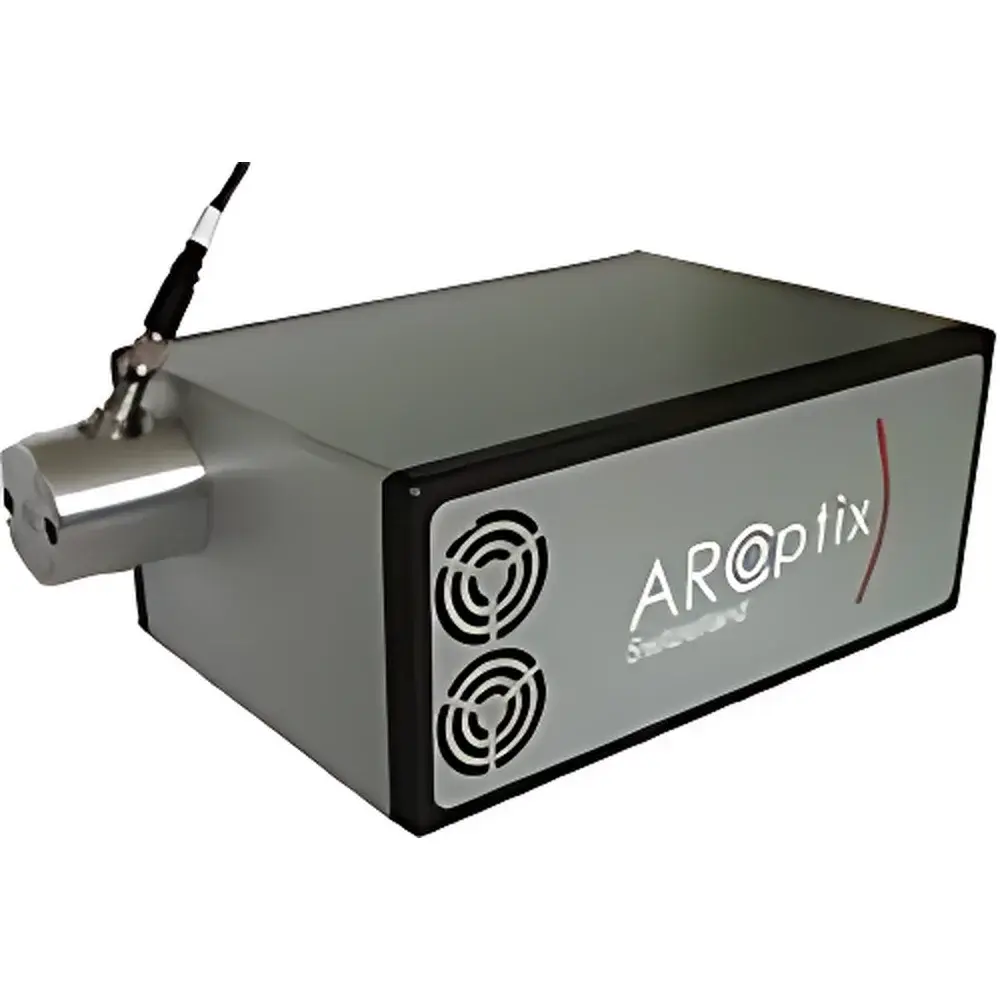
SPL Photonics FTIR-Rocket Fourier Transform Infrared Spectrometer
| Origin | Canada |
|---|---|
| Manufacturer Type | Authorized Distributor |
| Origin Category | Imported Instrument |
| Model | FTIR-Rocket |
| Pricing | Available Upon Request |
| Component Class | IR Source |
Overview
The SPL Photonics FTIR-Rocket is a compact, research-grade Fourier Transform Infrared (FTIR) spectrometer engineered for high-stability spectral acquisition in laboratory and teaching environments. Based on Michelson interferometry, the system employs a dynamically aligned moving mirror mechanism and a thermoelectrically cooled deuterated triglycine sulfate (DTGS) detector to deliver reliable mid-infrared spectral data across the standard 4000–400 cm⁻¹ range. Its modular architecture integrates a broadband infrared source—optimized for stable radiant output and low thermal drift—with precision optical alignment and vibration-damped housing. Designed for benchtop deployment, the FTIR-Rocket supports both transmission and attenuated total reflectance (ATR) sampling modalities without requiring external purging, though optional dry-air or nitrogen purge ports are available for enhanced atmospheric CO₂/H₂O suppression in high-resolution applications.
Key Features
- Compact, self-contained FTIR platform with integrated interferometer, IR source, and detector
- Thermoelectrically cooled DTGS detector for improved signal-to-noise ratio and baseline stability
- High-precision linear air-bearing scanning mechanism ensuring long-term wavenumber accuracy (±0.05 cm⁻¹ typical)
- Modular ATR accessory compatibility (ZnSe, Ge, or diamond crystal options) for direct solid/liquid analysis
- USB 3.0 interface with real-time data streaming and hardware-triggered acquisition support
- Rugged aluminum chassis with internal thermal management for consistent performance across ambient lab conditions (15–30 °C)
Sample Compatibility & Compliance
The FTIR-Rocket accommodates a broad range of sample types—including powders, films, liquids, pastes, and thin coatings—via standardized sample holders and optional accessories such as KBr pellet presses, gas cells (10 cm pathlength), and microsampling stages. It meets essential requirements for routine quality control and academic spectroscopy workflows under ISO 17025-accredited laboratories when operated with documented calibration procedures. While not pre-certified for GMP or FDA 21 CFR Part 11 compliance, its software architecture supports audit-trail-enabling configurations, user access controls, and electronic signature readiness when deployed with validated third-party LIMS or ELN integrations. All optical components comply with RoHS directives; the IR source assembly conforms to IEC 61000-6-3 electromagnetic emission standards.
Software & Data Management
The instrument ships with SPL SpectraSuite™ v4.x—a cross-platform (Windows/macOS) application built on Qt and Python-based backend libraries. It provides full control over scan parameters (scans per spectrum, resolution, apodization, zero-filling), real-time interferogram visualization, and baseline correction using asymmetric least squares (ALS) or rubber-band algorithms. Spectral libraries (including NIST, SDBS, and polymer reference sets) are embedded and searchable by functional group, CAS number, or similarity matching (cosine correlation >0.92 threshold). Export formats include CSV, JCAMP-DX, and HDF5 for traceable data interchange. Raw interferograms and processed spectra retain embedded metadata (date/time, operator ID, instrument serial, calibration timestamp) to support GLP documentation practices.
Applications
- Identification and quantification of organic functional groups in pharmaceutical excipients and active ingredients
- Monitoring chemical reaction progress via time-resolved spectral acquisition (e.g., esterification, polymerization)
- Characterization of thin-film coatings, nanocomposites, and 2D materials (e.g., graphene oxide, MXenes)
- Quality assurance of polymers, adhesives, and elastomers per ASTM D3481 and ISO 4611
- Teaching core concepts of molecular vibrations, selection rules, and spectral interpretation in undergraduate physical chemistry labs
- Forensic analysis of unknown residues, paints, and counterfeit materials using library-matching algorithms
FAQ
Is the FTIR-Rocket compatible with external ATR accessories from other manufacturers?
Yes—standardized threading (M27×0.75) and beam height alignment (120 mm above baseplate) ensure mechanical and optical compatibility with major third-party ATR modules.
Does the system require continuous purging to achieve baseline stability?
No; the sealed optical bench and desiccant cartridge provide >24-hour moisture resistance. For sub-0.1% absorbance noise at 2000 cm⁻¹, dry-air purge is recommended.
Can spectral data be exported in formats compliant with LIMS integration?
Yes—CSV and JCAMP-DX exports include mandatory metadata fields defined in ASTM E131 and ISO 11783-10 for automated ingestion into laboratory information management systems.
What calibration standards are supplied with the instrument?
A NIST-traceable polystyrene film standard is included for wavenumber verification; optional SRM 1921a (polyethylene) is available for intensity calibration.
Is firmware upgradable in the field?
Yes—secure USB-based firmware updates are supported via SPL’s authenticated download portal, with version rollback capability and SHA-256 integrity verification.



