
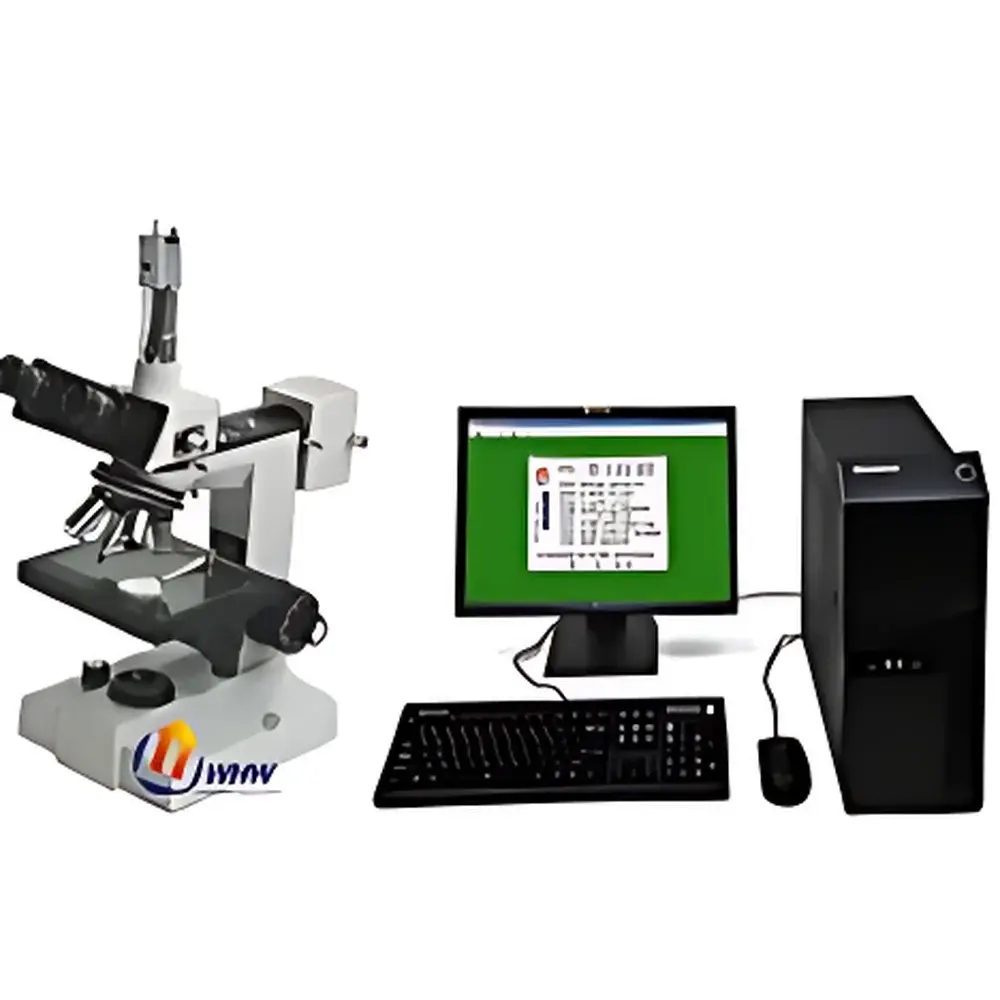
YANRUN AMM-200T Trinocular Upright Metallurgical Microscope with Image Processing Capability
| Brand | YANRUN |
|---|---|
| Origin | Shanghai, China |
| Manufacturer Type | Direct Manufacturer |
| Origin Category | Domestic (China) |
| Model | AMM-200T |
| Microscope Type | Upright (not inverted) |
| Image Analysis System | Optional (not standard) |
| Eyepieces | Widefield 10× (18 mm field number), Widefield 16× (11 mm field number) |
| Objectives | Plan Achromatic, Cover-Slip-Free: 4×/NA 0.10, 10×/NA 0.25, 40×/NA 0.65 (Spring-Loaded), 63×/NA 0.85 (Spring-Loaded, Oil Immersion Optional) |
| Mechanical Stage | 160 × 130 mm, Travel Range 76 × 50 mm, Vernier Scale Resolution 0.1 mm |
| Nosepiece | Ball-Bearing Mounted Quadruple Revolving Nosepiece |
| Focus Mechanism | Coaxial Coarse/Fine Adjustment, Total Travel 40 mm, Fine Focus Graduation 2 µm |
| Illumination | Reflected (Epi-) Illuminator with 6 V / 20 W Halogen Lamp, Dual Voltage Input (110 V / 220 V), Adjustable Brightness, Filter Set (Pale Blue, Pale Green) |
Overview
The YANRUN AMM-200T is a precision-engineered trinocular upright metallurgical microscope designed for high-fidelity microstructural analysis of polished metallographic specimens, ceramics, composites, and other opaque, reflective materials. Unlike inverted configurations optimized for bulk sample handling, the AMM-200T’s upright optical architecture positions the objective lenses above the specimen—enabling direct access to large or irregularly shaped samples mounted on standard metallographic slides or holders. Its optical path follows Köhler illumination principles, ensuring uniform, glare-free epi-illumination critical for quantitative phase identification, grain boundary delineation, inclusion analysis, and defect characterization. The system supports both visual observation via dual eyepieces and simultaneous digital imaging through its dedicated trinocular port, which maintains parfocality and photometric consistency across all magnifications. All optical components—including plan achromatic objectives and widefield eyepieces—are corrected for flat-field performance and minimal chromatic aberration, meeting ISO 10934-1 standards for metallurgical microscopy.
Key Features
- Trinocular head with 30° inclined viewing tube and interpupillary adjustment (55–75 mm), enabling ergonomic long-duration operation and seamless integration with CCD/CMOS cameras
- Four-position ball-bearing nosepiece ensures precise, repeatable objective alignment and mechanical stability during repeated switching between magnifications
- Coaxial coarse/fine focusing mechanism with 40 mm vertical travel and 2 µm fine-focus graduation—engineered for high reproducibility in depth-of-field-critical applications such as layered coating thickness measurement
- Reflected-light illumination system with voltage-compatible halogen lamp (6 V / 20 W), continuously adjustable intensity control, and interchangeable interference filters (pale blue, pale green) to enhance contrast for specific material phases
- Large mechanical stage (160 × 130 mm) with vernier-scaled X-Y translation (76 × 50 mm range, 0.1 mm resolution), supporting standardized ASTM E3 and ISO 643 specimen mounting protocols
- Plan achromatic objectives optimized for cover-slip-free use—eliminating refractive index mismatch errors common in metallography where specimens are typically polished bare-metal surfaces
Sample Compatibility & Compliance
The AMM-200T accommodates standard 25 mm and 50 mm diameter metallographic mounts, as well as custom-sized specimens up to 130 mm in width. Its upright configuration permits unobstructed access for etchant application, microhardness testing integration, and post-polish surface inspection without repositioning. The microscope complies with key international standards governing metallurgical evaluation: ASTM E3 (Standard Guide for Preparation of Metallographic Specimens), ASTM E112 (Standard Test Methods for Determining Average Grain Size), ISO 643 (Steel—Micrographic Determination of the Content of Non-Metallic Inclusions), and EN 10247 (Non-Destructive Testing—Metallographic Examination of Steel Castings). While not inherently GLP/GMP-certified, the system supports audit-ready documentation when paired with validated image acquisition software meeting FDA 21 CFR Part 11 requirements for electronic records and signatures.
Software & Data Management
The AMM-200T does not include embedded image analysis software; however, its trinocular port is optically calibrated for compatibility with third-party metrology-grade imaging platforms—including Olympus cellSens, Zeiss ZEN, and open-source solutions such as ImageJ/Fiji with appropriate camera drivers. When configured with optional digital imaging modules (e.g., 5 MP USB 3.0 CMOS camera), users can perform automated particle counting, grain size distribution analysis per ASTM E112, phase area fraction quantification, and hardness impression measurement. All exported image metadata (magnification, objective ID, exposure time, calibration scale) is preserved in TIFF or OME-TIFF formats to ensure traceability in quality control workflows compliant with ISO/IEC 17025 laboratory accreditation criteria.
Applications
- Quality assurance of heat-treated alloys, weld zones, and additive-manufactured metallic components
- Failure analysis of fractured surfaces, corrosion products, and intergranular cracking mechanisms
- Routine microstructure verification in foundries, aerospace component suppliers, and nuclear materials testing labs
- Research-level investigation of precipitate morphology, martensitic transformation kinetics, and oxide scale growth behavior
- Educational use in materials science laboratories for teaching metallographic preparation techniques and quantitative microstructural interpretation
FAQ
Is the AMM-200T suitable for fluorescence imaging?
No—this model lacks excitation filter cubes, dichroic mirrors, or high-sensitivity emission optics required for fluorescence microscopy. It is strictly configured for brightfield reflected-light observation.
Can oil immersion objectives be used with this microscope?
Yes—the 63×/NA 0.85 objective is spring-loaded and compatible with immersion oil (Type F, n = 1.518); a 100× oil objective is available as an optional upgrade.
What is the maximum specimen height clearance under the objective turret?
Approximately 32 mm from stage surface to lowest objective front lens at 4× magnification—sufficient for most standard metallographic mounts and low-profile fixtures.
Does the system support motorized stage or autofocus functions?
Not natively. These capabilities require external integration with OEM-compatible motorized stages or focus controllers, which must be calibrated independently.
How is calibration maintained across different objective magnifications?
Each objective is factory-aligned for parfocality and parcentricity; users perform stage micrometer-based pixel-to-micron calibration per objective using the trinocular output—recommended before each analytical session per ISO/IEC 17025 Clause 6.4.10.



