
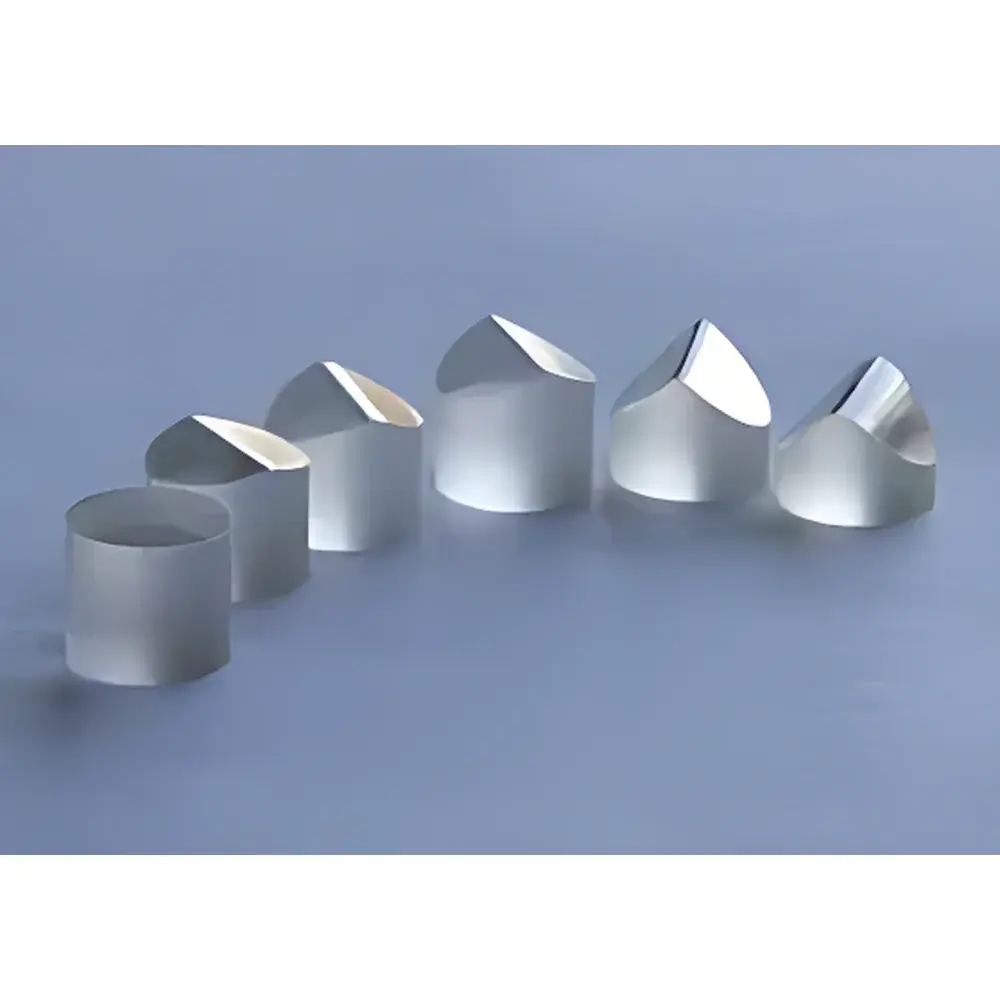
Powell Lens
| Brand | SPL Photonics |
|---|---|
| Origin | Zhejiang, China |
| Manufacturer Type | Authorized Distributor |
| Product Origin | Domestic (China) |
| Model | Powell Lens |
| Pricing | Upon Request |
Overview
The SPL Photonics Powell Lens is a precision-engineered optical line-generating element designed to transform Gaussian-profile laser beams into highly uniform, straight-line illumination with exceptional edge-to-edge intensity consistency. Unlike conventional cylindrical lenses—which produce non-uniform lines characterized by a central intensity peak and rapid falloff at the edges—the Powell lens employs a proprietary two-dimensional aspheric top surface that deliberately introduces controlled spherical aberration. This engineered wavefront distortion redistributes optical energy from the beam center toward the periphery, yielding a near-top-hat intensity profile across the projected line. The underlying principle relies on geometric ray mapping through a wedge-shaped, rotationally symmetric non-spherical facet, enabling deterministic light redistribution without diffraction-limited constraints. This makes the Powell lens particularly suitable for metrology-critical applications in machine vision, 3D structured-light scanning, alignment guidance, and automated optical inspection where line uniformity, straightness, and repeatability directly impact measurement fidelity.
Key Features
- Engineered aspheric top surface optimized for Gaussian-to-uniform line conversion with >80% ±5% intensity uniformity over the central 80% of line length
- Line straightness deviation < 0.1% over 80% of effective line length; aperture error < 3 mrad when properly aligned
- Available standard diameters: 6 mm and 8.9 mm; fan angles spanning 1° to 90°, selected based on substrate refractive index (n = 1.5 for low-angle variants; n = 1.8 high-index glass for wide-angle configurations)
- Custom design capability—including non-standard fan angles, substrate materials (e.g., fused silica, SF10), AR coatings (R < 0.25% @ specified λ), and mechanical mounting interfaces—with low one-time NRE cost
- Optimized for collimated or near-collimated input beams; performance sensitive to incident beam diameter, divergence, and alignment orthogonality relative to the prism apex
- Robust monolithic architecture with no moving parts, ensuring long-term stability under thermal cycling and mechanical vibration typical in industrial environments
Sample Compatibility & Compliance
The Powell lens is compatible with continuous-wave (CW) and pulsed laser sources operating across visible (405–670 nm), near-infrared (780–1064 nm), and select UV wavelengths—subject to appropriate substrate material selection and anti-reflection coating specification. It requires precise mechanical mounting to maintain beam orthogonality; misalignment >1° induces measurable line curvature and positional offset. While not a regulated medical device, its performance characteristics align with requirements outlined in ISO 10110-3 (optical component surface form tolerances) and ISO 11146-1 (laser beam width and divergence measurements). For integration into FDA-regulated instrumentation (e.g., surgical guidance systems or analytical instruments), full traceability of substrate certification, coating spectral data, and dimensional inspection reports can be provided upon request to support GLP/GMP documentation workflows.
Software & Data Management
The Powell lens operates as a passive optical component and does not incorporate embedded firmware, connectivity, or onboard data logging. Its integration into automated systems relies entirely on external optical design software (e.g., Zemax OpticStudio, CODE V) for ray-tracing validation and system-level performance modeling. SPL Photonics provides comprehensive technical documentation—including measured far-field line profiles, M²-compatible beam propagation data, and angular dispersion curves—for each standard and custom lens variant. All specifications are delivered in standardized CSV and PDF formats compatible with LIMS and PLM platforms. For customers implementing automated alignment stations or in-line calibration routines, SPL supports integration via detailed mechanical drawings (GD&T-compliant STEP files) and spectral transmission datasets usable in MATLAB or Python-based optical simulation pipelines.
Applications
- Machine vision-based 3D profilometry and triangulation sensors in automotive body-in-white inspection and battery electrode thickness monitoring
- Real-time alignment guidance in semiconductor wafer handling, PCB component placement, and robotic welding seam tracking
- Uniform line illumination for fluorescence excitation in high-throughput bioimaging platforms and flow cytometry systems
- Food processing line inspection—e.g., fill-level verification, foreign object detection, and package seal integrity assessment—where consistent line contrast is essential for sub-pixel edge detection
- Calibration reference elements in coordinate measuring machines (CMMs) and laser tracker systems requiring traceable straight-line artifacts
FAQ
What determines the optimal fan angle for my application?
Fan angle selection depends on working distance, required line length, and allowable spot size at the target plane. Larger fan angles yield shorter focal lines at fixed distances but demand higher input beam quality and tighter alignment tolerances.
Can the Powell lens be used with multimode or fiber-coupled lasers?
Yes—provided the output beam is spatially filtered or collimated to achieve M² < 1.3 and divergence < 1 mrad. Fiber-coupled sources require careful mode conditioning to avoid non-uniform line generation due to modal interference.
How does beam diameter affect line thickness and depth of field?
Input beam diameter directly governs line thickness: narrow-diameter input yields shallow depth of field and thinner lines; wider input increases DOF and line thickness proportionally. Alignment orientation (beam major axis parallel vs. perpendicular to prism apex) further modulates these parameters.
Is AR coating included as standard?
Standard units feature broadband AR coating for 400–700 nm. Custom coatings—including dual-band, NIR-specific, or ultra-low-reflectance (<0.1%) variants—are available with lead time adjustment.
Do you provide test reports for individual units?
Yes—each lens ships with a certificate of conformance including measured line uniformity profile, fan angle verification, surface quality (scratch-dig per MIL-PRF-13830B), and transmitted wavefront error (TWE) data.



