
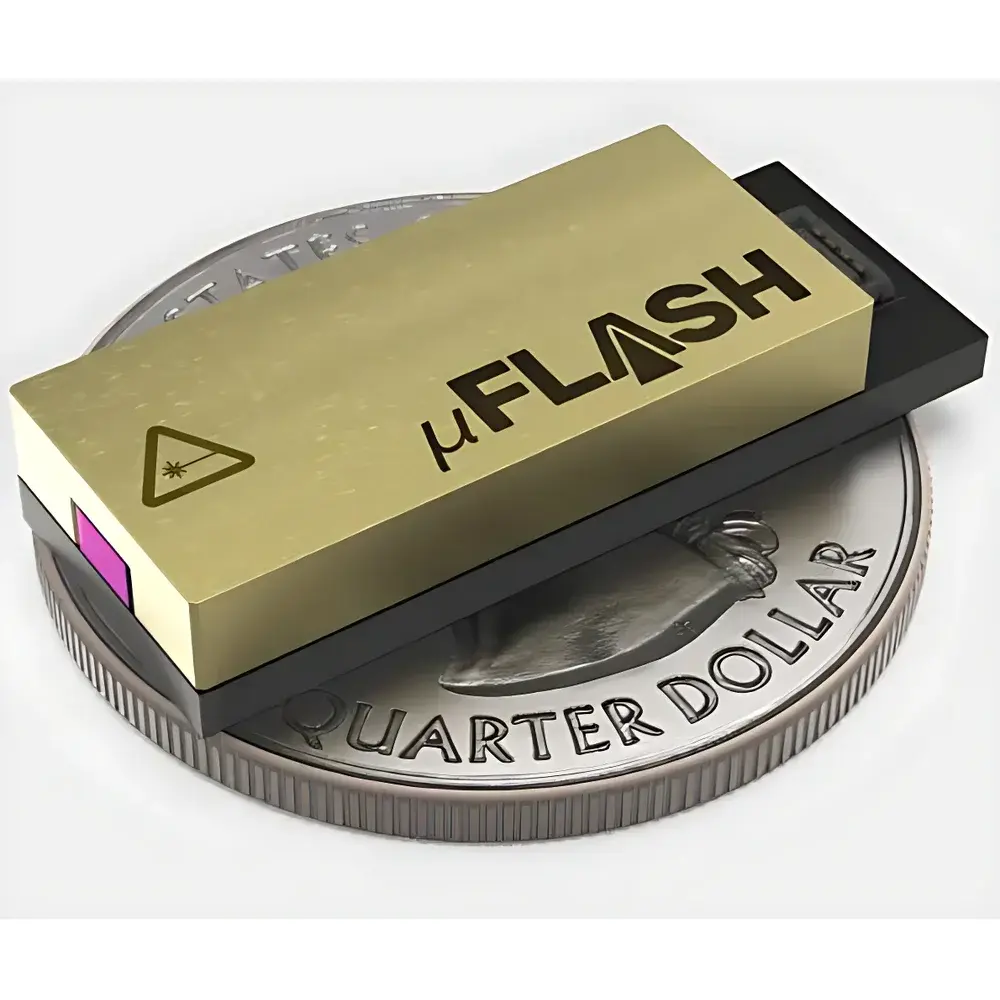
Integrated Optics Flash-Series Ultra-Compact Passively Q-Switched Picosecond Laser 1030U-11C
| Brand | Integrated Optics |
|---|---|
| Wavelength | 1030 ± 2 nm |
| Average Output Power | 20 mW |
| Pulse Width | < 900 ps |
| Repetition Rate | < 100 Hz (pulse-on-demand), burst mode up to higher rates |
| Peak Power | > 300 kW |
| Pulse Energy | < 250 µJ |
| Spectral Bandwidth | < 1 nm |
| Beam Mode | TEM₀₀ |
| Pulse Stability | < 10% RMS |
| Operating Voltage | +5 V DC |
| Dimensions | 50 × 30 × 18 mm |
| Cooling | Integrated TEC |
| Compliance | RoHS, CE-marked for industrial OEM integration |
Overview
The Integrated Optics Flash-Series 1030U-11C is an ultra-compact, passively Q-switched picosecond laser engineered for demanding OEM integration in portable and space-constrained photonic systems. Operating at a center wavelength of 1030 ± 2 nm with a near-diffraction-limited TEM₀₀ spatial profile, it delivers sub-nanosecond optical pulses (< 900 ps FWHM) generated via semiconductor saturable absorber mirror (SESAM)-based passive Q-switching within a monolithic DPSS architecture. Its core design principle centers on minimizing form factor without compromising pulse fidelity—achieving peak powers exceeding 300 kW and single-pulse energies up to 250 µJ—enabling high signal-to-noise ratio time-of-flight measurements, laser-induced breakdown spectroscopy (LIBS), and nonlinear excitation applications where temporal resolution and photon density are critical. Unlike conventional bulk or fiber-based picosecond sources, the 1030U-11C integrates the gain medium, saturable absorber, thermal management (TEC), and drive electronics into a single 50 × 30 × 18 mm package powered exclusively by +5 V DC—eliminating the need for high-voltage drivers or external chillers.
Key Features
- Ultra-compact footprint (50 × 30 × 18 mm) optimized for embedded integration in handheld, wearable, and UAV-mounted instrumentation
- Passively Q-switched solid-state architecture with SESAM for intrinsic pulse stability and long-term reliability without active modulation complexity
- Two operational modes: precise pulse-on-demand triggering (≤100 Hz) and thermally managed burst mode for enhanced duty-cycle flexibility
- Integrated thermoelectric cooler (TEC) with overheat protection circuitry ensures wavelength and pulse energy stability across ambient temperatures from 15–35 °C
- Digital TTL and analog modulation inputs support synchronization with external detectors, scanners, or data acquisition systems
- Standard SMA905 or FC/PC fiber coupling options available (SM, PM, or MM), enabling seamless interfacing with spectrometers, interferometers, or scanning optics
- Automatic power control (APC) loop maintains constant average output under varying thermal load or supply voltage fluctuations
- RoHS-compliant construction and CE marking align with EU directives for industrial equipment safety and electromagnetic compatibility (EMC)
Sample Compatibility & Compliance
The 1030U-11C is designed for direct integration into analytical and sensing platforms requiring robust, low-SWaP (Size, Weight, and Power) pulsed excitation. Its 1030 nm emission falls within the eye-safe region (Class 1M per IEC 60825-1:2014 when properly collimated and attenuated), making it suitable for field-deployable LIBS, standoff LIDAR, and biomedical imaging systems. While not certified for medical device use under FDA 21 CFR Part 820, its electrical and thermal behavior conforms to IEC 61000-6-2 (immunity) and IEC 61000-6-4 (emissions) standards. For GLP/GMP-aligned applications—including environmental monitoring and material identification—the laser supports traceable trigger logging and can be synchronized with timestamped spectral acquisition hardware compliant with ASTM E1712 and ISO/IEC 17025 data integrity requirements.
Software & Data Management
Integrated Optics provides a vendor-neutral USB-C interface with ASCII command protocol (SCPI-compatible) for full remote control of pulse mode selection, repetition rate setting, and internal diagnostics. The included Windows/Linux-compatible GUI enables real-time monitoring of diode current, TEC temperature, and output power history—exportable as CSV for audit trails. No proprietary runtime or license keys are required; all communication layers are open and documented for integration into LabVIEW, Python (PySerial), or MATLAB environments. Firmware updates preserve backward compatibility and include built-in checksum verification to ensure configuration integrity—a prerequisite for validated instrument workflows under ISO 9001 or FDA 21 CFR Part 11–aligned systems where electronic records must demonstrate authenticity and non-repudiation.
Applications
- Laser Radar & Time-of-Flight Sensing: Sub-300 ps pulse width enables millimeter-level spatial resolution in compact 3D mapping systems; high peak power extends effective range beyond 100 m in atmospheric conditions
- Portable LIBS Systems: Sufficient pulse energy and spectral purity enable elemental ablation and plasma excitation in handheld analyzers for alloy verification, soil analysis, and cultural heritage diagnostics
- Nonlinear Microscopy: Compatible with two-photon excited fluorescence (TPEF) and second-harmonic generation (SHG) when frequency-doubled using external BBO or LBO crystals
- Raman Excitation: Narrow spectral bandwidth (<1 nm) minimizes fluorescence background in fiber-coupled Raman probes for pharmaceutical QC and polymer characterization
- Optical Time-Domain Reflectometry (OTDR): Used as a seed source in amplified OTDR configurations for fault localization in multimode and single-mode telecom fibers
- Ultrafast Pump-Probe Experiments: Serves as a stable, turnkey pump source in tabletop transient absorption setups requiring synchronization jitter < 50 ps
FAQ
What is the maximum achievable burst duration in burst mode?
Burst duration is thermally limited; typical operation sustains ≥1 s at full repetition rate. With active heatsinking (e.g., copper baseplate + forced air), bursts exceeding 5 s have been demonstrated in laboratory validation—subject to ambient temperature and duty cycle constraints.
Is the 1030U-11C compatible with standard fiber-optic spectrometers?
Yes—when coupled via SMF-28 or HI1060 single-mode fiber, it delivers diffraction-limited beam quality suitable for grating-based spectrometers with input slits ≥25 µm. Optional collimation optics are available to match NA requirements.
Does the laser support external clock synchronization?
It accepts TTL-level external triggers with ≤10 ns jitter and supports programmable delay (0–100 ms) relative to trigger edge—enabling lock-in detection and gated acquisition protocols.
Can output power be modulated in analog mode?
Yes—0–5 V analog input adjusts average power linearly between 10–100% of rated output while preserving pulse shape and timing integrity.
What calibration documentation is provided?
Each unit ships with a factory test report including measured pulse width (autocorrelator trace), spectral centroid, M² factor, pulse energy histogram (1k-shot RMS stability), and thermal drift profile across operating temperature range. NIST-traceable power meter calibration certificates are available upon request.



