
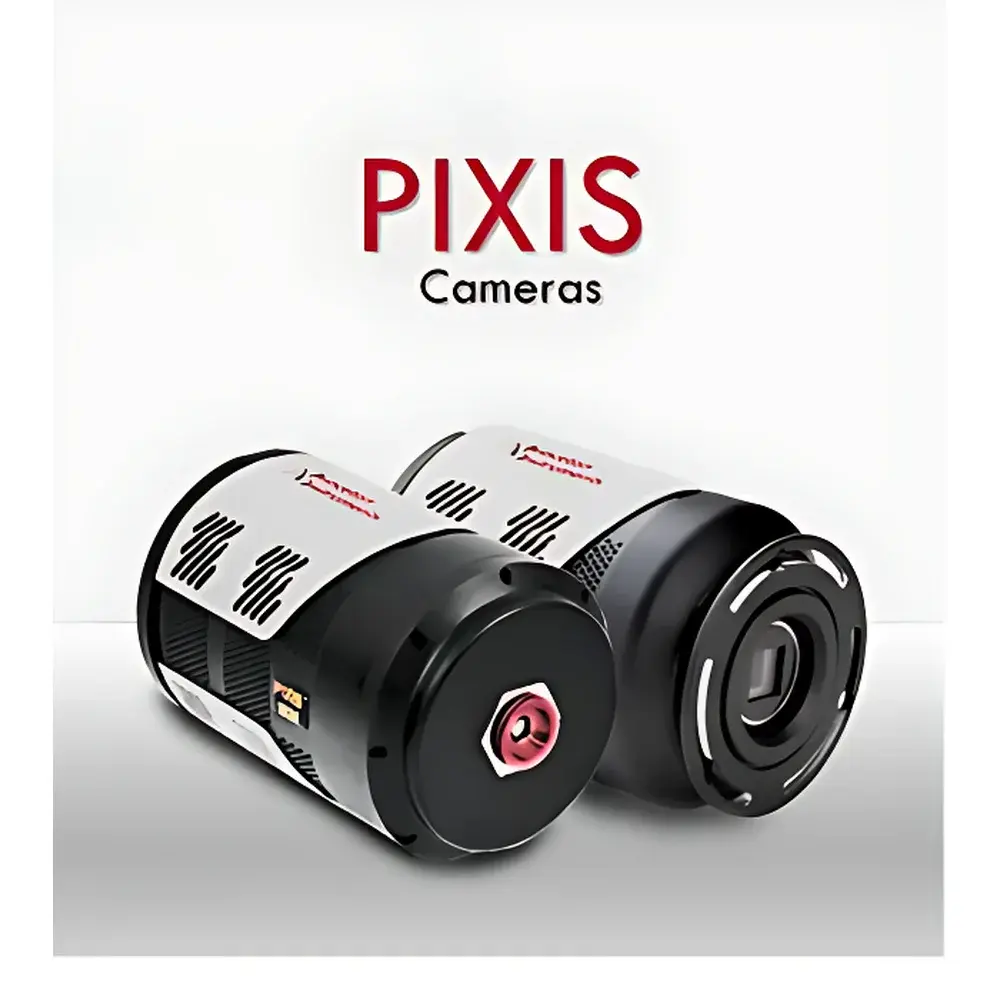
Princeton Instruments PIXIS Series Scientific CCD Cameras (Imaging & Spectroscopy Models)
| Brand | Princeton Instruments / Teledyne Princeton Instruments |
|---|---|
| Origin | USA |
| Camera Formats | 512×512 to 2048×2048 |
| Pixel Sizes | 13×13 µm, 13.5×13.5 µm, 20×20 µm, 24×24 µm, 26×26 µm |
| Spectral Range | 180–1100 nm |
| Cooling | Vacuum-sealed, thermoelectrically cooled to –90 °C |
| Readout | Dual-amplifier architecture (low-noise & high-dynamic-range modes) |
| Interface | High-speed USB 2.0 (2 MHz max readout rate) |
| Data Depth | True 16-bit digitization |
| QE | Up to 95% (eXcelon-enhanced back-illuminated deep depletion sensors) |
| Software | LightField 64-bit platform with IntelliCal wavelength/intensity calibration, PICAM API, LabVIEW/MATLAB/EPICS compatibility |
Overview
The Princeton Instruments PIXIS Series represents a benchmark in scientific-grade CCD imaging and spectroscopy instrumentation. Engineered for precision photon detection across demanding low-light applications, the PIXIS platform leverages back-illuminated (BI), back-illuminated deep-depletion (BIDD), and front-illuminated (FI) sensor architectures — each optimized for distinct spectral and dynamic requirements. Its core measurement principle relies on charge accumulation in silicon photodiodes under controlled integration times, followed by low-noise correlated double sampling (CDS) readout and 16-bit analog-to-digital conversion. The proprietary eXcelon process — a thin-film anti-etaloning coating applied to BI and BIDD sensors — significantly suppresses interference fringes in the near-infrared (700–1100 nm), while simultaneously enhancing quantum efficiency (QE) in both UV (180–250 nm) and NIR bands. All PIXIS models feature a hermetically sealed all-metal vacuum enclosure, enabling stable, maintenance-free operation with lifetime vacuum integrity — a critical requirement for long-exposure astronomical imaging, time-resolved fluorescence, and ultra-low-signal Raman experiments.
Key Features
- Full-metal vacuum housing with lifetime vacuum warranty — eliminates outgassing and ensures thermal stability during extended integrations
- eXcelon technology: proprietary anti-etaloning coating delivering >95% peak QE in UV and NIR without spectral artifacts
- Multi-sensor architecture support: BIDD (deep depletion), BI (standard back-illuminated), BUV (UV-enhanced), and FI (cost-optimized visible-NIR)
- Dual-readout amplifier design: selectable low-noise mode (sub-3 e⁻ RMS read noise) and high-dynamic-range mode (up to 100,000 e⁻ full well capacity)
- Thermoelectric cooling to –90 °C (air- or water-cooled variants available), reducing dark current to <0.001 e⁻/pixel/sec at –80 °C
- True 16-bit digitization with up to 2 MHz pixel readout speed via USB 2.0 — no frame-grabber required
- 100% fill factor across all pixel geometries (13×13 µm to 26×26 µm), preserving spatial resolution and photon collection efficiency
Sample Compatibility & Compliance
PIXIS cameras are compatible with standard C-mount, F-mount, and direct-coupled spectrograph interfaces (e.g., Acton, IsoPlane, SpectraPro). Sensor configurations support both imaging (wide-field, confocal, TERS, BEC imaging) and dispersive spectroscopy (Raman, fluorescence, absorption) workflows. The system complies with international standards for scientific instrumentation: ISO 14644-1 Class 5 cleanroom assembly, RoHS-compliant materials, and CE/FCC certification. For regulated environments, LightField software supports audit-trail-enabled acquisition (21 CFR Part 11 compliant when deployed with appropriate IT controls), GLP/GMP-aligned metadata tagging (timestamp, exposure, temperature, gain, calibration state), and traceable IntelliCal wavelength/intensity calibration per NIST-traceable sources.
Software & Data Management
LightField — Princeton Instruments’ native 64-bit acquisition and analysis platform — provides intuitive, scriptable control of all hardware parameters. Its integrated mathematical engine enables real-time spectral deconvolution, background subtraction, line profiling, and multi-region-of-interest (ROI) quantification. The PICAM SDK (64-bit C/C++/Python API) allows full programmatic access to camera registers, trigger logic, and streaming buffers — facilitating integration into custom automation frameworks. Native drivers ensure seamless interoperability with LabVIEW (NI-IMAQdx), MATLAB (Image Acquisition Toolbox), and EPICS-based synchrotron or telescope control systems. All acquired data is saved in vendor-neutral HDF5 format with embedded metadata (EXIF-style headers), ensuring long-term archival compliance and third-party analysis readiness.
Applications
- Tip-Enhanced Raman Spectroscopy (TERS): Sub-diffraction-limited spatial resolution enabled by high QE and low read noise at 532/633 nm excitation wavelengths
- Bose-Einstein Condensate (BEC) Imaging: Single-shot absorption imaging with sub-10 ms gate timing and shot-noise-limited contrast at 780 nm
- Astronomical Photometry: Long-exposure (>30 min), drift-scanned imaging with <0.1% pixel-to-pixel non-uniformity after flat-field correction
- Surface-Enhanced Raman Scattering (SERS): Detection of attomolar analyte concentrations using EMCCD-compatible low-light acquisition protocols
- Fluorescence Lifetime Imaging (FLIM): Time-gated acquisition synchronized to pulsed lasers (via external TTL input) with <10 ns temporal jitter
- Micro-CT Reconstruction: High-SNR projection datasets acquired at 0.5–5 µm voxel resolution using scintillator-coupled configurations
FAQ
What sensor types are available in the PIXIS series?
PIXIS offers front-illuminated (FI), back-illuminated (BI), back-illuminated deep-depletion (BIDD), and UV-enhanced (BUV) CCD sensors — each selected for optimal QE, etaloning suppression, and spectral coverage.
How does eXcelon technology improve performance over conventional back-illuminated CCDs?
eXcelon applies a precisely tuned dielectric stack to eliminate Fabry-Pérot interference fringes in the NIR while increasing absolute QE by up to 25% in the 300–400 nm band and maintaining >90% QE from 600–900 nm.
Is LightField software validated for use in regulated pharmaceutical or clinical research environments?
Yes — when deployed with documented IT validation protocols (including user access control, electronic signature, and audit trail activation), LightField meets FDA 21 CFR Part 11 and EU Annex 11 requirements for electronic records and signatures.
Can PIXIS cameras be synchronized with external laser pulse trains or shutter systems?
All models support hardware triggering via TTL, LVDS, or optical inputs with programmable delay (10 ns resolution) and gate width control — essential for pump-probe, time-resolved luminescence, and gated ICCD emulation.
What cooling options are supported, and how does cooling stability affect quantitative accuracy?
Air-cooled and water-cooled variants achieve stable –90 °C sensor temperatures; thermal drift <0.02 °C/hour ensures dark current repeatability within ±0.5% over 12-hour acquisitions — critical for radiometric calibration and inter-session comparability.





