
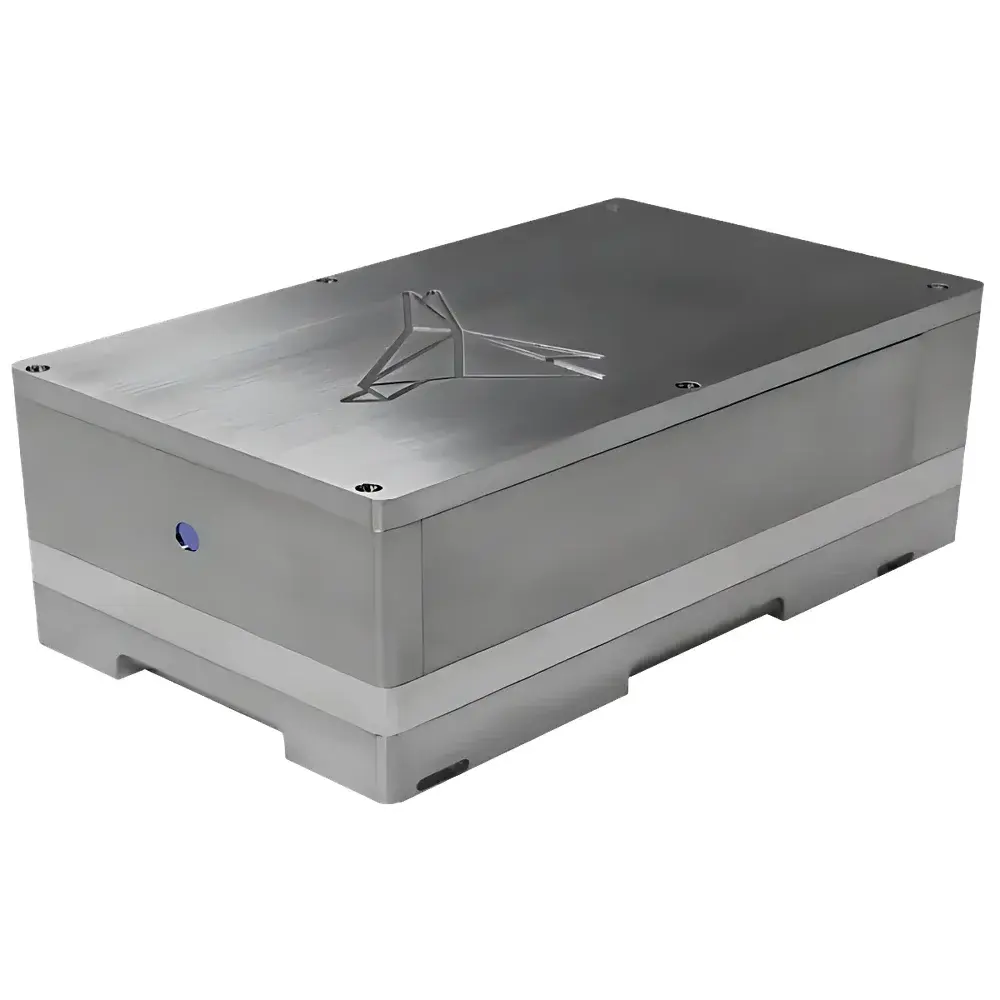
Skylark Lasers 320NX Single-Frequency Continuous-Wave C-DPSS Ultraviolet Laser
| Brand | Skylark Lasers |
|---|---|
| Origin | United Kingdom |
| Model | 320NX |
| Central Wavelength | 320 nm |
| Output Power | Up to 200 mW (fixed within operating range) |
| Spectral Bandwidth | < 0.5 MHz |
| Spatial Mode | TEM₀₀ |
| Operation Mode | CW, Single Longitudinal Mode (SLM) |
| Spectral Stability (8 h) | ±0.2 pm |
| Power Stability (8 h, P-P) | ≤ 2% |
| Intensity Noise (10 Hz–10 MHz) | ≤ 0.1% RMS |
| Beam Diameter (exit aperture) | 0.6–1.2 mm |
| Beam Divergence | 1.0 mrad (diffraction-limited) |
| Beam Pointing Stability | ≤ 5 µrad/°C |
| Coherence Length | > 100 m |
| Polarization Ratio | ≥ 100:1 (vertical) |
| Laser Head Dimensions | 240 × 150 × 100 mm |
| Controller Dimensions | 238 × 170 × 54 mm |
| Warm-up Time | 5–30 min |
| Power Consumption | < 200 W |
| Beam Height | 65 mm |
| Operating Temperature | 18–30 °C (laser head stability ±1.5 °C) |
| Storage Temperature | 0–50 °C |
| Humidity | 0–50% RH (non-condensing) |
| Cooling Options | Fan-assisted heatsink or water-cooled TEC |
| Interface | USB (plug-and-play), optional external analog modulation (0–10 V), AOM-compatible up to 200 kHz |
Overview
The Skylark Lasers 320NX is a high-performance, single-frequency continuous-wave (CW) ultraviolet (UV) laser engineered for applications demanding exceptional spectral purity, long-term power stability, and diffraction-limited beam quality. Built upon Skylark’s proprietary BRaMMS™ (Broadband Resonator with Monolithic Mode Selection) platform, the 320NX leverages compact diode-pumped solid-state (C-DPSS) architecture to generate stable, narrow-linewidth UV light at 320 nm—enabling precision optical metrology, quantum optics experiments, and high-resolution spectroscopic techniques where conventional UV sources lack coherence or stability.
Unlike multi-mode or broadband UV sources, the 320NX operates exclusively in single longitudinal mode (SLM), delivering sub-0.5 MHz spectral bandwidth and coherence lengths exceeding 100 meters. Its monolithic resonator design eliminates mechanical drift pathways, ensuring intrinsic robustness against environmental perturbations—a critical requirement for interferometric alignment, holographic recording, and Brillouin scattering setups. The system integrates a thermally stabilized Nd:YAG/KTP-based frequency-doubling architecture optimized for UV output with minimal thermal lensing and long-term wavelength fidelity.
Key Features
- Single-frequency CW output at 320 nm with 100 m coherence length
- Ultra-stable spectral performance: ±0.2 pm drift over 8 hours under controlled ambient conditions
- High power stability: ≤2% peak-to-peak variation over 8-hour continuous operation
- Low-intensity noise: ≤0.1% RMS (10 Hz–10 MHz), suitable for photon-counting and lock-in detection
- TEM00 spatial profile with M² < 1.1, beam divergence of 1.0 mrad (diffraction-limited)
- Compact, modular design: laser head (240 × 150 × 100 mm) and separate controller (238 × 170 × 54 mm)
- USB-enabled plug-and-play interface with full remote diagnostics and firmware-upgradable control software
- Thermally isolated laser head with ±1.5 °C internal stabilization, supporting GLP-compliant operation
- Optional analog modulation input (0–10 V) and AOM integration for intensity control up to 200 kHz
Sample Compatibility & Compliance
The 320NX is designed for integration into regulated and research-grade optical platforms requiring traceable, repeatable UV excitation. Its fixed-wavelength, low-noise output ensures compatibility with fluorescence lifetime imaging (FLIM), Raman shift calibration standards (e.g., NIST-traceable polystyrene beads), and semiconductor wafer inspection protocols aligned with SEMI F20 and ISO 10110-7. The laser meets IEC 60825-1:2014 Class 3B safety requirements when operated with appropriate interlocks and beam enclosures. All firmware and software logs support audit trails compliant with FDA 21 CFR Part 11 for electronic records in GMP environments. Thermal management options—including fan-assisted heatsinks and closed-loop chiller integration—enable deployment in cleanroom settings (ISO Class 5–7) without compromising wavelength or power stability.
Software & Data Management
The bundled Skylark Control Suite provides cross-platform (Windows/macOS/Linux) GUI and command-line interfaces for real-time monitoring of laser parameters—including output power, cavity temperature, pump diode current, and internal sensor diagnostics. All operational data are timestamped and exportable in CSV or HDF5 format for post-acquisition analysis. The software supports programmable power ramping, scheduled on/off cycles, and event-triggered logging—essential for automated metrology workflows. Remote access via Ethernet (optional module) enables centralized fleet management across multi-lab installations. Firmware updates preserve configuration integrity and include version-controlled rollback capability, satisfying ISO/IEC 17025 requirements for instrument validation documentation.
Applications
- High-resolution Raman spectroscopy: Enables detection of low-cross-section vibrational modes in pharmaceutical crystallinity analysis and 2D material characterization
- Confocal and STED microscopy: Provides diffraction-limited excitation for sub-200 nm resolution imaging of UV-fluorescent probes (e.g., DAPI, Hoechst)
- Semiconductor metrology: Supports mask inspection, photomask defect review, and EUV lithography source development through stable UV illumination
- Quantum optics: Serves as a coherent pump source for SPDC-based entangled photon generation and atomic vapor cell cooling at UV transitions
- Holographic data storage: Delivers phase-stable writing beams for high-density optical memory fabrication
- Flow cytometry and microfluidic cytometry: Enables multiparameter UV-excited fluorescence detection with minimized photobleaching
- Grating master fabrication: Powers interference lithography systems requiring long-coherence-length UV exposure
FAQ
What is the typical warm-up time required to achieve full spectral and power stability?
The 320NX achieves operational stability within 5–30 minutes depending on ambient thermal conditions; full specification compliance (±0.2 pm, ≤2% P-P) is guaranteed after 30 minutes of continuous operation.
Can the 320NX be fiber-coupled, and what coupling efficiencies are achievable?
Yes—optional fiber coupling is available. Multimode fiber coupling efficiency exceeds 95%; single-mode coupling achieves >70% with proper mode-matching optics.
Is the laser compatible with vacuum or controlled-atmosphere environments?
The laser head is fully sealed and rated for operation in non-condensing environments (0–50% RH); direct vacuum integration requires custom feedthroughs and is not supported out-of-the-box.
Does the system support external modulation, and what bandwidth is available?
Analog modulation input (0–10 V) is standard; optional acousto-optic modulator (AOM) integration supports intensity modulation up to 200 kHz.
What cooling methods are supported, and how do they impact long-term stability?
Fan-assisted passive cooling suffices for lab environments; closed-loop water cooling improves power stability to ≤1% P-P over 24 hours and extends diode lifetime by reducing thermal cycling stress.





