
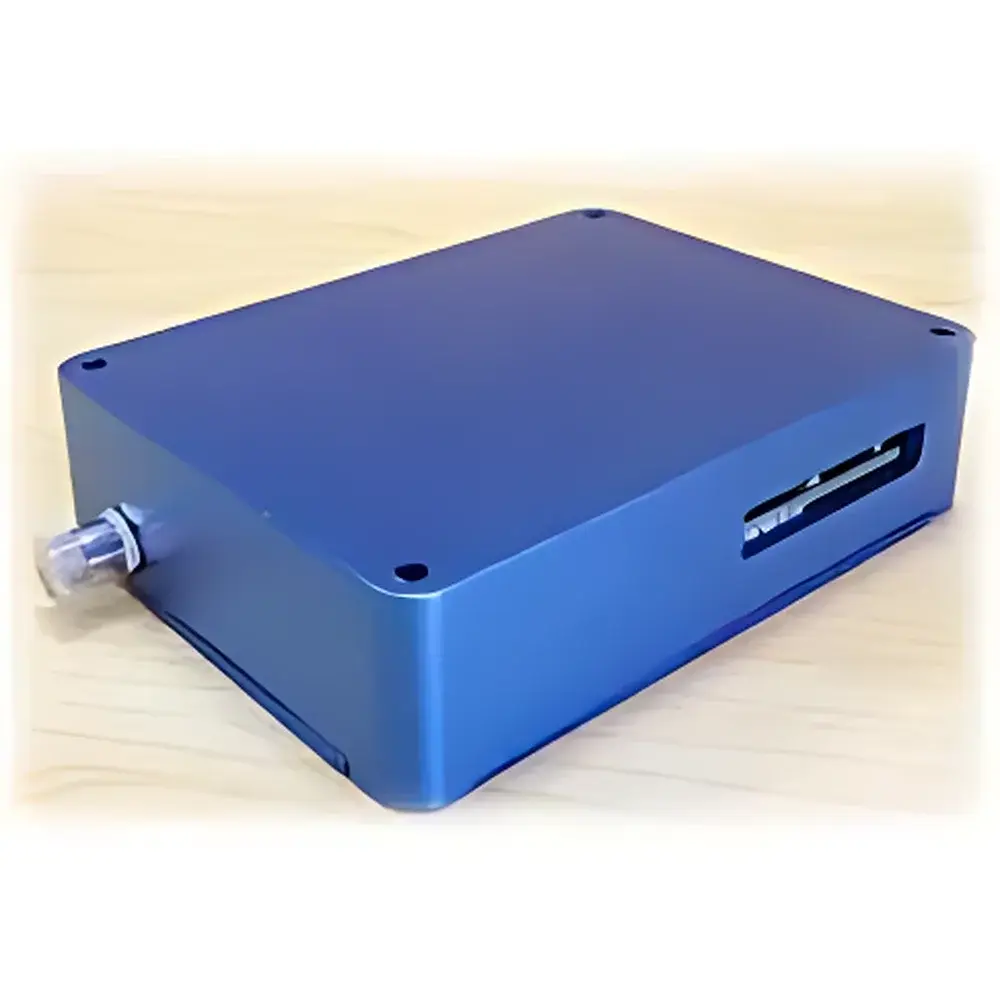
SPL Laser-785-500-OEM Diode-Pumped Solid-State (DPSS) Raman Laser Module
| Brand | SPL |
|---|---|
| Wavelength | 785 nm |
| Output Power | up to 500 mW |
| Beam Delivery | Free-space or SMA905-coupled fiber (100 µm VIS-NIR core) |
| Coupling Efficiency | >75% |
| Spectral Stability | <±0.05 nm (over 8 hrs, 25°C ambient) |
| Power Stability | <±1.5% RMS (8 hrs) |
| Linewidth | <0.1 nm (FWHM) |
| TEC Temperature Control | ±0.1°C setpoint accuracy |
| Operating Temperature Range | 15–35°C |
| Dimensions | 120 × 80 × 45 mm |
| Compliance | CDRH Class IIIb (OEM configuration), RoHS, CE |
Overview
The SPL Laser-785-500-OEM is a compact, OEM-optimized diode-pumped solid-state (DPSS) laser module engineered specifically for high-fidelity Raman spectroscopy applications. Operating at a precisely stabilized 785 nm wavelength—optimal for minimizing fluorescence interference in organic and biological samples—the module leverages intracavity frequency-doubling of a Nd:YVO₄ gain medium pumped by high-brightness 808 nm laser diodes. Its monolithic cavity design, integrated thermoelectric cooler (TEC), and digital PID temperature controller ensure sub-0.05 nm spectral drift and <±1.5% RMS power fluctuation over continuous 8-hour operation—critical for quantitative Raman intensity calibration and long-term instrument validation. Unlike generic laser diodes, this DPSS architecture delivers inherently narrow linewidth (<0.1 nm FWHM), low spatial mode noise (TEM₀₀), and superior pointing stability—enabling reliable coupling into single-mode fibers and high-resolution spectrometer input slits without active realignment.
Key Features
- Stabilized 785 nm output with <0.05 nm wavelength drift over 8 hours under constant ambient conditions
- Maximum CW output power of 500 mW in free-space or fiber-coupled configuration (SMA905, 100 µm core, NA 0.22)
- Optical coupling efficiency >75% into standard VIS-NIR multimode fiber—validated per IEC 61290-1-3 methodology
- Integrated TEC and high-resolution temperature sensing (±0.02°C resolution) with closed-loop digital control
- OEM-friendly electrical interface: 5 V / 12 V dual-rail input, TTL-compatible external trigger (rising-edge, 10 kHz)
- Compliant with CDRH Class IIIb safety requirements for embedded integration; includes interlock circuitry and emission indicator
- Compact footprint (120 × 80 × 45 mm) with aluminum alloy housing for thermal dissipation and EMI shielding
Sample Compatibility & Compliance
This laser module is designed for integration into analytical platforms requiring regulatory-compliant optical sources—particularly benchtop and portable Raman systems deployed in pharmaceutical QC, forensic material identification, and academic research labs. It meets essential electromagnetic compatibility (EMC) requirements per EN 55011 Group 1 Class B and environmental robustness per IEC 60068-2-1/2 (cold/heat testing). While not certified to FDA 21 CFR Part 11 as a standalone device, its analog/digital control architecture supports traceable parameter logging when interfaced with validated host software—enabling GLP/GMP-aligned audit trails for method transfer and instrument qualification (IQ/OQ/PQ). The 785 nm wavelength conforms to ASTM E1840 and ISO 8573-9 recommendations for vibrational spectroscopy excitation where fluorescence suppression is prioritized over quantum efficiency.
Software & Data Management
The module communicates via standardized OEM control lines—not USB or RS-232—ensuring deterministic timing for synchronization with spectrometer acquisition triggers and stage motion controllers. Host systems may implement real-time monitoring of internal TEC current, photodiode feedback voltage, and fault status (e.g., overtemperature, interlock open) through optional analog outputs. For system-level validation, SPL provides a comprehensive interface specification document detailing pinout definitions, timing diagrams, and failure mode response protocols—facilitating seamless integration into LabVIEW, Python (PyVISA), or MATLAB-based control frameworks. Firmware updates are performed via JTAG interface during manufacturing; field-upgradable logic is not supported, preserving long-term validation integrity.
Applications
- Raman spectroscopic analysis of polymers, pharmaceuticals, and cultural heritage artifacts where 785 nm minimizes autofluorescence
- Portable/handheld Raman analyzers for field-deployable hazardous material detection (e.g., explosives, narcotics)
- Process analytical technology (PAT) systems for in-line raw material verification in API manufacturing
- Confocal Raman microscopy setups requiring diffraction-limited beam quality and stable irradiance
- Calibration sources for spectrometer wavelength and intensity validation (traceable to NIST-traceable reference standards)
- Education and training platforms for teaching laser physics, spectroscopy, and optoelectronic instrumentation design
FAQ
Is this laser module suitable for use in FDA-regulated environments?
Yes—when integrated into a validated host instrument with appropriate software controls, audit trail generation, and change management procedures, it supports compliance with 21 CFR Part 11 requirements for electronic records and signatures.
Can the output be modulated at kHz frequencies?
Yes—via the 0–5 V analog modulation input with >10 kHz small-signal bandwidth; modulation depth is linear across 10–90% of rated power.
What fiber types are compatible with the SMA905 output option?
Standard 100 µm core, 0.22 NA multimode silica fibers optimized for 700–1000 nm transmission; custom coupling to 200 µm or polarization-maintaining fiber is available upon request.
Does the module include built-in beam collimation optics?
No—free-space output is provided as a raw elliptical beam (typ. 1.2 × 2.5 mm, M² <1.3); collimation or focusing optics must be added externally per application requirements.
Is laser safety documentation provided for system-level certification?
Yes—SPL supplies a complete CDRH technical file including divergence measurements, accessible emission limits (AEL) calculations, and labeling guidance compliant with IEC 60825-1:2014 Edition 3.






