
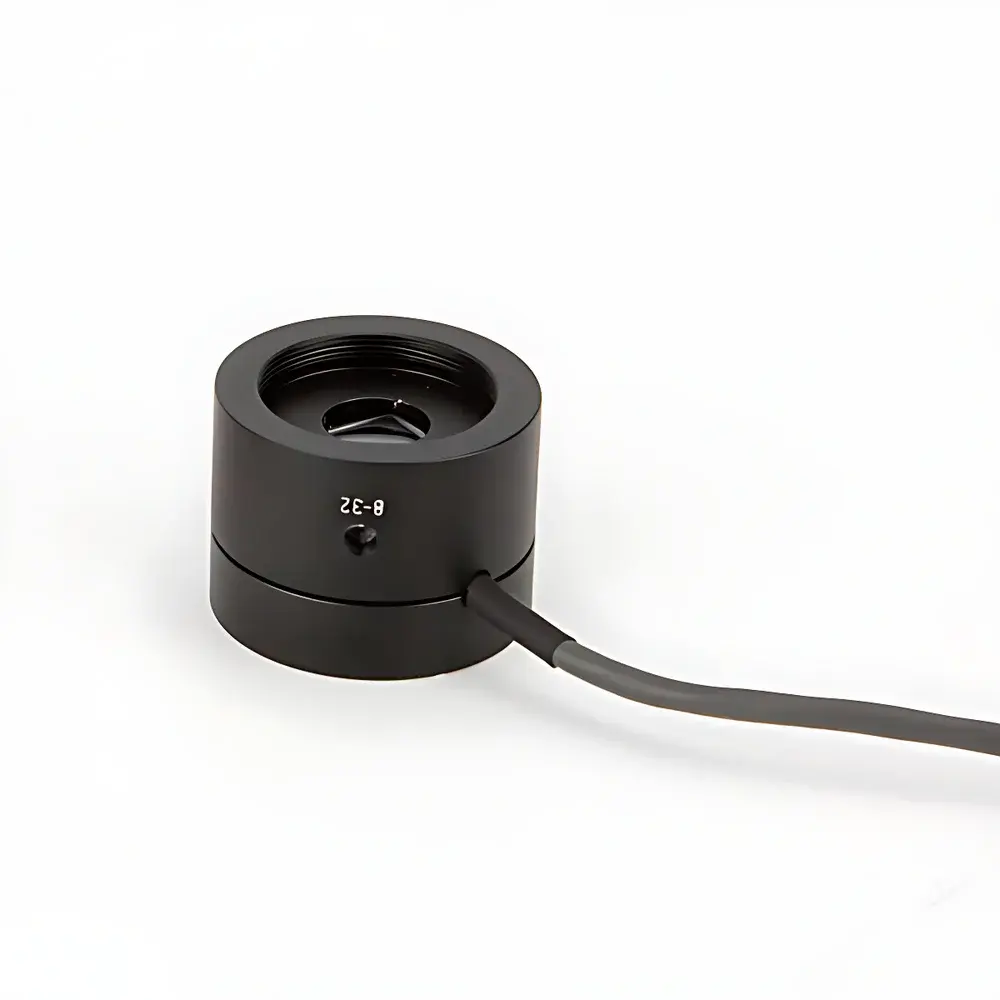
SPL SPL-8202 UV-Enhanced Silicon / Silicon / InGaAs Photodiode Power Sensor
| Brand | SPL |
|---|---|
| Origin | Zhejiang, China |
| Model | SPL-8202 |
| Detector Materials | UV-enhanced Si (200–1100 nm), Si (350–1100 nm), InGaAs (800–1650 nm) |
| Interface Options | DB15 (for SPL-8201 meter), USB 2.0, Bluetooth |
| Active Area | 1 cm² (Si/UV-Si), 0.071 cm² (InGaAs) |
| NEP | 3.9×10⁻¹⁴ W/√Hz (UV-Si), 4.5×10⁻¹³ W/√Hz (Si), 1.2×10⁻¹³ W/√Hz (InGaAs) |
| Response Time | 5.9 µs (UV-Si), 2 µs (Si), 0.2 µs (InGaAs) |
| Max. Power Density (unattenuated) | 1 mW/cm² (UV-Si), 10 mW/cm² (Si/InGaAs) |
| Power Range (unattenuated) | 100 pW – 1 mW (UV-Si), 100 pW – 10 mW (Si/InGaAs) |
| Attenuation Options | OD1 / OD2 / OD3 removable calibrated filters |
| Fiber Adapters | SMA, FC |
| Operating Temperature | 5–50 °C |
| Humidity | <70% RH |
| Dimensions | Ø38 mm × 28 mm |
| Weight | 105 g |
Overview
The SPL SPL-8202 is a modular, digitally integrated photodiode-based optical power sensor engineered for high-fidelity radiometric measurement across ultraviolet, visible, and near-infrared spectral bands. Unlike analog photodetectors requiring external signal conditioning, the SPL-8202 embeds an on-board analog-to-digital converter, microcontroller, and non-volatile memory to perform real-time signal digitization, linearization, temperature compensation, and factory calibration data storage. This architecture eliminates analog voltage transmission errors, minimizes susceptibility to electromagnetic interference (EMI), and ensures traceable, repeatable measurements without reliance on external amplifiers or third-party DAQ systems. The sensor operates on the principle of photocurrent generation in semiconductor junctions—UV-enhanced silicon (Si-UV), standard silicon (Si), and indium gallium arsenide (InGaAs)—each selected for optimal quantum efficiency within its designated wavelength band: 200–1100 nm (UV-Si), 350–1100 nm (Si), and 800–1650 nm (InGaAs). All variants comply with fundamental photometric definitions per CIE S 025/E:2015 and support SI-traceable power measurement in watts (W), milliwatts (mW), and decibel-milliwatt (dBm) units.
Key Features
- Integrated digital signal processing: On-sensor ADC, gain control, and real-time linearization reduce system-level noise and eliminate analog cabling artifacts.
- Embedded NIST-traceable calibration data: Factory-applied wavelength-dependent responsivity curves stored in EEPROM; valid for both bare and attenuated configurations when OD1/OD2/OD3 filters are installed.
- Dual interface flexibility: DB15 output compatible with SPL-8201 optical power meter for benchtop operation; USB 2.0 or Bluetooth interface enables direct PC connectivity and multi-channel synchronization via USB hub.
- Modular detector selection: Interchangeable head modules allow users to deploy UV-Si, Si, or InGaAs sensing elements without changing instrumentation—optimized for laser characterization, fiber optic testing, and spectrophotometer validation.
- Removable, calibrated neutral density filters: OD1 (10×), OD2 (100×), and OD3 (1000×) attenuation plates are mechanically registered and individually calibrated; each filter’s correction factor is auto-applied during measurement.
- Free-space and fiber-coupled operation: Standard 1.128 cm (UV-Si/Si) or 0.3 cm (InGaAs) active diameter accommodates collimated beams; optional SMA or FC fiber adapters enable seamless integration into telecom, sensing, and OEM optical assemblies.
Sample Compatibility & Compliance
The SPL-8202 series supports quantitative optical power measurement of continuous-wave (CW) and quasi-CW sources including He-Cd lasers (325 nm), diode lasers (405–1550 nm), supercontinuum sources, LED arrays, and broadband lamps. Its UV-enhanced Si variant meets ASTM E275–21 requirements for UV-VIS spectrophotometer detector qualification, while the InGaAs module satisfies IEC 61280-2-9 for optical power meter verification in single-mode fiber systems. All sensors ship with individual calibration certificates compliant with ISO/IEC 17025:2017—documenting uncertainty budgets at ≥15 wavelength points per detector type, including expanded uncertainties (k=2) referenced to NIST SRM 2210. The device architecture supports GLP/GMP environments through audit-ready firmware logging and time-stamped calibration metadata retention.
Software & Data Management
The SPL OPM (Optical Power Measurement) software provides a validated platform for real-time acquisition, statistical analysis (mean, std dev, min/max, histogram), and export in CSV, TXT, or HDF5 formats. It implements full 21 CFR Part 11 compliance features—including electronic signatures, role-based access control, and immutable audit trails—for regulated pharmaceutical, biotech, and medical device applications. An open-source SDK (C/C++, Python, LabVIEW, MATLAB) enables custom automation, integration into CI/CD test benches, and OEM embedding. Firmware updates preserve calibration integrity via cryptographic checksum verification, and all sensor parameters—including serial number, calibration date, and filter configuration—are programmatically readable via USB HID protocol.
Applications
- Laser safety compliance testing per ANSI Z136.1 and IEC 60825-1, particularly for UV-A and NIR Class 3B/4 sources.
- Fiber optic component characterization: insertion loss of isolators, couplers, and WDM filters at 850/1310/1550 nm.
- Photovoltaic cell spectral response mapping using monochromator-coupled irradiance scanning.
- Calibration transfer between reference standards and field-deployable meters in metrology labs.
- Real-time monitoring of pump diode stability in DPSS and fiber laser systems.
- Multi-sensor array deployment for spatial beam profiling via synchronized sampling across up to 16 channels.
FAQ
Does the SPL-8202 require external power when connected via USB?
No—the USB interface supplies both power and data; no additional power adapter is needed for USB or Bluetooth operation.
Can the same OPM software manage mixed-detector configurations (e.g., UV-Si + InGaAs) simultaneously?
Yes—OPM natively detects and labels each sensor by model suffix (-02, -04, -06) and applies appropriate calibration tables and unit conversions in real time.
Is the OD3 attenuation filter certified for use with high-power pulsed lasers?
OD filters are rated for CW operation only; for pulsed sources, users must verify peak power density against damage thresholds specified in the datasheet and consider thermal lensing effects.
How is calibration traceability maintained after installing a user-selected OD filter?
Each OD filter carries a unique serial number linked to its individual calibration certificate; the sensor firmware auto-loads corresponding correction factors upon physical installation and reports them in all exported data files.
Are mechanical mounting options compatible with standard optical rails and post holders?
Yes—the housing features dual-threaded mounting holes (8-32 and M4) aligned to industry-standard kinematic base spacing, enabling rigid integration into cage systems and translation stages.



