
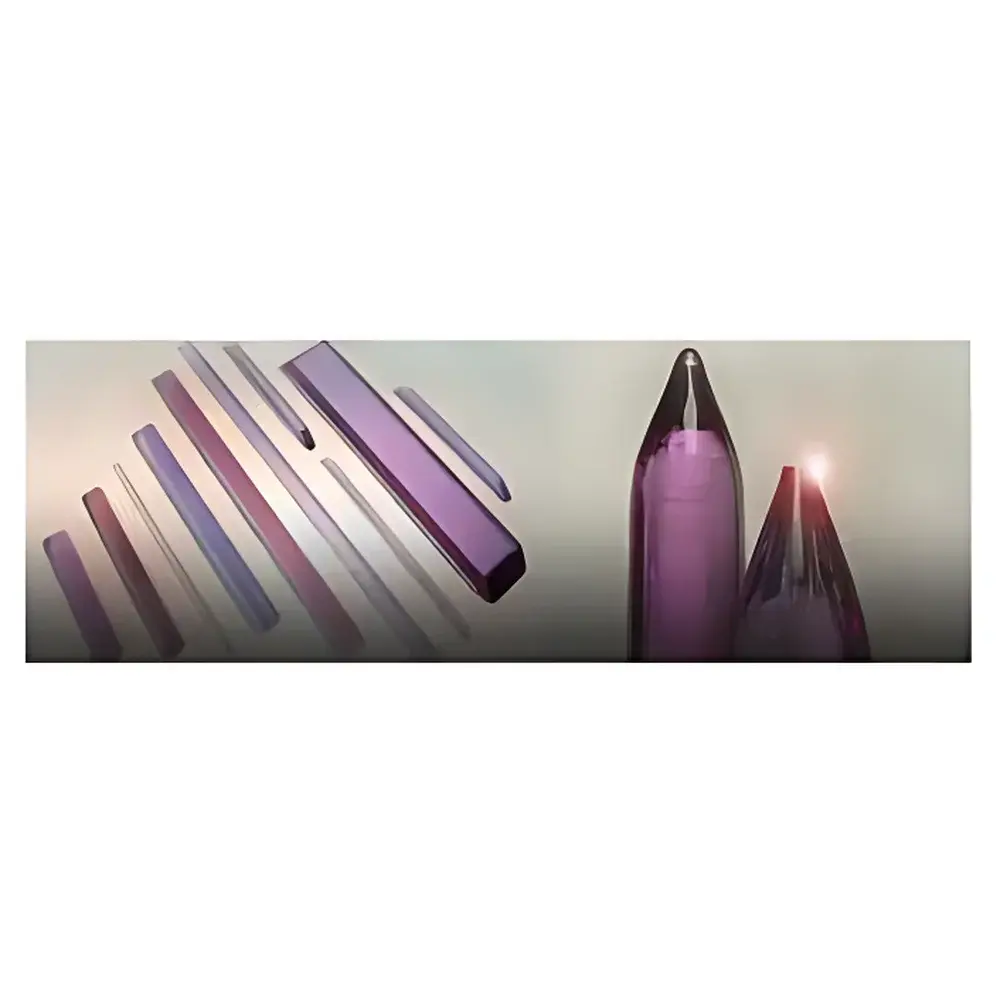
Nd:YAG Laser Crystal by SYNOPTICS
| Brand | SYNOPTICS |
|---|---|
| Origin | USA |
| Manufacturer Type | Authorized Distributor |
| Import Status | Imported |
| Model | Nd:YAG |
| Price Range | USD 0 – 7,200 (FOB) |
| Wavelength Range | 500–3000 nm |
| Rod Length | 3–152.4 mm |
| Rod Diameter | 2–32 mm |
| Slab Max Size | 7 × 26 × 250 mm |
| Nd³⁺ Doping Concentration | 0.2–1.4 ± 0.1 at.% |
| Wavefront Distortion | <λ/4 per inch (λ = 632 nm), standard |
| Extinction Ratio | ≥25 dB |
| Surface Quality | 10–5 scratch-dig (MIL-O-13830A) |
| Endface Flatness | λ/10 |
| Endface Parallelism | ≤10 arc seconds |
| Endface Perpendicularity | ≤5 arc minutes |
| Edge Chamfer | 0.005" ± 0.003" × 45° |
| Finish Roughness | 55 ± 5 µin (ground finish) |
| AR Coating Reflectivity | <0.25% @ design wavelength(s) |
| Laser Damage Threshold | >10 J/cm² (1064 nm, 10 ns, 10 Hz) |
| Thermal Conductivity | ~11 W/m·K (25 °C) |
| Mechanical Hardness | ~8.5 Mohs |
Overview
The Nd:YAG (Neodymium-doped Yttrium Aluminum Garnet, Y3Al5O12) laser crystal is a foundational solid-state gain medium widely employed in pulsed and continuous-wave (CW) laser systems operating primarily at 1064 nm, with harmonics at 532 nm (SHG), 355 nm (THG), and 266 nm (FHG). Engineered for high optical homogeneity, low wavefront distortion, and exceptional thermal management, this crystal leverages the broad emission cross-section and favorable four-level energy structure of Nd3+ ions embedded in the cubic YAG host lattice. Its high thermal conductivity (~11 W/m·K), mechanical robustness (Mohs hardness ~8.5), and resistance to thermal shock make it suitable for high-average-power and high-repetition-rate applications across industrial, medical, scientific, and defense domains.
Key Features
- High optical uniformity and low birefringence, verified via interferometric wavefront analysis (<λ/4 per inch, standard; <λ/16 per inch, optional)
- Precisely controlled Nd3+ doping concentration (0.2–1.4 ± 0.1 at.%), optimized for specific pump absorption depth and gain saturation behavior
- End faces polished to λ/10 flatness, parallelism ≤10 arc seconds, and perpendicularity ≤5 arc minutes — meeting stringent cavity alignment requirements
- Surface quality compliant with MIL-O-13830A (10–5 scratch-dig); ground finish roughness 55 ± 5 µin, with custom polishing options available
- High-laser-damage-threshold dielectric coatings (AR or HR) deposited per MIL-C-48497, with R < 0.25% at designated wavelengths and LDT >10 J/cm² (1064 nm, 10 ns, 10 Hz)
- Full traceability from Czochralski crystal growth through precision cutting, annealing, polishing, coating, and ISO 9001:2008–certified inspection and packaging
Sample Compatibility & Compliance
This Nd:YAG crystal is compatible with flashlamp-pumped, diode-pumped, and fiber-coupled pump architectures. Rod configurations support stable resonator designs (e.g., plano-concave, V-shaped), while slab geometries enable zigzag or face-cooled high-power architectures. All crystals are manufactured and tested in accordance with internationally recognized optical material standards, including ISO 10110 (optical element specification), ISO 9001:2008 (quality management), and MIL-PRF-13830B (optical surface quality). Documentation includes full metrology reports (interferograms, spectrophotometry, extinction ratio, LDT verification), supporting GLP-compliant qualification and FDA 21 CFR Part 11–aligned audit trails when integrated into regulated laser systems.
Software & Data Management
While the Nd:YAG crystal itself is a passive optical component, SYNOPTICS provides comprehensive digital documentation packages upon request: calibrated spectral transmittance/reflectance data (200–3000 nm), interferometric wavefront maps (Zernike coefficients), thermal lensing simulation inputs (dn/dT, thermo-optic coefficient), and dimensional inspection reports in PDF and CSV formats. These datasets integrate directly with common laser design platforms (e.g., ASAP, Zemax OpticStudio, LASCAD) for cavity modeling, mode analysis, and thermal load prediction. Traceable lot numbers and QC certificates are archived for ≥10 years, supporting long-term system validation and regulatory submissions.
Applications
- Medical: Q-switched dermatology and ophthalmology systems (tattoo removal, pigment lesion treatment, posterior capsulotomy)
- Industrial: High-precision marking, drilling, welding, and ablation in aerospace and electronics manufacturing
- Scientific Research: Pump source for OPOs and Ti:sapphire amplifiers; seed oscillator in ultrafast CPA systems; LIBS and LIDAR transmitter modules
- Defense & Aerospace: Rangefinders, target designators, directed-energy testbeds, and space-qualified lidar transceivers (qualification per MIL-STD-810G and ECSS-Q-ST-70C)
- Quantum Technologies: Frequency-stabilized 1064 nm sources for cold atom trapping and optical lattice experiments
FAQ
What is the typical thermal lensing behavior of Nd:YAG under diode pumping?
Thermal lensing arises from temperature-dependent refractive index gradients (dn/dT ≈ 7.3 × 10⁻⁶ K⁻¹) and stress-induced birefringence. For a 3-mm-diameter × 50-mm rod pumped at 50 W, focal length typically ranges from 15–30 cm depending on coolant flow rate and mounting geometry.
Can SYNOPTICS supply custom-coated Nd:YAG with dual-wavelength AR (e.g., 808 nm + 1064 nm)?
Yes. Multi-band anti-reflection coatings covering pump and lasing bands are routinely fabricated using ion-beam sputtering, with reflectivity <0.15% per surface at both wavelengths and LDT validated per ISO 21254.
Is bulk absorption data available at 808 nm for different Nd concentrations?
Yes. Absorption coefficient α(808 nm) scales linearly with Nd content (e.g., α ≈ 4.2 cm⁻¹ at 0.6 at.% Nd, 8.5 cm⁻¹ at 1.2 at.% Nd), measured via photothermal deflection spectroscopy and provided in calibration reports.
Do you offer vacuum-compatible packaging for space-qualified delivery?
Yes. Crystals can be supplied in Class 100 cleanroom-sealed, outgassing-certified containers (per ASTM E595) with residual gas analysis (RGA) reports and humidity-controlled desiccant packaging.




