
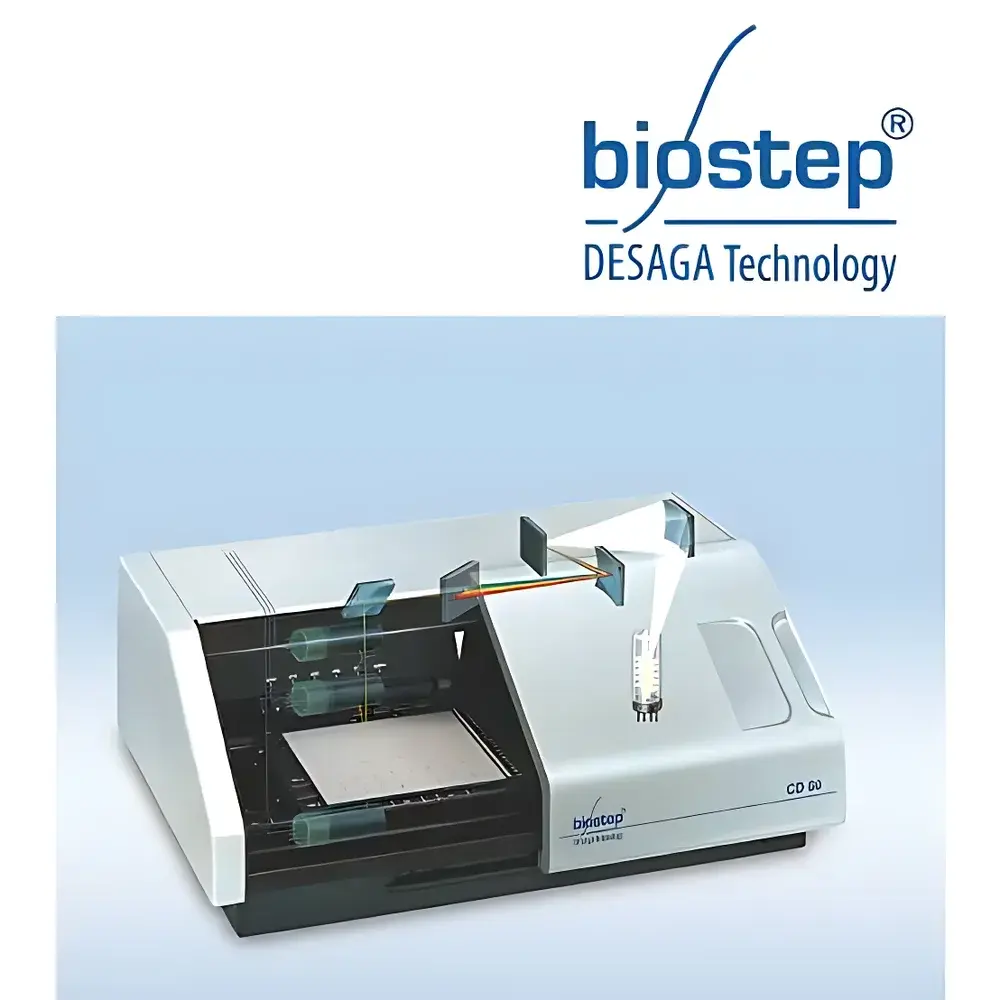
Biostep CD60 Automated Thin Layer Chromatography Scanner
| Brand | Biostep |
|---|---|
| Origin | Germany |
| Model | CD60 |
| Instrument Type | HPTLC Densitometer |
| Operation Mode | Fully Automated |
| Detection Modes | Absorption, Reflection, Fluorescence, Transmission |
| Wavelength Range | 190–900 nm |
| Light Sources | Deuterium Lamp, Tungsten-Halogen Lamp, Mercury Lamp |
| Monochromator | Stepper Motor-Driven Holographic Grating (1200 lines/mm) |
| Spectral Bandwidth | 5–260 nm |
| Wavelength Accuracy | < ±0.1 nm |
| Wavelength Repeatability | < ±0.2 nm |
| Minimum Spatial Resolution | 0.025 mm |
| Imaging Wavelength Range | 190–900 nm |
| Sample Stage Dimensions | 265 × 200 mm |
| Scan Speed | 20 mm/s |
Overview
The Biostep CD60 Automated Thin Layer Chromatography (TLC) Scanner is a high-precision densitometer engineered for quantitative and qualitative analysis of compounds separated on silica gel, aluminum oxide, or cellulose-based thin-layer plates. Based on the well-established principles of reflectance and transmission densitometry—complemented by fluorescence excitation and detection—the CD60 delivers trace-level sensitivity and reproducible optical density measurements across a broad UV-Vis spectral range (190–900 nm). Designed as a core analytical tool in regulated laboratories, it supports high-performance thin-layer chromatography (HPTLC) workflows from sample application to final report generation. Its heritage traces back to DESAGA, the German pioneer that introduced the world’s first commercial TLC scanner in the 1950s; following its acquisition by Biostep in 2011, the platform underwent rigorous engineering refinement to meet modern GLP, GMP, and FDA 21 CFR Part 11 compliance requirements.
Key Features
- Fully automated operation with motorized lamp switching, grating positioning, and stage movement—enabling unattended multi-method runs
- Triple-light-source configuration (deuterium, tungsten-halogen, and mercury lamps) with automatic alignment and spectral optimization per measurement mode
- High-resolution scanning at 0.025 mm spatial resolution, supporting both linear and advanced zigzag scanning modes to compensate for plate heterogeneity
- Multi-wavelength acquisition capability—including dual-wavelength ratiometric scanning to suppress background interference and full-spectrum scanning for spectral deconvolution
- Integrated stepper-motor-driven holographic monochromator (1200 lines/mm) ensuring precise wavelength selection and long-term optical stability
- Large-format sample stage (265 × 200 mm) accommodating standard HPTLC plates (20 × 10 cm, 20 × 20 cm), as well as custom-sized gels and membranes
- Scan speed of 20 mm/s with real-time signal averaging—optimized for throughput without compromising signal-to-noise ratio
Sample Compatibility & Compliance
The CD60 accommodates a wide range of planar separation media: silica gel 60 F254/F365, RP-18, amino, cyano, and cellulose plates; polyacrylamide and agarose gels; IEF strips; and blotting membranes (e.g., nitrocellulose, PVDF). It is routinely deployed in pharmaceutical QC labs for herbal extract profiling (e.g., flavonoids, alkaloids, saponins), food contaminant screening (mycotoxins, pesticides), forensic dye analysis, and biopharmaceutical purity assessment (e.g., monoclonal antibody fragments, glycoprotein isoforms). All data acquisition, processing, and audit trails comply with 21 CFR Part 11 electronic records and signatures requirements. System validation packages support IQ/OQ protocols aligned with ISO/IEC 17025 and ICH Q5A–Q5E guidelines. Instrument calibration is traceable to NIST-certified reference standards.
Software & Data Management
The proprietary WinCATS software (v1.4.12 or later) provides complete instrument control, method development, and quantitative data evaluation. It supports method templates for USP , EP 2.2.27, and AOAC Official Methods. Key functions include: automatic baseline correction, peak detection via derivative thresholding or manual adjustment, integration using Simpson’s rule or orthogonal polynomial fitting, and multi-point calibration with linear, quadratic, or Michaelis-Menten nonlinear models. The software generates 3D chromatogram surfaces for spectral–spatial visualization, exports raw data in ASCII and CSV formats, and produces PDF reports with embedded metadata (operator ID, timestamp, instrument serial number, calibration status). Audit trail logging records all user actions, parameter changes, and result modifications with immutable timestamps.
Applications
- Phytochemical analysis of traditional Chinese medicine (TCM) formulations, including simultaneous quantification of multiple marker compounds (e.g., berberine, paeoniflorin, glycyrrhizin)
- Residue testing in food and feed—detection of aflatoxins B1/G1, ochratoxin A, and patulin at sub-ppb levels using fluorescence enhancement
- Quality control of cosmetic actives (e.g., hydroquinone, kojic acid, retinol) and preservatives (methylparaben, triclosan)
- Protein and nucleic acid characterization via SDS-PAGE and native PAGE densitometry, including molecular weight estimation and relative quantification
- Forensic document examination—differentiation of ink compositions and aging studies based on dye degradation profiles
- Process monitoring in fine chemical synthesis—tracking reaction intermediates and side products on preparative TLC plates
FAQ
Does the CD60 support GLP-compliant data archiving?
Yes—WinCATS enforces role-based access control, electronic signatures, and tamper-evident audit trails meeting OECD GLP Principles and EU Annex 11 requirements.
Can the instrument perform quantitative analysis without internal standards?
Yes—absolute quantification is achievable using external calibration curves; however, internal standard normalization is recommended for improved precision in complex matrices.
Is the CD60 compatible with third-party image analysis software?
Raw scan data (16-bit TIFF) and peak tables (CSV) are fully exportable; however, proprietary spectral libraries and method files require WinCATS for interpretation.
What maintenance intervals are recommended for optical components?
Lamp lifetimes are rated at ≥2000 h (deuterium), ≥5000 h (tungsten-halogen), and ≥1000 h (mercury); annual verification of wavelength accuracy and photometric linearity is advised using certified reference filters.
How does zigzag scanning improve quantification accuracy on non-uniform TLC plates?
By acquiring multiple overlapping scans along a defined path perpendicular to the migration direction, zigzag mode averages out local variations in layer thickness, binder content, and fluorescence quenching—yielding higher inter-plate reproducibility than single-line raster scans.
Related Products





