
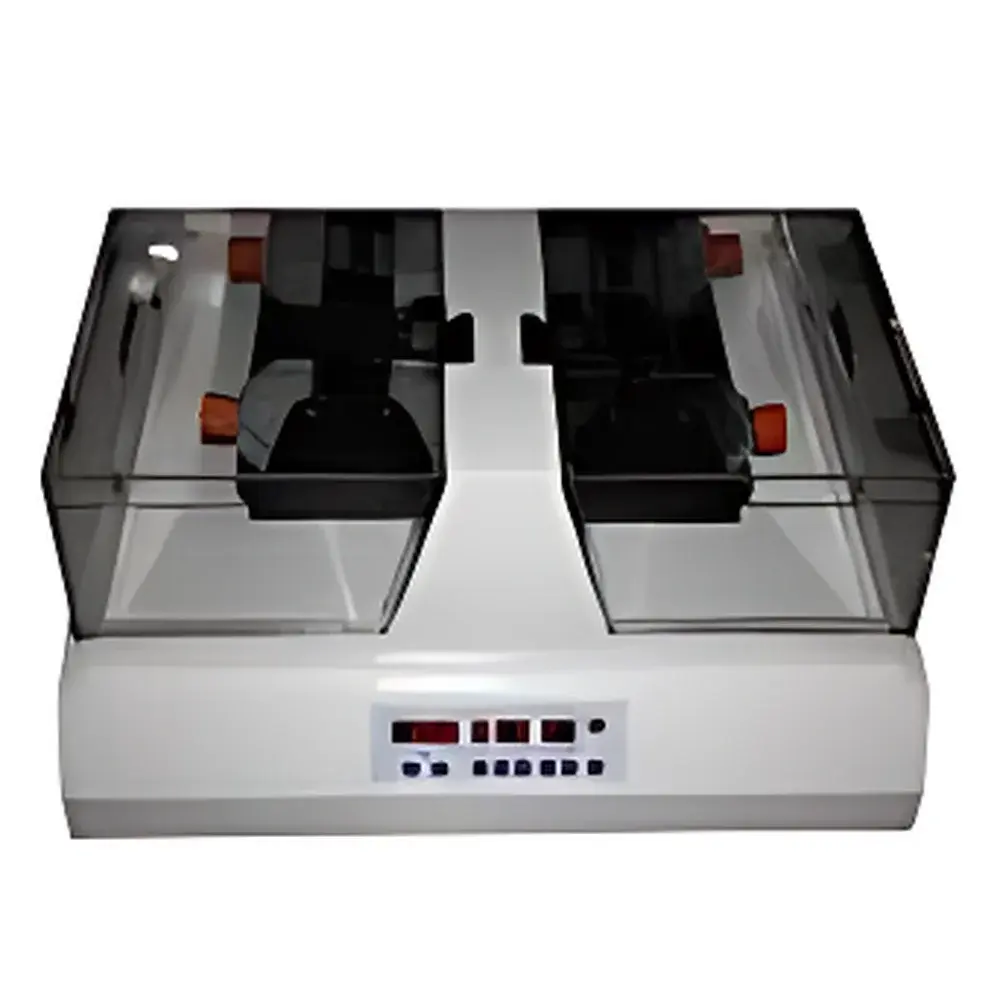
DHS CL-100 Cryo-Thaw Cell Disruption Oscillator
| Brand | DHS |
|---|---|
| Origin | Beijing, China |
| Model | CL-100 |
| Throughput | 4–8 × T175 flasks |
| Amplitude | 70 mm |
| Oscillation Frequency | 50–280 rpm (adjustable) |
| Runtime | 1–99 min (adjustable) |
| Pause Duration | 1–99 s (adjustable) |
| Cycle Count | 1–9 (adjustable) |
| Surface Finish | Stainless steel or powder-coated |
| Noise Level | Low (suitable for laboratory environments) |
| Compliance | Designed for GMP-compliant cell processing workflows |
Overview
The DHS CL-100 Cryo-Thaw Cell Disruption Oscillator is an engineered platform for mechanical lysis of mammalian, bacterial, and yeast cells via controlled cryo-thaw oscillation. Unlike sonication or high-pressure homogenization, this system leverages repeated thermal cycling—alternating between sub-zero freezing (typically −80 °C) and thawing (room temperature or 37 °C)—combined with vigorous horizontal reciprocating motion to induce intracellular ice crystal formation, membrane phase transition stress, and physical shear at the cell–vessel interface. The 70 mm amplitude ensures sufficient kinetic energy transfer to promote collision-driven disruption between cells and between cells and the inner surface of rigid T175 culture flasks. Its design prioritizes reproducibility in low-to-medium throughput applications where enzymatic or detergent-based lysis may compromise downstream assay integrity—such as native protein extraction, organelle isolation, or nucleic acid recovery requiring minimal chemical interference.
Key Features
- High-amplitude (70 mm), low-frequency oscillation optimized for cryo-thaw–induced mechanical stress without excessive foaming or aerosol generation
- Dual-surface options: electropolished stainless steel or epoxy-powder-coated chassis, both compliant with ISO 14644-1 Class 7 cleanroom maintenance protocols and compatible with routine GMP-grade disinfection (e.g., 70% ethanol, hydrogen peroxide vapor)
- Secure, tool-free flask retention system with spring-loaded clamps accommodating T175 flasks (175 cm² growth area) across four to eight positions—designed to prevent lateral slippage during high-cycle operation
- Programmable multi-stage protocol engine supporting up to nine sequential cycles, each comprising user-defined oscillation duration, pause interval, and frequency setpoint
- Acoustically damped drive mechanism achieving <55 dB(A) at 1 m distance—enabling continuous operation in shared laboratory spaces without acoustic interference to adjacent instrumentation
- Integrated thermal safety interlock (optional accessory integration) to synchronize with ultra-low temperature freezers or cryogenic storage units for automated freeze–thaw sequence initiation
Sample Compatibility & Compliance
The CL-100 is validated for use with standard polycarbonate or borosilicate glass T175 tissue culture flasks under controlled ambient conditions (15–25 °C). It supports common cryoprotectant formulations (e.g., 10% DMSO in FBS) and accommodates post-thaw centrifugation-ready sample handling. While not certified to IEC 61000-4 electromagnetic compatibility standards out-of-the-box, its power supply meets GB/T 17626.2–2018 (equivalent to IEC 61000-4-2:2008) for electrostatic discharge immunity. The device architecture aligns with principles outlined in USP “Cellular and Gene Therapy Products” for non-invasive lysis methods and supports documentation traceability required under GLP Annex 11 and FDA 21 CFR Part 11 when paired with validated electronic lab notebook (ELN) integration.
Software & Data Management
The CL-100 operates via a front-panel LCD interface with rotary encoder navigation and non-volatile memory storing up to 20 user-defined protocols. All parameter changes—including rpm, runtime, pause time, and cycle count—are logged with timestamp and operator ID (via optional RFID badge reader module). Exportable CSV logs capture start/stop timestamps, actual frequency deviation (<±2 rpm), and cumulative operational hours—facilitating preventive maintenance scheduling and audit readiness. No proprietary software installation is required; however, DHS provides a USB-C–enabled firmware update utility compatible with Windows 10/11 and macOS 12+ for calibration certificate synchronization and security patch deployment.
Applications
- Preparation of whole-cell lysates for Western blotting, ELISA, and activity assays where protease inhibitors or reducing agents must be minimized
- Isolation of mitochondria, nuclei, or plasma membrane fractions from adherent cell lines (e.g., HEK293, CHO-K1, A549) without detergent-induced organelle fusion
- Processing of cryopreserved primary human PBMCs or stem cell batches prior to flow cytometry or single-cell RNA-seq library construction
- Scale-down modeling of industrial-scale freeze–thaw lysis steps in biomanufacturing process development (QbD-aligned)
- Comparative studies evaluating lysis efficiency versus bead-beating or nitrogen cavitation across Gram-positive bacterial strains (e.g., Bacillus subtilis, Staphylococcus aureus)
FAQ
Can the CL-100 be operated inside a cold room or freezer chamber?
No—the unit is rated for ambient operation only (15–25 °C, <80% RH non-condensing). External placement adjacent to ultra-low temperature freezers is recommended, with manual or robotic transfer of flasks between thermal zones.
Is validation support available for IQ/OQ/PQ documentation?
Yes. DHS provides a vendor-qualified Installation Qualification (IQ) template and Operational Qualification (OQ) test protocol—including amplitude verification using laser vibrometry and frequency linearity assessment against NIST-traceable tachometer standards.
What maintenance intervals are recommended?
Biannual inspection of clamp spring tension and drive belt tension is advised. Annual recalibration of the onboard timer and frequency feedback loop is recommended for GxP-regulated environments.
Does the CL-100 meet CE or UL safety certification requirements?
It complies with GB 4793.1–2019 (equivalent to IEC 61010-1:2010) for electrical safety in laboratory equipment. CE marking is not affixed, as the device is intended for research use only and excludes clinical diagnostic application claims.
Can custom flask adapters be fabricated for non-T175 vessels?
Yes—DHS offers engineering consultation for OEM adapter plates compatible with roller bottles, stacked cell factories, or microcarrier-based bioreactor bags (up to 10 L working volume), subject to mechanical resonance analysis.



