
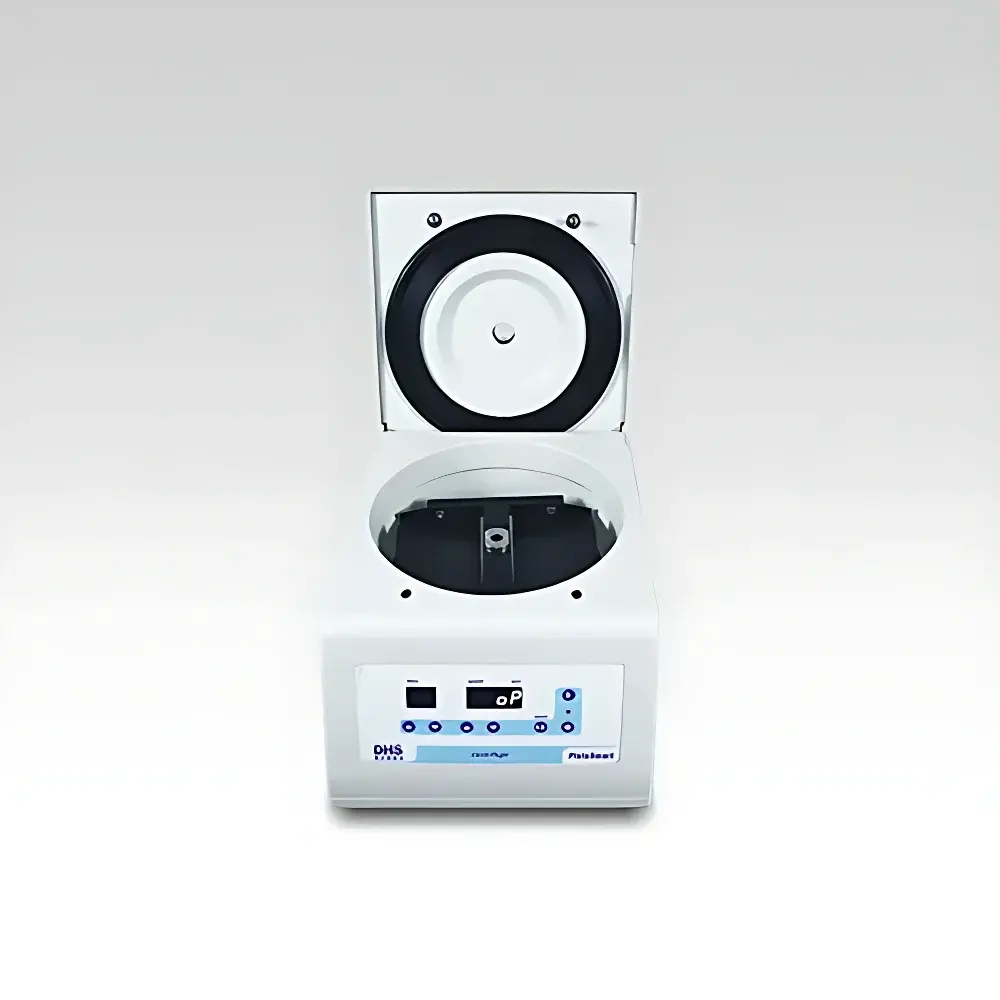
PlateSmart Plate Centrifuge by DHS
| Brand | DHS |
|---|---|
| Origin | Tianjin, China |
| Model | Plate-Smart |
| Instrument Type | Benchtop Plate Centrifuge |
| Max Speed | 2500 rpm |
| Max RCF | 650 × g |
| Capacity | 4 × 96-well microplates, or 2 × deep-well plates, or 2 × PCR plates |
| Drive System | High-torque disc motor, direct drive |
| Control | Microprocessor-based, digital time/speed display |
| Timer Range | 1–99 min + continuous mode |
| Speed Range | 500–2500 rpm |
| Power Supply | 110–230 V, 50 Hz, 150 W |
| Max Temperature Rise | <12 °C |
| Dimensions (W×D×H) | 310 × 380 × 300 mm |
| Net Weight | 12 kg |
| Safety | Automatic rotor stop upon lid opening, mechanical safety interlock |
Overview
The PlateSmart Plate Centrifuge by DHS is a purpose-engineered benchtop centrifuge designed exclusively for high-throughput microplate processing in life science, clinical diagnostics, and pharmaceutical quality control laboratories. Unlike general-purpose centrifuges, the PlateSmart employs a fixed-angle plate rotor architecture optimized for uniform sedimentation across 96-well, 384-well, deep-well, and PCR microplates—enabling rapid pelleting of cells, beads, precipitates, or unbound reagents without cross-well disturbance. Its operation is based on controlled radial acceleration (RCF) generation via direct-drive disc motor technology, delivering precise, repeatable force application across all wells simultaneously. The device operates within the low-speed centrifugation range (500–2500 rpm, up to 650 × g), making it suitable for delicate biological samples including cultured mammalian cells, antibody-coated magnetic beads, enzymatic reaction mixtures, and nucleic acid purification eluates—where excessive g-force could compromise integrity or cause well-to-well carryover.
Key Features
- High-torque disc motor with direct drive: Eliminates belt slippage and gear wear, ensuring long-term speed stability and minimal mechanical noise (<55 dB(A) at 2500 rpm).
- Microprocessor-controlled interface: Digital LED display shows real-time speed (rpm) and remaining time; intuitive membrane keypad supports precise parameter entry.
- Dual-mode operation: Programmable timer (1–99 minutes) plus dedicated “Spin” button for immediate short-duration centrifugation without presetting.
- Integrated safety architecture: Mechanical lid lock with automatic rotor deceleration upon lid opening; overload and overheat protection circuits compliant with IEC 61010-1 safety standards.
- Compact footprint and lightweight design: 310 × 380 × 300 mm dimensions and 12 kg net weight enable flexible placement on biosafety cabinets, laminar flow hoods, or crowded lab benches.
- Thermal management system: Optimized airflow path and low-power motor design limit internal temperature rise to <12 °C during continuous operation—critical for temperature-sensitive assays.
Sample Compatibility & Compliance
The PlateSmart accommodates standardized microplate formats per ANSI/SLAS specifications: 96-well flat-bottom, U/V-bottom, and PCR plates (0.2 mL and 0.1 mL); 384-well assay plates; and 96-well deep-well plates (1.1–2.2 mL capacity). It supports common labware materials including polypropylene, polystyrene, and cyclic olefin copolymer (COC). The centrifuge meets electromagnetic compatibility requirements per EN 61326-1 and electrical safety per EN 61010-1. While not certified for GLP/GMP production environments out-of-the-box, its deterministic timing, non-volatile parameter storage, and audit-ready operational log (via optional RS-232 output) support alignment with FDA 21 CFR Part 11–aligned workflows when integrated into validated laboratory information management systems (LIMS).
Software & Data Management
The PlateSmart operates as a standalone instrument with embedded firmware controlling all motion and safety logic. No external software is required for basic operation. However, optional serial communication (RS-232) enables integration with third-party automation platforms or custom script-based protocols (e.g., Python-controlled batch runs via LabVIEW or PySerial). All user-defined parameters—including speed, time, and Spin activation—are stored in non-volatile memory and retained after power cycling. Firmware updates are performed via USB-to-serial adapter using DHS-provided utilities, with version history and checksum validation to ensure traceability. For regulated environments, timestamped operation logs (start/stop time, final speed, duration) can be exported for inclusion in electronic batch records.
Applications
- Routine pelleting of ELISA plates prior to substrate addition or washing steps.
- Accelerating binding kinetics in immunoassays by enhancing antigen–antibody contact frequency.
- Consolidating magnetic bead suspensions in nucleic acid extraction kits (e.g., QIAamp, MagMAX).
- Removing residual ethanol or isopropanol from column-based DNA cleanup protocols.
- Pre-centrifugation of cell culture supernatants in high-throughput cytotoxicity screening.
- Stabilizing viscous reagent dispenses (e.g., glycerol stocks, enzyme master mixes) prior to robotic liquid handling.
FAQ
What microplate formats are supported?
The PlateSmart accepts ANSI/SLAS-compliant 96-well, 384-well, deep-well, and PCR plates—provided they conform to standard height (14.5–20.5 mm) and footprint (127.76 × 85.48 mm) specifications.
Is calibration required before first use?
No factory calibration is needed; the instrument ships with NIST-traceable speed verification documentation. Users may perform periodic verification using an optical tachometer per ISO 15197 guidelines.
Can the centrifuge operate continuously beyond 99 minutes?
Yes—the “Continuous” mode bypasses the timer and maintains set speed until manually stopped or lid opened.
Does the PlateSmart generate significant heat during extended runs?
Internal temperature rise remains below 12 °C even during 60-minute continuous operation at 2500 rpm, minimizing thermal impact on thermolabile samples.
What safety certifications does the unit hold?
It complies with IEC 61010-1 (Safety Requirements for Electrical Equipment for Measurement, Control, and Laboratory Use) and EN 61326-1 (EMC for Laboratory Equipment).



