
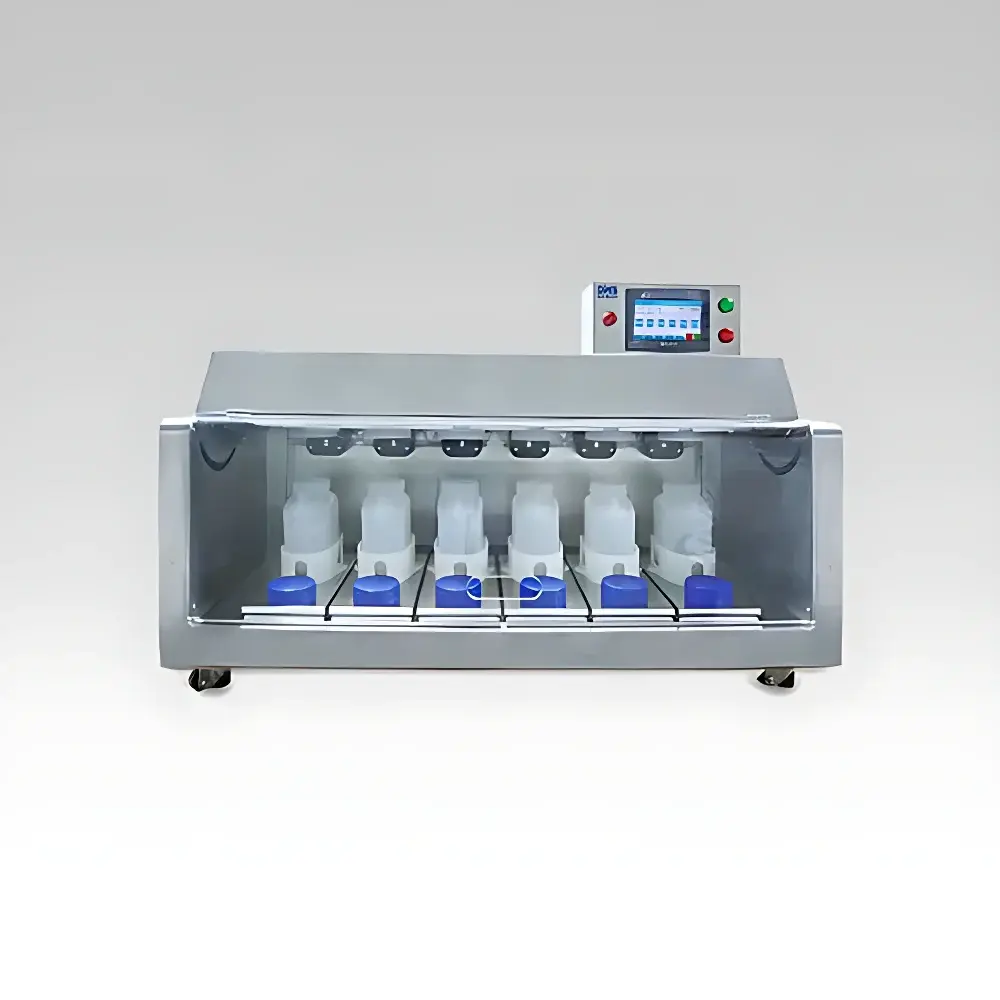
DHS FF-16/FF-18/FF-26 Benchtop Centrifuge Bottle Filling System
| Brand | DHS |
|---|---|
| Origin | Tianjin, China |
| Manufacturer Type | Authorized Distributor |
| Regional Classification | Domestic (China) |
| Models | FF-16, FF-18, FF-26 |
| Price Range | USD 28,000 – 57,000 |
| Fill Capacity | 1 L × 6 bottles, 1 L × 8 bottles, or 2 L × 6 bottles |
| Pump Type | Peristaltic |
| Weighing Integration | Simultaneous centrifuge bottle and cap weighing |
| Enclosure | Foam-suppression shield |
| Form Factor | Benchtop, ISO Class 5-compatible |
| Control Interface | Touchscreen HMI with automated cycle sequencing |
Overview
The DHS FF-16/FF-18/FF-26 Benchtop Centrifuge Bottle Filling System is a precision-engineered, GMP-aligned liquid dispensing platform designed for aseptic and high-containment bioprocessing environments. It operates on a gravimetric filling principle—integrating real-time load-cell feedback with peristaltic pump actuation to achieve repeatable volumetric delivery into sterile centrifuge bottles under controlled laminar airflow conditions. Unlike volumetric fillers relying solely on pump calibration, this system continuously monitors mass gain during filling, compensating for fluid density variations, viscosity shifts, and minor tubing elasticity—critical for consistent dosing of sensitive biologics such as monoclonal antibodies, viral vectors, and cell culture supernatants. Its benchtop footprint and modular design enable seamless integration into ISO Class 5 (Grade A) biosafety cabinets or isolators, supporting both R&D-scale process development and clinical batch manufacturing.
Key Features
- Benchtop architecture compliant with localized laminar flow requirements—no floor-standing infrastructure or dedicated HVAC support needed.
- Integrated dual-load-cell weighing system: simultaneously measures empty bottle + cap tare weight and real-time fill mass, enabling closed-loop gravimetric control with ±0.5% repeatability (typical) across defined operating ranges.
- Pharmaceutical-grade peristaltic pump assembly with quick-release, single-use tubing cartridges—eliminates cross-contamination risk and supports rapid changeover between batches or product types.
- Dedicated foam suppression shield mounted directly above the filling zone, minimizing surface agitation and preventing bubble entrainment in shear-sensitive formulations.
- Intuitive touchscreen HMI with preconfigured SOP-driven workflows: auto-tare, fill-sequence validation, weight-based endpoint termination, and cycle log export.
- Modular bottle tray configuration: FF-16 accommodates six 1 L centrifuge bottles; FF-18 handles eight 1 L bottles; FF-26 supports six 2 L bottles—all using standardized conical-bottom polypropylene vessels with threaded caps (e.g., Thermo Fisher Nalgene™ 3110 series).
Sample Compatibility & Compliance
The system is validated for use with aqueous buffers, protein solutions (0.1–200 mg/mL), lipid nanoparticle (LNP) suspensions, and low-viscosity cell culture harvests (≤50 cP). All wetted surfaces contact only USP Class VI-certified silicone or pharmaceutical-grade thermoplastic elastomer tubing. The device meets mechanical safety requirements per IEC 61010-1 and electromagnetic compatibility per IEC 61326-1. While not certified as Class I medical device under FDA 21 CFR Part 820, it is routinely deployed in GLP-compliant laboratories and supports 21 CFR Part 11-compliant data integrity when connected to validated LIMS or MES platforms via RS-485 or Ethernet/IP. Documentation packages include IQ/OQ protocols, material traceability records, and cleaning validation templates aligned with ASTM E2656 and ISO 13408-1.
Software & Data Management
The embedded controller runs a deterministic real-time OS with non-volatile cycle logging. Each fill event records timestamp, bottle ID (manually entered or barcode-scanned), tare mass, target mass, actual dispensed mass, deviation (%), pump RPM profile, and operator ID. Audit trails are immutable and time-stamped with NTP-synchronized clocks. Data exports in CSV or PDF format meet ALCOA+ principles (Attributable, Legible, Contemporaneous, Original, Accurate, Complete, Consistent, Enduring, Available). Optional OPC UA interface enables bidirectional integration with DeltaV, Siemens Desigo, or LabVantage for centralized batch record compilation and electronic signature capture.
Applications
- Aseptic fill-finish of intermediate bioprocess streams prior to ultrafiltration/diafiltration or cryopreservation.
- Preparation of reference standards and QC working stocks under ISO/IEC 17025-accredited testing labs.
- High-throughput formulation screening where precise volume allocation across multiple parallel vessels is required.
- Fill operations in BSL-2/BSL-3 containment suites where glovebox-compatible instrumentation is mandated.
- Supporting Phase I–II clinical trial material production under EU Annex 1 and USP guidelines for ancillary materials.
FAQ
Is the FF-series compatible with stainless-steel centrifuge bottles?
No—only polypropylene or polycarbonate conical centrifuge bottles with standardized thread dimensions (e.g., 50 mL–2 L Nalgene™ or Corning™ formats) are supported due to load-cell sensitivity and tray geometry constraints.
Can the system be validated for GMP manufacturing?
Yes—DHS provides IQ/OQ documentation templates and supports third-party PQ execution. Full validation requires site-specific risk assessment and integration with facility utilities (e.g., compressed air, nitrogen purge).
What maintenance intervals are recommended for the peristaltic pump tubing?
Tubing replacement is scheduled per 200 operational hours or after each product changeover—whichever occurs first—to maintain accuracy and prevent particulate generation.
Does the system support multi-step filling (e.g., buffer + active ingredient)?
Not natively—the FF-series performs single-fluid, single-volume fills per cycle. Sequential multi-fluid dispensing requires external coordination via PLC-level sequencing.
Is remote monitoring available?
Standard Ethernet connectivity enables SNMP-based status polling and alarm forwarding; full remote operation requires additional firewall-hardened gateway configuration and IT security review.




