
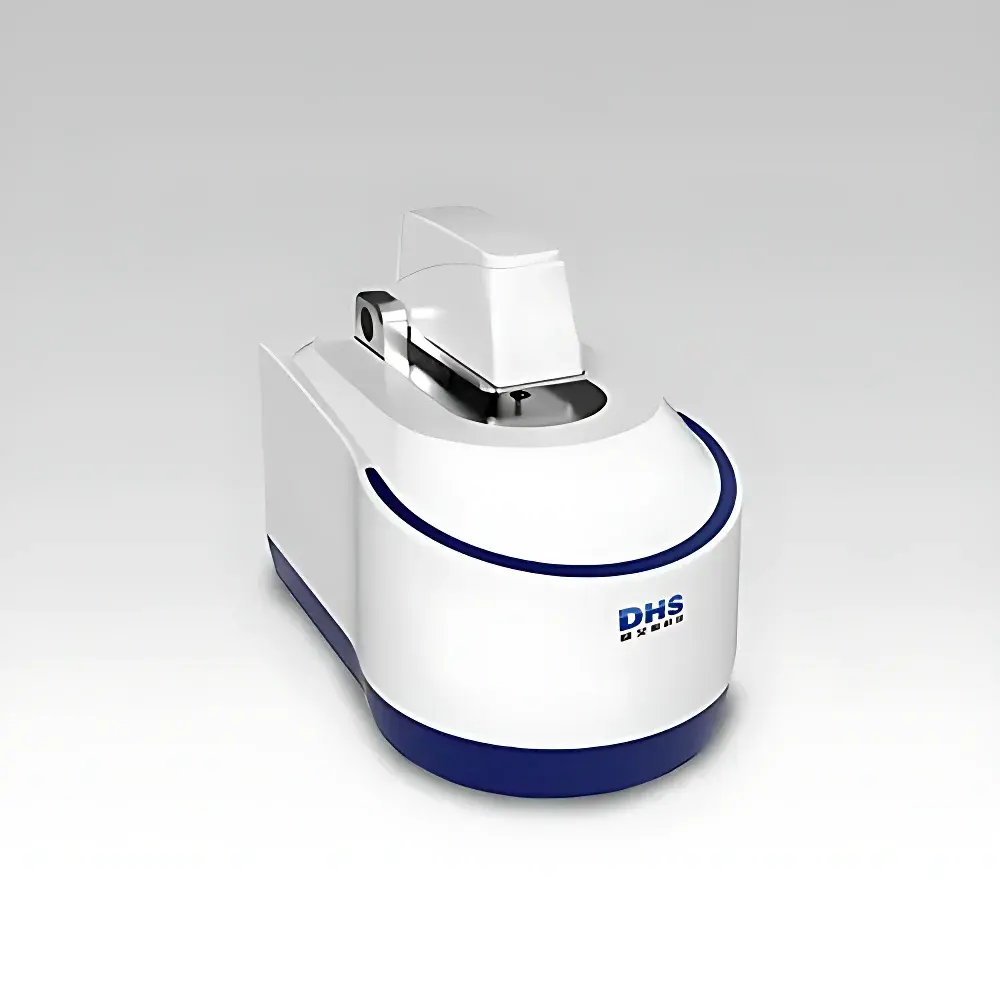
DHS NanoPro 2020 Ultraviolet-Visible Microvolume Spectrophotometer
| Brand | DHS |
|---|---|
| Origin | Tianjin, China |
| Model | NanoPro 2020 |
| Optical Design | Dual-beam |
| Detector | 2048-pixel linear CCD array |
| Wavelength Range | 185–910 nm |
| Wavelength Accuracy | ±1 nm |
| Spectral Bandwidth | ≤1.8 nm (FWHM at Hg 253.7 nm) |
| Stray Light | ≤0.0001% T |
| Minimum Sample Volume | 0.5 µL |
| Minimum Pathlength | 0.05 mm |
| Maximum dsDNA Concentration | 15,000 ng/µL |
| Absorbance Accuracy | ±3% at 0.65 A (350 nm) |
| Absorbance Precision | ±0.002 A (1 mm pathlength) |
| Measurement Time | <5 s |
| Cuvette Mode | Yes (heating: 37±0.5 °C |
| magnetic stirring | 150–850 rpm) |
| Variable Pathlength Options | 0.05, 0.2, 1, 2, 5, 10 mm |
| Data Interface | USB + Wi-Fi |
| Power Supply | AC 110–220 V, 50/60 Hz |
| Weight | 2.1 kg |
Overview
The DHS NanoPro 2020 is a dual-beam microvolume ultraviolet-visible (UV-Vis) spectrophotometer engineered for high-precision nucleic acid, protein, and cell suspension quantification in resource-constrained or high-throughput laboratory environments. It operates on the principle of absorbance spectroscopy—measuring sample attenuation of collimated polychromatic light across the 185–910 nm spectral range—and employs a Hamamatsu flash xenon lamp as its stable, long-life broadband source. Unlike conventional cuvette-based instruments, the NanoPro 2020 utilizes variable-pathlength microfluidic measurement, enabling direct analysis of sub-microliter volumes without dilution. Its optical architecture integrates a high-resolution 2048-pixel linear CCD detector with real-time background correction, delivering reproducible photometric data under both drop-based and standard cuvette configurations. Designed for compliance with routine QC/QA workflows, the system supports traceable calibration protocols aligned with ISO/IEC 17025 documentation practices.
Key Features
- Dual-beam optical design with real-time reference beam compensation, minimizing drift from lamp instability or environmental fluctuations.
- Variable pathlength capability—from 0.05 mm to 10 mm—enabling accurate quantification of samples ranging from highly diluted oligonucleotides (down to 0.4 ng/µL dsDNA) to concentrated lysates (up to 15,000 ng/µL dsDNA) without manual dilution.
- Integrated cuvette mode with Peltier-controlled heating (37 ± 0.5 °C) and programmable magnetic stirring (150–850 rpm), supporting kinetic assays and temperature-sensitive measurements such as enzyme activity or thermal denaturation profiling.
- Wi-Fi-enabled remote operation via tablet interface, allowing unattended time-course acquisition with user-defined intervals and automatic timestamped file naming.
- Preloaded quantification algorithms for dsDNA, ssDNA, RNA, oligos, proteins (BCA, Bradford, Lowry, Pierce 660 nm), and common fluorescent dyes—including extinction coefficient libraries for SYBR Gold, Ethidium Bromide, and Qubit reagents.
- Full-spectrum scanning at 1-nm resolution across 185–910 nm, with customizable wavelength selection, peak identification, and spectral overlay for comparative analysis.
Sample Compatibility & Compliance
The NanoPro 2020 accommodates diverse biological matrices including purified nucleic acids, crude lysates, protein solutions, antibody conjugates, and bacterial/fungal suspensions (OD600). Its low-volume footprint (0.5 µL minimum) preserves precious clinical or synthetic samples. The instrument meets core performance criteria outlined in ASTM E275–21 (Standard Practices for Describing and Measuring Performance of UV-Vis Spectrophotometers) and supports audit-ready data management per FDA 21 CFR Part 11 requirements when deployed with validated software configurations. All absorbance values are traceably referenced to NIST-traceable standards, and pathlength calibration is verified using certified neutral density filters. Optional IQ/OQ documentation packages are available for GLP and GMP-regulated laboratories.
Software & Data Management
The NanoPro Control Suite runs on Windows-based platforms and provides intuitive graphical workflow navigation, context-sensitive help, and export-compatible data formatting (CSV, PDF, XML). Each measurement session automatically generates a metadata-rich file containing instrument ID, date/time stamp, pathlength, wavelength settings, raw spectra, and calculated concentrations. Audit trails record all user actions—including parameter modifications, calibration events, and file deletions—with immutable timestamps. Data encryption and role-based access control align with institutional IT security policies. Firmware updates are performed via USB drive, ensuring offline validation integrity. Wi-Fi connectivity enables secure cloud synchronization (when permitted by local network policy) and centralized instrument fleet monitoring.
Applications
- Nucleic acid quantification and purity assessment (A260/A280, A260/A230) for next-generation sequencing library preparation and CRISPR guide RNA synthesis.
- High-concentration protein formulation analysis in biopharmaceutical development, where traditional 1-cm cuvettes saturate detectors.
- Real-time monitoring of enzymatic reactions (e.g., NADH oxidation, protease cleavage) using kinetic absorbance tracking at user-defined wavelengths.
- Cell density normalization in microbiology and fermentation studies via OD600 measurement alongside optional multi-wavelength absorption profiling.
- Quality control of fluorescently labeled probes used in qPCR, FISH, and flow cytometry—leveraging built-in dye-specific extinction coefficients and excitation/emission cross-talk correction.
FAQ
What is the minimum detectable dsDNA concentration?
The NanoPro 2020 achieves a lower limit of quantitation of 0.4 ng/µL dsDNA under optimized 1-mm pathlength conditions.
Can the instrument perform kinetic measurements in cuvette mode?
Yes—cuvette mode supports time-resolved absorbance acquisition with configurable interval timing, temperature stabilization, and magnetic agitation for homogeneous reaction monitoring.
Is spectral data export compatible with third-party analysis tools?
Raw absorbance spectra are exportable as CSV files with wavelength and intensity columns, fully interoperable with OriginLab, GraphPad Prism, Python (NumPy/Pandas), and R environments.
How is pathlength calibrated and verified?
Pathlength verification uses factory-calibrated quartz slides with certified step heights; users may perform periodic validation using air/water or glycerol reference standards per SOP.
Does the system support multi-user environments with permission levels?
Yes—the software implements three-tier access control (Operator, Supervisor, Administrator) with password protection and encrypted log files compliant with ALCOA+ data integrity principles.





