
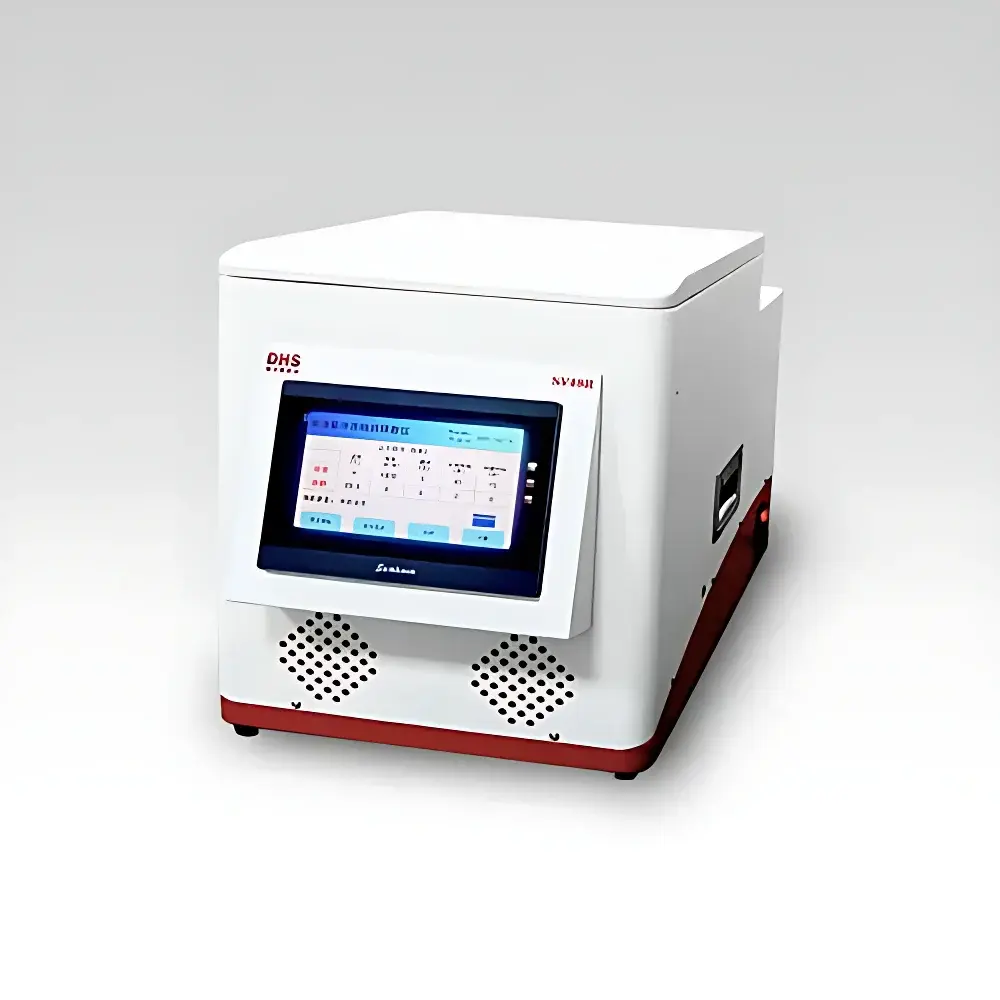
DHS SV48R High-Throughput Cryogenic Tissue Grinder
| Brand | DHS |
|---|---|
| Origin | Tianjin, China |
| Model | SV48R |
| Temperature Range | −20 °C to 40 °C |
| Maximum Frequency | 2100 cycles/min |
| Sample Capacity | 48 tubes per run |
| Touchscreen | 7-inch HD capacitive display |
| Program Storage | ≥100 user-defined protocols |
| Construction | Stainless steel interior chamber, aluminum alloy adapters |
| Acceleration/Deceleration Time | ≤2 s to/from max speed |
| Compliance | Designed for GLP-compliant workflows, compatible with ISO 17025 laboratory environments |
Overview
The DHS SV48R High-Throughput Cryogenic Tissue Grinder is an engineered solution for rapid, reproducible, and temperature-controlled mechanical homogenization of biological tissues in research, clinical diagnostics, and pharmaceutical development laboratories. Operating on the principle of high-frequency vertical impact grinding—where sample tubes are vigorously oscillated against grinding beads inside cryo-cooled adapters—the instrument delivers consistent particle size reduction while preserving molecular integrity. Its integrated refrigeration system, powered by a premium imported compressor and eco-friendly refrigerant, maintains precise thermal control from −20 °C to +40 °C, enabling reliable RNA, DNA, and protein extraction without thermal degradation. Unlike conventional bead mills relying on horizontal orbital motion, the SV48R’s vertically oriented drive mechanism ensures uniform energy transfer across all 48 positions simultaneously, minimizing inter-sample variability and eliminating the need for batch sequential processing.
Key Features
- Cryogenic Precision Control: Factory-calibrated refrigeration system achieves stable sub-zero temperatures (−20 °C) within <90 seconds; temperature stability maintained ±0.5 °C during extended runs.
- High-Frequency Vertical Impact Drive: Dual eccentric motor assembly delivers up to 2100 cycles per minute with symmetrical force distribution—optimized for efficient cell lysis and matrix disruption in fibrous or fatty tissues.
- Locking Adapter System: Threaded retention caps with anti-backlash threads prevent adapter loosening under high-frequency operation, ensuring mechanical safety and protocol repeatability.
- Corrosion-Resistant Aluminum Adapters: CNC-machined 6061-T6 aluminum blocks with anodized surface finish provide dimensional stability across thermal cycling and resist chemical exposure from common lysis buffers.
- Intuitive Human-Machine Interface: 7-inch industrial-grade capacitive touchscreen supports multi-language UI (English default), real-time parameter monitoring, and graphical protocol editing with password-protected administrator access.
- Rapid Dynamic Response: Full-speed acceleration and deceleration completed within 2 seconds—critical for minimizing heat accumulation and enabling precise pulse-mode grinding protocols.
- Modular Hardware Architecture: Standard 2-mL, 5-mL, and 15-mL tube configurations supported; custom adapter designs available for specialty vials (e.g., CryoPure®, Safe-Lock™) under OEM engineering collaboration.
Sample Compatibility & Compliance
The SV48R accommodates a broad spectrum of biological matrices—including mammalian liver, muscle, tumor biopsies, plant leaves, microbial pellets, and frozen blood clots—across tube formats ranging from 0.2 mL PCR strips to 15 mL conical centrifuge tubes. All wetted components comply with USP Class VI biocompatibility standards. The instrument’s operational log and parameter audit trail meet basic requirements for GLP documentation; when paired with optional LIMS-integrated software modules, it supports 21 CFR Part 11–compliant electronic signatures and change-controlled method storage. Routine maintenance intervals align with ISO/IEC 17025 clause 6.4.10 (equipment verification), and calibration certificates for temperature and frequency sensors are provided upon installation.
Software & Data Management
Embedded firmware supports local storage of ≥100 user-defined grinding protocols, each configurable with independent ramp profiles, dwell times, cycle counts, and temperature setpoints. USB export enables CSV-formatted run logs (timestamp, target temp, actual temp, frequency, duration, error codes) for traceability. Optional Ethernet-enabled firmware upgrade (v3.2+) permits remote monitoring via secure HTTPS API endpoints, integration with LabVantage or Thermo Fisher SampleManager platforms, and automated backup to network-attached storage. All data files adhere to FAIR principles (Findable, Accessible, Interoperable, Reusable) through embedded metadata tags compliant with ISA-Tab schema conventions.
Applications
- High-yield nucleic acid isolation for NGS library prep and qPCR validation
- Pre-analytical sample homogenization in biobanking operations (ISO 20387-aligned workflows)
- Proteomic sample preparation requiring phosphoprotein preservation
- Metabolite extraction from thermolabile plant secondary compounds
- Microbiome studies involving anaerobic gut content processing under chilled conditions
- Quality control testing of lyophilized biologics and vaccine formulations
FAQ
What types of grinding media are compatible with the SV48R?
Stainless steel, zirconia, and tungsten carbide beads (0.5–4.0 mm diameter) are validated; bead-to-sample mass ratios follow manufacturer-recommended guidelines per tissue type.
Is the instrument suitable for GMP-regulated environments?
Yes—when deployed with documented IQ/OQ protocols, calibrated sensors, and version-controlled firmware, the SV48R meets foundational requirements for equipment qualification in pharmaceutical QC labs.
Can the SV48R be integrated into automated liquid handling workflows?
Via optional I/O expansion module (8-channel TTL input/output), it synchronizes with robotic arms and plate handlers using standardized trigger signals (e.g., dry contact closure at start/finish).
Does the refrigeration system require external ventilation or coolant lines?
No—self-contained air-cooled condenser operates efficiently in standard lab ambient conditions (15–30 °C, <70% RH); rear clearance of ≥10 cm is required for thermal dissipation.
How often must the drive belt be replaced?
Under continuous use (8 hrs/day), the reinforced poly-V belt is rated for 12,000 hours; preventive replacement is scheduled every 24 months or per usage log analysis.



