
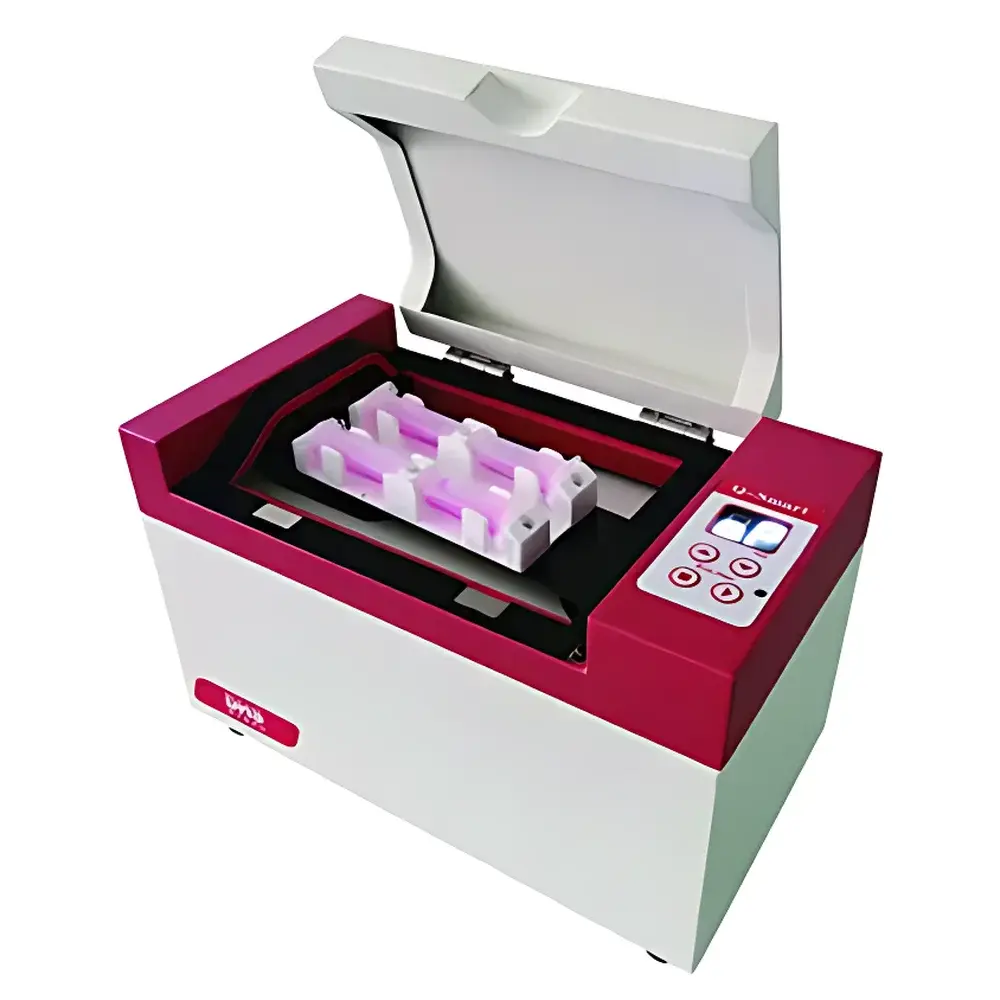
DHS Q-Smart AC/DC-Powered High-Energy Compact Tissue Grinder
| Brand | DHS |
|---|---|
| Origin | Tianjin, China |
| Model | Q-Smart |
| Power Supply | Dual AC (100–240 VAC, 50/60 Hz) & DC (12–24 VDC) |
| Maximum Speed | 3000 rpm |
| Sample Capacity | 4 × 4 mL tubes (patented thick-walled DHS grinding tubes) |
| Tube Compatibility | Custom 4 mL impact-resistant grinding tubes |
| Operating Time on Battery | >3 hours (8.5 Ah external power bank) |
| Safety Interlock | Lid-activated automatic shutdown |
| Dimensions | Height ≈ 220 mm (≈2/3 height of standard 500 mL beverage bottle) |
| Weight | <3.5 kg |
| Application Scope | Hair, soft/hard/brittle/elastic/fibrous biological tissues, food, microorganisms, minerals |
Overview
The DHS Q-Smart is a portable, high-energy tissue grinder engineered for rapid, reproducible homogenization of diverse sample types under variable power conditions. Unlike conventional vortex or bead-beating systems constrained to fixed AC outlets, the Q-Smart integrates dual-mode power architecture—accepting both standard AC input and regulated DC supply (12–24 VDC)—enabling uninterrupted operation in field laboratories, mobile testing units, biosafety cabinets, or remote collection sites where grid access is limited or unavailable. Its core mechanism employs multi-axis orbital agitation combined with high-frequency vertical impact, generating intense mechanical shear and collision forces within sealed, chemically inert grinding tubes. This kinematic profile ensures efficient cell lysis, particle size reduction, and matrix homogenization across heterogeneous samples—including keratin-rich human hair, fibrous plant tissues, tough microbial pellets, and mineralized biological composites—without significant thermal buildup or nucleic acid degradation when operated within recommended time windows.
Key Features
- True Dual-Power Flexibility: Internally regulated power management accepts universal AC input (100–240 VAC, 50/60 Hz) and direct-current sources (12–24 VDC), eliminating dependency on fixed infrastructure.
- High-Energy Multi-Dimensional Motion: Proprietary drive system delivers synchronized orbital rotation and vertical oscillation at up to 3000 rpm, maximizing kinetic energy transfer while minimizing tube wear and cross-contamination risk.
- Patented 4-Tube Processing Platform: Accommodates four custom-engineered 4 mL DHS grinding tubes with reinforced walls and optimized internal geometry for consistent bead trajectory and uniform energy distribution.
- One-Second Tube Engagement: Integrated quick-lock clamp mechanism secures tubes with single-hand operation—no tools, no alignment calibration—reducing setup time and operator fatigue during high-throughput workflows.
- Integrated Safety Architecture: Mechanical lid interlock halts motor rotation instantly upon cover opening; all moving components are fully enclosed within an IP20-rated housing compliant with IEC 61010-1 for laboratory equipment safety.
- Field-Ready Portability: Compact footprint (≤220 mm height, <3.5 kg mass) and compatibility with standard 8.5 Ah external power banks support ≥3 hours of continuous operation without AC reconnection.
Sample Compatibility & Compliance
The Q-Smart demonstrates validated performance across ISO 17025-aligned sample categories: keratinous matrices (human hair, nails), soft animal tissues (liver, spleen), fibrous botanicals (leaves, stems), hydrated microbial cultures (yeast, Gram-positive bacteria), freeze-dried food matrices, and low-density mineral powders. Tube design complies with ISO 8573-1 (compressed air purity) for cleanroom-compatible use and meets material compatibility requirements per USP for polypropylene-based consumables. While not certified for GMP manufacturing environments, its repeatable torque delivery and documented run-time stability support GLP-compliant method development and QC release testing in clinical, forensic, and agricultural laboratories.
Software & Data Management
The Q-Smart operates as a standalone instrument with embedded firmware controlling speed, duration, and pause intervals via tactile membrane keypad. No proprietary software is required for basic operation; however, optional USB-C data logging (firmware v2.1+) records timestamped run parameters (rpm, elapsed time, lid status) in CSV format for audit trail generation. Exported logs satisfy traceability requirements under FDA 21 CFR Part 11 when paired with institutional electronic record policies and user-access controls. Firmware updates are delivered via signed binary files through DHS’s secure technical portal—no cloud connectivity or third-party telemetry.
Applications
- Routine forensic toxicology: Rapid homogenization of hair segments prior to LC-MS/MS analysis of drug metabolites.
- Agricultural residue screening: Uniform dispersion of pesticide-treated plant tissues for QuEChERS extraction.
- Clinical microbiology: Efficient lysis of biofilm-forming bacterial isolates for MALDI-TOF MS identification.
- Nutritional science: Particle size reduction of fortified cereals and dietary supplements for elemental analysis (ICP-OES).
- Environmental monitoring: Homogenization of soil-microbe composites for metagenomic DNA extraction.
- Biobanking: Standardized processing of flash-frozen tissue biopsies across decentralized collection nodes.
FAQ
Can the Q-Smart be used inside a biosafety cabinet?
Yes—the unit’s low electromagnetic emissions, compact dimensions, and DC-operability make it suitable for Class II A2 and B2 cabinets without airflow disruption.
Is the 4 mL tube compatible with common commercial lysis kits?
Yes—tubes meet ANSI/SLAS dimensional standards and accept standard 2.8 mm stainless steel or zirconia beads used in commercial bead-beating protocols.
Does the instrument support programmable multi-step protocols?
No—Q-Smart offers fixed-speed, timer-based operation only; advanced sequencing requires external automation integration via TTL trigger interface (optional accessory).
What maintenance is required for long-term reliability?
Annual inspection of drive coupling integrity and recalibration of speed sensor output using DHS-certified tachometer; no lubrication or consumable parts beyond tubes and beads.
How is thermal management handled during extended runs?
Passive aluminum heat sinking integrated into motor housing, combined with duty-cycle limitations (2500 rpm), prevents coil temperature exceedance per IEC 60034-1 insulation class F specifications.
Related Products



