
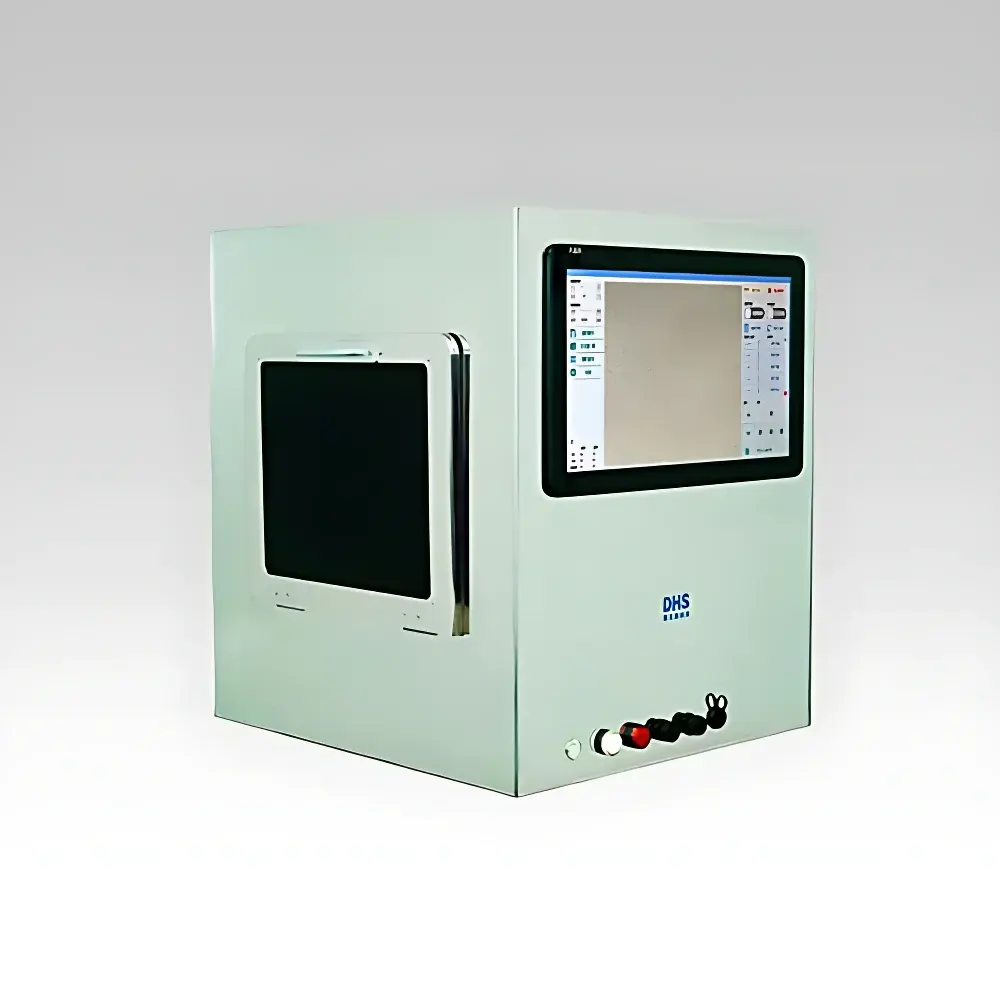
BCM200 In Situ Cell Factory Monitoring System by DHS
| Brand | DHS |
|---|---|
| Model | BCM200 |
| Origin | Tianjin, China |
| Category | Optical Microscope – Tool Measuring Microscope for Bioreactor Monitoring |
| Imaging Capability | Real-time in situ observation of up to 10-layer cell factories |
| Observation Layers | Bottom 3 layers + top 2 layers (5 layers total) |
| Field Coverage per Layer | Up to 80% |
| Magnification | 10× |
| Imaging Sensor | Imported high-resolution color CMOS camera |
| Optical Design | Infinity-corrected, ultra-flat field optical path with beam folding |
| Automation | Closed-loop precision motorized stage and focus control |
| Software | Role-based three-tier user permission system with audit trail |
| Display | 21-inch integrated HD monitor |
| Construction | Stainless steel housing, oxidation-resistant and contamination-minimized |
| Compliance Framework | Designed to support GLP/GMP-aligned workflows and 21 CFR Part 11–ready data integrity architecture |
| Price Range | USD $13,500 – $27,000 (FOB Tianjin) |
Overview
The BCM200 In Situ Cell Factory Monitoring System is a purpose-built optical instrumentation platform engineered for non-invasive, real-time morphological and confluence assessment of adherent mammalian cells cultivated in multilayer cell factory systems. Unlike conventional offline microscopy or destructive sampling methods, the BCM200 employs an infinity-corrected, folded optical path with ultra-flat field correction—enabling high-fidelity, distortion-free imaging across large-area polycarbonate or PETG cell factory surfaces. Its core measurement principle relies on transmitted brightfield illumination combined with high-NA objective optics and a calibrated 10× magnification pathway, optimized for cellular resolution at sub-20 µm detail without requiring medium removal or substrate detachment. The system is specifically validated for use with standard 1-layer to 10-layer cell factories (e.g., Nunc™ Cell Factory®, Corning® CellSTACK®, and similar ISO-compliant bioreactor vessels), delivering consistent image geometry and photometric repeatability across all observable layers.
Key Features
- Non-destructive in situ monitoring: Eliminates the need for medium aspiration, trypsinization, or vessel disassembly—preserving sterility and culture integrity throughout the production cycle.
- Five-layer selective imaging capability: Simultaneous optical access to the bottom three layers and top two layers of stacked cell factories; each layer imaged over ≥80% of its usable surface area (typically ≥1,200 cm² per layer).
- Motorized closed-loop positioning: Precision stepper-driven Z-axis focus and X-Y translation ensure repeatable focal plane alignment across all layers; positional accuracy maintained within ±1.5 µm over extended operation.
- Integrated 21-inch industrial-grade display: Full-HD (1920 × 1080) touchscreen interface with embedded GUI for real-time image acquisition, annotation, and session logging.
- Stainless steel structural chassis: Electropolished AISI 304 housing with sealed optical compartments, compliant with ISO 14644-1 Class 7 cleanroom compatibility requirements.
- Three-tier software permission architecture: Administrator, Supervisor, and Operator roles with password-protected access, mandatory electronic signatures, and immutable audit trails meeting FDA 21 CFR Part 11 Annex 11 expectations.
Sample Compatibility & Compliance
The BCM200 accommodates commercially available cell factory formats ranging from 1 to 10 layers, including those conforming to ASTM F2971-23 (Standard Specification for Polycarbonate Cell Culture Vessels) and ISO 5725-2:2022 (accuracy and precision of measurement methods). It supports both serum-containing and serum-free media formulations, as well as common substrates such as collagen-coated, fibronectin-coated, or uncoated surfaces. All optical components are certified free of leachable organics per USP , and the system’s mechanical design meets IEC 61000-6-2/6-4 electromagnetic compatibility standards. Routine calibration verification is supported via NIST-traceable stage micrometers and photometric reference tiles.
Software & Data Management
The embedded DHS VisionSuite™ v3.2 software provides native DICOM-compatible image export (JPEG2000, TIFF, PNG), time-lapse sequence capture (up to 999 frames/hour), and confluence quantification using adaptive threshold segmentation algorithms. Metadata—including timestamp, operator ID, layer index, focus position, illumination intensity, and environmental log tags (if integrated with external CO₂/temp sensors)—is automatically embedded into each image file. All user actions, configuration changes, and report generation events are recorded in a tamper-evident SQLite database with SHA-256 hashing. Exported datasets comply with ALCOA+ principles (Attributable, Legible, Contemporaneous, Original, Accurate, Complete, Consistent, Enduring, Available) for regulatory submission readiness.
Applications
- Real-time QC release testing of monoclonal antibody production batches in upstream bioprocessing.
- In-process monitoring of vaccine seed train expansion (e.g., Vero, MDCK, or CHO-S cells) under cGMP conditions.
- Confluence validation prior to harvest or passaging in regenerative medicine workflows.
- Comparative morphology analysis during process characterization studies (ICH Q5D, Q5E).
- Supporting tech transfer documentation for FDA BLA or EMA MAA submissions where in situ imaging evidence is required.
FAQ
Can the BCM200 image all 10 layers of a cell factory simultaneously?
No—optical constraints limit simultaneous high-resolution imaging to five designated layers (bottom 3 + top 2). Intermediary layers require manual repositioning or optional add-on z-stack modules.
Is the system compatible with sterile hood integration?
Yes—the compact footprint (W620 × D710 × H1,020 mm) and front-access design allow seamless installation inside Class II A2 biosafety cabinets with ≥300 mm rear clearance.
Does the software support LIMS or MES integration?
Yes—via RESTful API and HL7-compatible webhooks; preconfigured connectors available for Thermo Fisher SampleManager, LabVantage, and Siemens Opcenter.
What is the recommended maintenance interval?
Optical alignment verification every 6 months; CMOS sensor cleaning and illumination uniformity check every 3 months; full preventive maintenance annually per DHS Service Protocol SP-BCM200-REV4.
Can third-party analysis plugins be loaded into the software?
Only validated, digitally signed plugins approved through DHS’s Partner Integration Program (PIP); end-user code injection is disabled by firmware-level security policies.




