
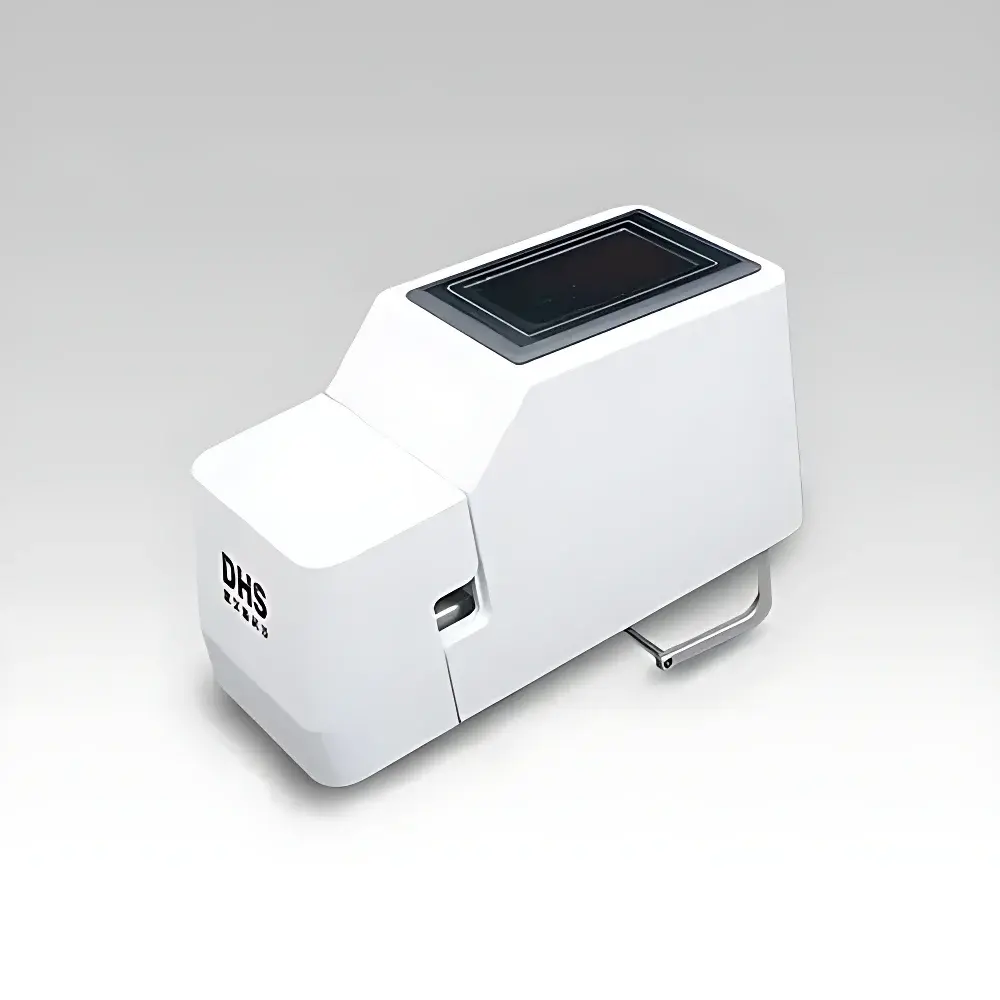
DHS BS600 Automated Sterile Tube Sealer
| Brand | DHS |
|---|---|
| Origin | Tianjin, China |
| Manufacturer Type | Authorized Distributor |
| Origin Category | Domestic (China) |
| Model | BS600 |
| Pricing | Available Upon Request |
| Sealing Diameter Range | 1/4″ to 1″ (6.35 mm to 25.4 mm) OD |
| Seal Width | 20 mm |
| Sealing Time | 2–4 min |
| Actuation | Fully Automatic Compression |
| Cooling Method | Forced Air Cooling |
| Dimensions (W×H×D) | 141 × 223 × 369 mm |
| Net Weight | ~3.5 kg |
| Operation Interface | Touch-Enabled Single-Touch Control Panel |
| User Access Control | Three-Tier Role-Based Authentication |
| Audit Trail | Full GLP/GMP-Compliant Electronic Log with Timestamped Events |
| Power Supply | 100–240 VAC, 50/60 Hz |
| Compliance | ISO 13485 Design Controls, ASTM F2097 (Standard Guide for Sterile Barrier Systems), FDA 21 CFR Part 11 Ready (via optional software module) |
Overview
The DHS BS600 Automated Sterile Tube Sealer is an engineered solution for aseptic tubing termination in bioprocessing, pharmaceutical manufacturing, and clinical laboratory environments. It employs resistive thermal sealing technology—applying precisely controlled heat and mechanical compression—to fuse thermoplastic tubing (e.g., silicone, PVC, C-Flex®, Tygon®) without introducing particulates, solvents, or consumable components. Unlike flame-based or mechanical crimping methods, the BS600 delivers consistent, hermetic seals across variable tube diameters (6.35–25.4 mm OD), eliminating operator-dependent variability and supporting closed-system processing requirements defined in USP , EU GMP Annex 1, and ISO 14644-1 Class A/B environments. Its compact footprint and lightweight design enable deployment at point-of-use—adjacent to bioreactors, fill-finish lines, or isolators—without requiring dedicated utility infrastructure.
Key Features
- Wide-diameter adaptability: Standard configuration supports tubes from 1/4″ to 1″ OD; modular jaw inserts allow field-expansion to accommodate non-standard tubing profiles per customer validation protocols.
- 20 mm uniform seal zone: Optimized thermal distribution across a broad contact surface ensures complete polymer fusion, minimizing weak seams and leakage risk under pressure or vacuum conditions.
- Proven operational reliability: Validated for ≥100 consecutive successful seals per cycle without recalibration; each unit undergoes individual functional testing—including temperature ramp verification, force calibration, and timing accuracy checks—prior to shipment.
- Flexible deployment: Weighing only 3.5 kg with integrated wall-mount bracket and benchtop stand, the sealer operates in horizontal, vertical, or suspended orientation without compromising seal integrity.
- Single-touch automation: Integrated microprocessor controls all phases—tube insertion detection, jaw closure, heating profile execution, cooling cycle, and jaw release—eliminating manual timing or pressure adjustment.
- Regulatory-ready access control: Three-tier permission structure (Operator / Supervisor / Administrator) enforces procedural compliance; all user actions, seal events, and parameter changes are immutably logged with ISO 8601 timestamps and digital signatures.
Sample Compatibility & Compliance
The BS600 is validated for use with medical-grade thermoplastic tubing commonly employed in fluid transfer applications: silicone (Shore A 30–70), polyvinyl chloride (PVC), thermoplastic elastomers (TPE), and fluoropolymer-coated variants. It does not support rigid polymers (e.g., PTFE, polypropylene) or metal-reinforced hoses. All sealing parameters comply with ASTM F2097 guidance for sterile barrier system integrity and align with ISO 11607-1 requirements for packaging validation. The device’s electronic record architecture meets FDA 21 CFR Part 11 foundational criteria when paired with validated third-party LIMS or MES integration; audit trail files export in CSV and PDF/A-1b formats for long-term archival per ALCOA+ principles.
Software & Data Management
The embedded firmware provides real-time status feedback via LED indicators and a high-contrast monochrome display. Optional Ethernet/Wi-Fi connectivity enables remote monitoring through HTTPS-secured web interface (firmware v2.3+). Seal logs—including date/time, operator ID, tube diameter selected, actual seal duration, peak temperature, and pass/fail flag—are stored locally (16 GB internal flash) for ≥12 months of continuous operation. Data export supports automated SFTP push to enterprise servers or manual USB retrieval. All logs retain cryptographic hash integrity verification to prevent tampering—a prerequisite for GxP audits.
Applications
- Aseptic disconnect/reconnect during bioreactor harvest or media transfer
- Pre-sterilized tubing loop termination prior to gamma irradiation or EtO validation
- Point-of-care IV line sealing in compounding pharmacies (USP / compliant workflows)
- Cell therapy manufacturing: cryopreservation bag tubing isolation pre-freeze
- QC lab sample line quarantine after environmental monitoring swabbing
- Single-use system (SUS) component qualification under ICH Q5A/Q5B
FAQ
Does the BS600 require consumables such as sealing tapes or cartridges?
No. It uses direct resistive heating of the tube wall; no consumables are involved.
Can the BS600 seal tubes containing liquid or condensation?
Yes—it accommodates dry, moist, or fully filled thermoplastic tubing up to 80% internal volume, provided the liquid is non-corrosive to stainless steel jaws and operating below 60°C.
Is IQ/OQ/PQ documentation available?
Yes. DHS provides standardized Installation Qualification (IQ) and Operational Qualification (OQ) protocols; Performance Qualification (PQ) templates are customizable per client’s process-specific acceptance criteria.
What maintenance is required?
Annual calibration verification of temperature sensor and actuation force; cleaning of jaw surfaces with 70% IPA between batches is recommended.
How is traceability ensured during multi-shift operations?
Each seal event is cryptographically signed with unique operator credentials, machine serial number, and UTC timestamp—fully compatible with electronic batch record (EBR) systems.



