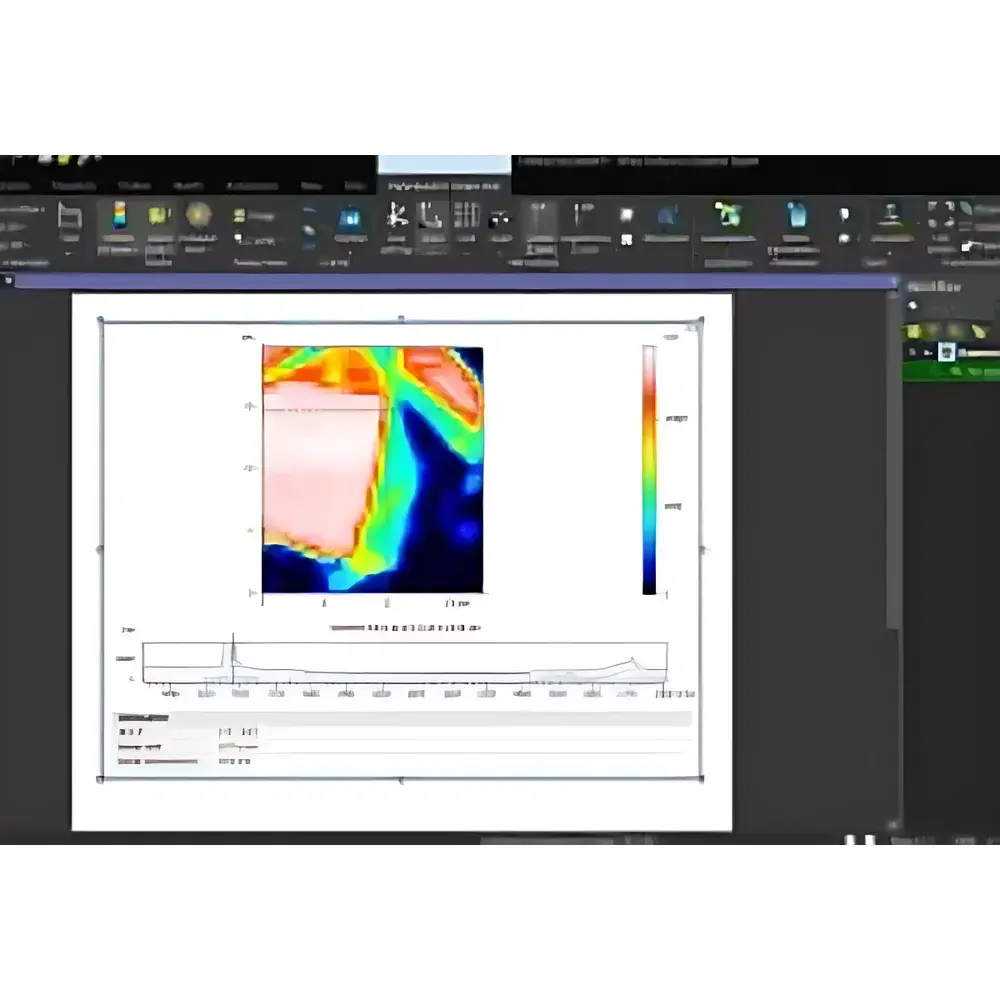
Wiley Surface to Spectral Analysis Software Suite
| Brand | Wiley |
|---|---|
| Origin | USA |
| Manufacturer Type | Authorized Distributor |
| Product Category | Imported |
| Model | Wiley Surface to Spectral Analysis Software Suite |
| Price Range | USD 13,500 – 20,500 |
Overview
Wiley Surface to Spectral Analysis Software Suite is a domain-specific scientific data integration platform engineered for correlative microspectroscopy and multimodal materials characterization. It implements a unified computational architecture grounded in spectral image registration, hyperspectral data cube processing, and spatial-spectral correlation modeling. Designed explicitly for laboratories performing advanced surface science, nanomaterials research, and failure analysis, the software bridges optical, electron, and probe-based microscopy with complementary spectroscopic modalities—including Raman, FTIR, NIR, UV-Vis, XPS, EDX/EDS, EELS, CL, PL, and TERS. Its core function is not standalone spectral acquisition but rather post-acquisition fusion, quantification, and contextual interpretation of heterogeneous datasets acquired across disparate instruments and vendors—enabling rigorous, traceable, and reproducible correlative analysis under GLP-compliant workflows.
Key Features
- Hyperspectral Data Cube Processing: Native support for vendor-agnostic spectral image formats (e.g., .dm3, .tif stacks with metadata, .spc, .spa, .jdx, .csv with wavelength/energy headers); enables pixel-wise spectral fitting, band ratio mapping, and spectral unmixing via constrained non-negative matrix factorization (cNMF) or principal component analysis (PCA).
- Multimodal Image Registration Engine: Sub-pixel alignment of SEM/TEM topography, AFM height maps, CL intensity images, and EDX elemental maps using intensity-based and feature-matching algorithms—critical for quantitative cross-instrument correlation.
- Integrated KnowItAll ID Expert Interface: Direct export of selected spectra (Raman, FTIR, ATR, NIR, UV-Vis) to Wiley’s KnowItAll ID Expert software for library search against >1.2 million reference spectra; supports spectral preprocessing (baseline correction, smoothing, normalization) prior to matching.
- 3D Chemical Visualization Framework: Converts 2D chemical distribution maps (e.g., Raman peak intensity, EDX elemental concentration, CL emission wavelength centroid) into interactive 3D surface plots, volume renderings, or isosurface models—georeferenced to underlying topographic or morphological data.
- Modular Plugin Architecture: Extensible via certified plugins for SEM/EDS (Oxford AZtec, Thermo Fisher Pathfinder), SPM (Bruker NanoScope Analysis), particle analysis (ImageJ/Fiji macros), and profilometry (Veeco Wyko, Zygo MetroPro) — all governed by a common metadata schema compliant with ASTM E2807 and ISO/IEC 17025 documentation requirements.
Sample Compatibility & Compliance
The software accepts input from solid-state, thin-film, and particulate samples analyzed under ambient, vacuum, or controlled-environment conditions. It fully supports spectral data conforming to NIST SRD-149 (Raman), NIST SRD-69 (FTIR), and USP (UV-Vis) reference standards. All processing steps—including baseline correction, peak deconvolution, and multivariate decomposition—are auditable and logged with timestamped operator ID, parameter settings, and version-controlled algorithm identifiers. The system satisfies FDA 21 CFR Part 11 requirements for electronic records and signatures when deployed with validated IT infrastructure and user access controls. Audit trails, raw data retention policies, and method validation reports align with ISO/IEC 17025:2017 Clause 7.7 (Results Reporting) and GLP Principles (OECD Series on Principles of Good Laboratory Practice).
Software & Data Management
Data management follows a hierarchical project-based structure: Projects → Experiments → Instruments → Acquisition Sessions → Processed Datasets. Each dataset retains full provenance—linking original instrument metadata (acquisition date, laser power, grating, detector gain), applied processing scripts (Python-based or GUI-defined), and exported results (CSV, TIFF, PDF, HTML reports). Export options include FAIR-compliant JSON-LD metadata bundles and HDF5 containers supporting hierarchical storage of spectral cubes, masks, and derived maps. Batch processing pipelines are scriptable via Python API (compatible with SciPy, scikit-learn, and h5py), enabling integration into automated QA/QC workflows. All user actions are recorded in an immutable audit log, including failed operations, parameter overrides, and manual corrections—ensuring full traceability for regulatory review.
Applications
- Correlative failure analysis of semiconductor devices: overlaying Raman stress maps onto SEM/EDX dopant distributions and AFM topography to localize strain-induced defects.
- Nanoparticle composition and crystallinity mapping in battery cathode materials using combined PL lifetime imaging, Raman phase identification, and EDS stoichiometry.
- Biomineralization studies: co-registering CL emission spectra from bone sections with TEM-EELS oxygen K-edge fine structure and AFM mechanical property maps.
- Photocatalyst surface heterogeneity assessment: integrating TERS chemical contrast, XPS valence state quantification, and PL quantum yield maps at sub-100 nm resolution.
- Forensic trace evidence analysis: correlating Raman spectral clusters in paint layers with SEM-EDS elemental stratigraphy and FTIR functional group distribution.
FAQ
Is this software a standalone acquisition platform or post-processing suite?
It is strictly a post-acquisition data integration and analysis environment. No hardware control or real-time acquisition capabilities are included.
Does it require a separate license for KnowItAll ID Expert?
Yes. Integration with KnowItAll ID Expert requires an active, licensed installation of KnowItAll (v2023 or later) and subscription to applicable spectral libraries (e.g., RamanLib, IRLib, UV-VisLib).
Can processed results be exported in formats compatible with LIMS or ELN systems?
Yes. CSV, XML, JSON-LD, and PDF/A-2 compliant reports support direct ingestion into most LIMS (e.g., LabVantage, Thermo Fisher SampleManager) and ELN platforms (e.g., Benchling, LabArchives).
What level of IT infrastructure validation is required for GxP environments?
Full validation per GAMP5 Category 4 applies. Documentation packages—including IQ/OQ/PQ protocols, risk assessments, and change control logs—are available upon request for qualified customers.
Are updates and technical support included in the initial purchase?
A 12-month Software Maintenance Agreement (SMA) covering patches, minor version upgrades, and priority email support is included. Extended SMA contracts are available.
Related Products