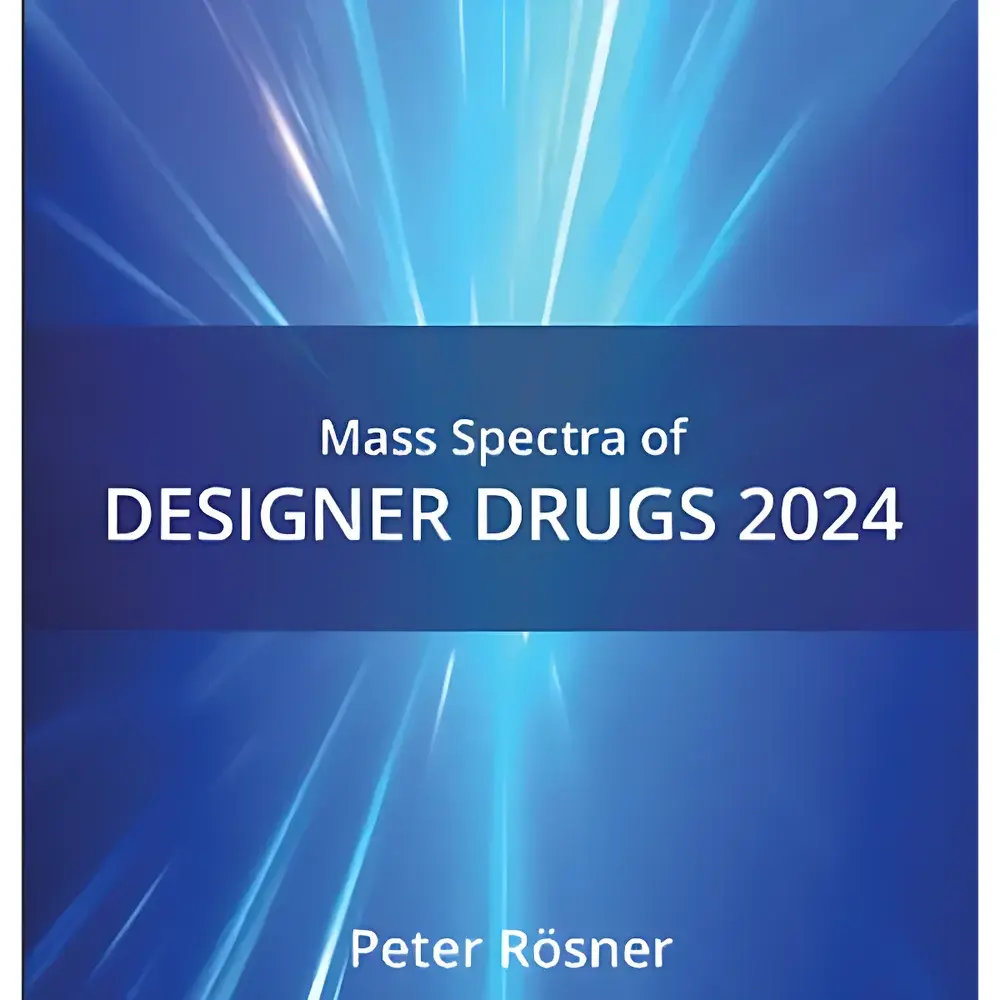
Wiley Designer Drugs Mass Spectral Database
| Brand | Wiley |
|---|---|
| Origin | USA |
| Model Year | 2024 |
| Software Type | Mass Spectrometry Library |
| Total Spectra | 35,094 |
| Unique Compounds | 26,712 |
| Verified Kovats Indices | 22,057 |
| Average Quality Index (QI) per Spectrum | 965 |
| Opioids | 371 |
| Fentanyl Analogues | 3,180 |
| Cannabinoids | 1,997 |
Overview
The Wiley Designer Drugs Mass Spectral Database is a rigorously curated, annually updated spectral reference library engineered for forensic toxicology, clinical laboratory medicine, and regulatory compliance laboratories performing gas chromatography–mass spectrometry (GC-MS) and liquid chromatography–mass spectrometry (LC-MS) analysis. Built upon decades of collaboration with forensic science laboratories, regional crime labs, and international public health agencies, this database delivers high-fidelity electron ionization (EI) mass spectra—acquired under standardized 70 eV conditions—paired with chemically validated structural annotations, retention index data, and contextual metadata. Its primary function is to support confident compound identification in complex biological matrices (e.g., urine, blood, hair) where novel psychoactive substances (NPS), opioid analogues, synthetic cannabinoids, and chemical warfare agent precursors require rapid, unambiguous spectral matching. Unlike generic commercial libraries, the Wiley Designer Drugs Database emphasizes forensic-grade traceability: each spectrum is cross-referenced to original analytical reports, peer-reviewed literature, clandestine synthesis documentation, and interlaboratory validation studies.
Key Features
- Annual updates ensuring alignment with emerging NPS trends—including newly scheduled fentanyl analogues, substituted cathinones, tryptamines, and benzodiazepine derivatives.
- 35,094 experimentally acquired EI mass spectra, all derived from authentic reference standards or rigorously characterized seized materials.
- 26,712 unique chemical entities, each assigned IUPAC nomenclature, CAS Registry Numbers (where applicable), and 2D/3D structural diagrams compliant with IUPAC and ChemDraw standards.
- 22,057 experimentally determined Kovats retention indices—critical for GC-MS method development and retention time prediction across diverse column chemistries (e.g., DB-5ms, Rxi-5Sil MS).
- Average Quality Index (QI) of 965 per spectrum—calculated using NIST-assigned confidence metrics based on peak intensity distribution, fragment reproducibility, and signal-to-noise ratio.
- Comprehensive coverage of high-priority substance classes: 3,180 fentanyl analogues (including carfentanil, acetylfentanyl, and fluorofentanyl variants), 1,997 cannabinoids (synthetic and semi-synthetic), and 371 structurally diverse opioids beyond traditional morphine/codeine scaffolds.
Sample Compatibility & Compliance
The database is fully compatible with major GC-MS and LC-MS data systems—including Thermo Fisher Scientific Chromeleon, Agilent MassHunter, Waters Empower, and Shimadzu GCMSsolution—via standard NIST .msp and .cdf import protocols. All spectral entries adhere to ASTM E2912-21 (Standard Guide for Mass Spectral Data Exchange) and ISO/IEC 17025:2017 requirements for reference material traceability. Each compound record includes documented provenance: source laboratory, acquisition date, instrument platform (e.g., Thermo ISQ 7000, Agilent 5977B), and spectral acquisition parameters. The database supports audit-ready workflows compliant with FDA 21 CFR Part 11, EU Annex 11, and GLP/GMP documentation standards through integrated metadata logging and version-controlled release archives.
Software & Data Management
Delivered as a standalone spectral library package, the Wiley Designer Drugs Database integrates seamlessly into existing LIMS and electronic lab notebook (ELN) environments via API-accessible metadata endpoints. It supports hierarchical search by molecular formula, exact mass, functional group, legal status (e.g., UNODC Schedule I/II), or structural similarity (Tanimoto coefficient ≥0.85). Batch processing tools enable automated library searching across hundreds of unknown samples while generating full audit trails—including match factor scores, reverse match factors, probability-weighted identifications, and spectral deviation alerts. Version history is maintained per annual release (e.g., “Wiley Designer Drugs v2024.1”), with backward compatibility ensured for legacy instrument control software.
Applications
- Routine toxicology screening in clinical and forensic laboratories for postmortem, impaired driving, and workplace drug testing.
- Supporting DEA, EMA, and WHO early-warning systems for monitoring NPS emergence and geographic dispersion patterns.
- Method validation for ISO/IEC 17025-accredited laboratories requiring reference spectral evidence during proficiency testing.
- Training and competency assessment for mass spectrometrists using real-world case spectra from confirmed seizures and clinical intoxications.
- Forensic chemistry research on metabolic biotransformation pathways—leveraging co-eluting metabolite spectra and diagnostic fragment ions.
FAQ
Is the Wiley Designer Drugs Database compatible with open-source mass spectral search engines such as AMDIS or MS-DIAL?
Yes—spectra are provided in vendor-neutral NIST MSP format and can be converted to AMDIS-compatible formats using freely available utilities like msConvert (ProteoWizard).
How frequently is the database updated, and what is the versioning protocol?
A new annual release is published each Q1 (January–March), designated by year (e.g., v2024). Minor patches (e.g., v2024.1) address urgent additions or corrections, with full change logs provided in PDF format.
Does the database include quantitative information (e.g., response factors or calibration curves)?
No—this is a qualitative identification library only. Quantitative methods must be developed separately using certified reference standards and matrix-matched calibration.
Are spectral matches validated against in-house reference standards at Wiley?
All spectra included in the database were originally generated by partner forensic laboratories using authenticated reference materials; Wiley performs secondary spectral integrity checks but does not conduct primary synthesis or characterization.