
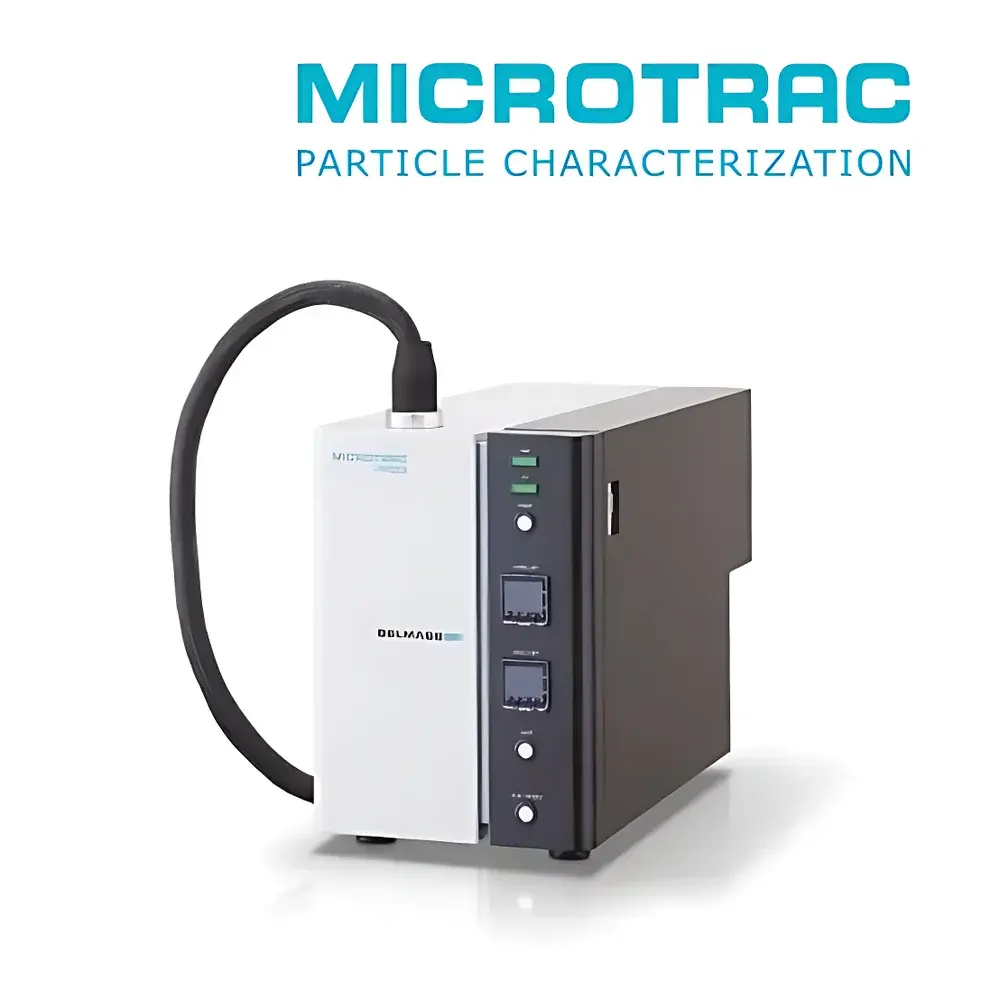
Microtrac BELMASS II Online Quadrupole Mass Spectrometer
| Brand | Microtrac |
|---|---|
| Origin | Japan |
| Manufacturer Type | Authorized Distributor |
| Origin Category | Imported Instrument |
| Model | BELMASS II |
| Instrument Type | Chemisorption Analyzer with Integrated Online MS Detection |
| Gas Inlet Ports | Up to 16 |
| Temperature Stability | ±0.001 °C |
| Supported Techniques | TPD, TPR, TPS, Pulse Titration, BET Surface Area Analysis (via coupled gas dosing) |
| Mass Range | 1–200 amu |
| Detector | Faraday Cup / Continuous Dynode Electron Multiplier (C-SEM) |
| Minimum Detectable Concentration | <1 ppm (gas-dependent) |
| Scan Speed Options | Auto, 0.01–10 sec per amu (selectable) |
| Detection Channels | Up to 16 simultaneous mass channels |
| Sample Interface | Heated capillary transfer line (up to 300 °C), integrated dry scroll pump |
Overview
The Microtrac BELMASS II is a compact, benchtop quadrupole mass spectrometer engineered for real-time, quantitative gas-phase analysis in catalytic and surface science laboratories. Unlike conventional mass spectrometers optimized solely for qualitative identification, the BELMASS II integrates hardware and signal processing innovations—such as thermally stabilized ion optics, heated sample transfer lines (up to 300 °C), and a dedicated dry scroll vacuum pump—to significantly enhance reproducibility and quantitative fidelity in dynamic gas environments. Its core measurement principle relies on mass-selective ion transmission through a radiofrequency (RF)/DC-stabilized quadrupole filter, followed by detection via dual-mode electronics (Faraday cup for high-concentration stability and C-SEM for trace-level sensitivity). Designed explicitly for integration with catalytic characterization platforms—including automated chemisorption analyzers, microreactors, and thermogravimetric systems—the BELMASS II delivers time-resolved, multi-mass-channel data essential for kinetic modeling, reaction mechanism elucidation, and catalyst deactivation studies.
Key Features
- Benchtop quadrupole architecture with robust mechanical design for continuous operation in analytical laboratory environments
- Heated capillary inlet system (0–300 °C) minimizing condensation and adsorption losses of polar or low-volatility species (e.g., NH₃, H₂O, CO₂)
- Integrated dry scroll vacuum pump eliminating oil backstreaming and enabling rapid pump-down (<60 s to operating pressure)
- High-precision temperature control (±0.001 °C) across critical components—ion source, quadrupole rod set, and detector—to ensure long-term mass calibration stability
- Configurable scan modes: fixed-mass monitoring, stepped-scan, or full-spectrum acquisition with user-defined dwell times (0.01–10 s per amu)
- Simultaneous monitoring of up to 16 preselected mass-to-charge (m/z) channels, supporting parallel quantification of reactants, intermediates, and products
- Mass range of 1–200 amu with unit-mass resolution and <1 ppm minimum detectable concentration (for common gases including H₂, CO, O₂, NH₃, CH₄, and NO)
Sample Compatibility & Compliance
The BELMASS II interfaces seamlessly with standard catalytic test systems via stainless-steel or fused-silica heated transfer lines. It supports both continuous flow and pulsed injection configurations, making it compatible with TPD, TPR, TPS, and pulse chemisorption protocols per ASTM D7215, ISO 18382, and IUPAC-recommended methodologies. The instrument complies with CE marking requirements for electromagnetic compatibility (EMC Directive 2014/30/EU) and low-voltage safety (LVD Directive 2014/35/EU). When operated in GLP- or GMP-regulated environments, audit-trail-enabled software options support 21 CFR Part 11 compliance for electronic records and signatures.
Software & Data Management
The BELMASS II is controlled via Microtrac’s proprietary MassControl Suite—a Windows-based application supporting method-driven acquisition, real-time spectral visualization, and multi-parameter synchronization with external instruments (e.g., temperature ramps from TGA or gas dosing events from chemisorption analyzers). Raw data are stored in vendor-neutral HDF5 format with embedded metadata (timestamp, pressure, temperature, instrument configuration). Batch processing tools enable peak integration, background subtraction, and relative sensitivity factor (RSF)-based quantification using certified gas standards. Export options include CSV, ASCII, and direct linkage to MATLAB, Python (via PyHDF), or LabVIEW for advanced kinetic modeling.
Applications
- Quantitative tracking of desorbed species during temperature-programmed desorption (TPD) to determine binding energies and active site distributions
- In situ monitoring of redox behavior in catalysts under reducing (TPR) or oxidizing (TPO) atmospheres
- Real-time analysis of transient surface reactions during temperature-programmed sulfidation (TPS) or carburization
- Pulse titration quantification of metal dispersion and active surface area using CO, H₂, or O₂
- Dynamic gas-phase composition analysis during microreactor testing of Fischer–Tropsch, ammonia synthesis, or CO₂ hydrogenation catalysts
- Supporting BET surface area determination when coupled with volumetric gas dosing modules and calibrated reference gases
FAQ
Can the BELMASS II detect ammonia without interference from water vapor?
Yes—its heated inlet line (up to 300 °C) and hydrophobic internal surfaces minimize water condensation, while mass isolation at m/z = 17 enables selective NH₃ detection even in humid effluent streams.
Is calibration required before each analysis?
A full mass calibration is recommended weekly or after major maintenance; however, the system maintains mass accuracy within ±0.1 amu for >72 h under stable thermal conditions.
How does the BELMASS II integrate with third-party chemisorption analyzers?
Via TTL-triggered synchronization and analog voltage inputs/outputs, enabling coordinated temperature ramping, gas switching, and data timestamp alignment across platforms.
What vacuum level does the dry scroll pump achieve?
The integrated pump achieves a base pressure of ≤5 × 10⁻³ mbar, sufficient for stable quadrupole operation across the full 1–200 amu range without turbomolecular assistance.
Does the system support automated sequence runs for unattended overnight operation?
Yes—MassControl Suite includes scriptable method sequences with error handling, automatic file naming, and email alerts upon completion or fault detection.



