
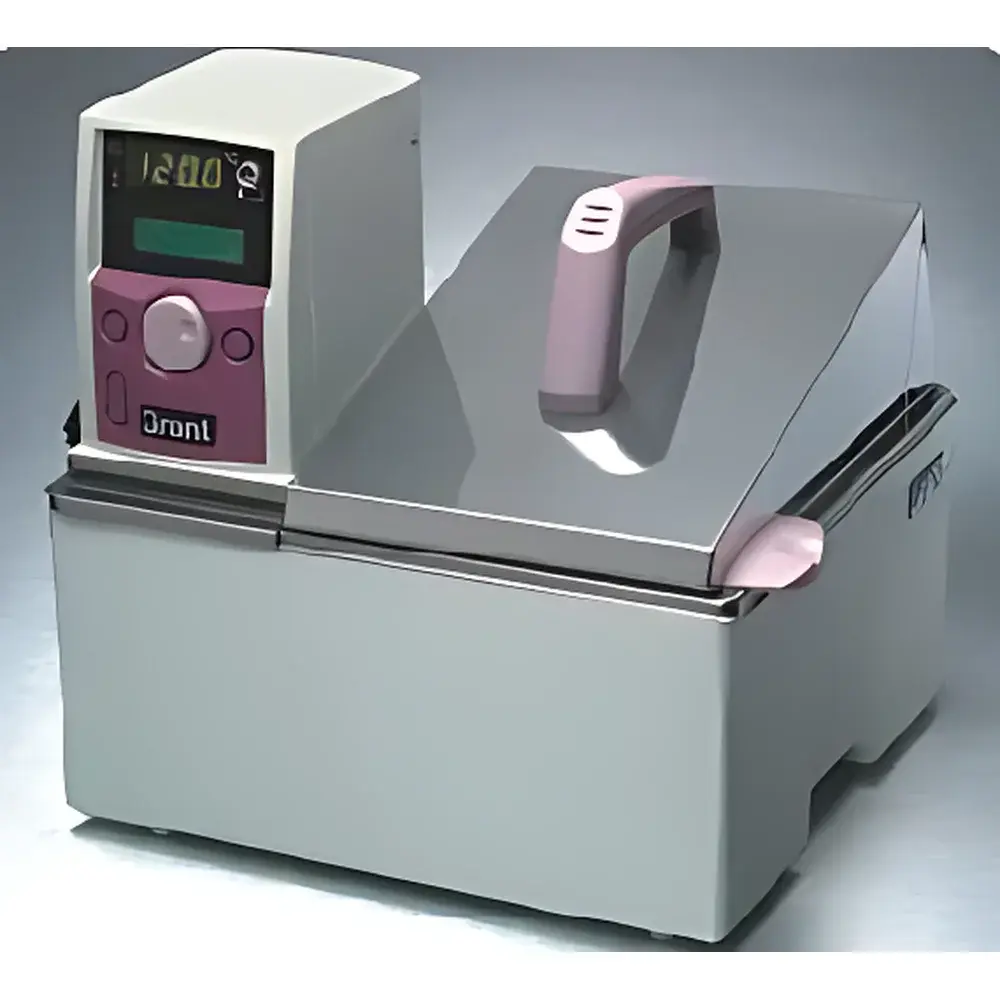
Grant GD120-S12 Digital Programmable Circulating Bath
| Brand | Grant Instruments |
|---|---|
| Origin | United Kingdom |
| Model | GD120-S12 |
| Temperature Range | 0 °C to 100 °C (stainless steel bath) / RT+5 °C to 99 °C (plastic bath) |
| Stability @37 °C | ±0.02 °C |
| Uniformity @37 °C | ±0.05 °C |
| Set Resolution | 0.1 °C |
| Display | 4-digit 13 mm LED |
| Bath Volume | 12 L |
| Heating Power | 1.4 kW (240 V) / 1.3 kW (115 V) |
| Safety | Float-switch low-fluid protection |
| Calibration | Two-point user calibration |
| External Dimensions (L×W×H) | 420 × 350 × 180 mm |
| Overall Dimensions (incl. controller) | 420 × 350 × 360 mm |
| Power Supply | 230 V, 50–60 Hz (1.5 kW) / 120 V, 50–60 Hz (1.4 kW) |
| Compatible Accessories | C1G immersion cooler, PL12 lid, VR/QR tube racks, RS14 lift platform |
Overview
The Grant GD120-S12 Digital Programmable Circulating Bath is a precision-engineered temperature control system designed for demanding laboratory applications requiring high thermal stability, uniformity, and operational flexibility. Built upon Grant Instruments’ legacy of UK-manufactured thermal management solutions, the GD120-S12 employs a robust Peltier-free resistive heating architecture combined with intelligent PID control and continuous liquid circulation via an integrated pump. Unlike open-loop static baths, this unit maintains temperature setpoints through active feedback regulation—measuring bath fluid temperature at multiple points and dynamically adjusting heater output and flow rate to counteract environmental drift, sample load changes, or evaporation losses. Its stainless-steel bath (GD100-S12 variant) supports operation from 0 °C to 100 °C, while the plastic-bath configuration (GD100-P12) operates from ambient +5 °C to 99 °C. The system meets essential performance benchmarks defined in ISO 17025-accredited laboratories, including thermal stability ≤ ±0.02 °C and spatial uniformity ≤ ±0.05 °C at 37 °C—critical parameters for enzyme kinetics, cell culture incubation, viscosity standardization, and reference material conditioning.
Key Features
- Dual-mode digital interface: Intuitive rotary encoder plus two dedicated function keys enable rapid, tactile temperature setting and parameter navigation without menu diving.
- High-visibility 4-digit LED display (13 mm character height): Ensures legibility from distances up to 3 meters—ideal for shared lab environments or hood-mounted installations.
- Programmable visual alarm: Integrated status indicator flashes when preset time-temperature cycles complete, supporting unattended overnight protocols.
- Four-user memory slots: Store and recall frequently used temperature setpoints—including three factory-default presets and one custom value—for rapid method re-execution.
- Two-point user calibration: Enables traceable adjustment at two independent temperatures (e.g., 25 °C and 60 °C) to compensate for sensor drift and align readings with NIST-traceable reference thermometers.
- Float-switch fluid-level safety: Automatically disables heating if bath volume falls below minimum operational level—preventing dry-run damage and thermal runaway.
- Modular bath construction: Interchangeable stainless-steel (S-series) or chemically resistant polypropylene (P-series) tanks allow optimization for corrosion resistance, weight constraints, or cost-sensitive workflows.
Sample Compatibility & Compliance
The GD120-S12 accommodates diverse sample formats through standardized accessory integration. Its 303 × 220 mm top opening and 140 mm maximum fluid depth support immersion of flasks, cuvettes, reaction vessels, and multi-well plates. Optional VR and QR tube racks enable high-density processing of microcentrifuge tubes (0.5–30 mL), accommodating up to 36 × 16 mm tubes per rack. For shallow-bottom containers (e.g., Petri dishes or microtiter plates), the RS14 lift platform raises samples to optimal immersion depth without altering bath volume or flow dynamics. All stainless-steel components comply with EN 10088-1 standards for austenitic corrosion-resistant steel. The unit conforms to IEC 61010-1:2010 safety requirements for electrical equipment in laboratory use and carries CE marking under the EU Low Voltage Directive. While not inherently GLP/GMP-certified, its audit-ready features—including user calibration logs, temperature history storage, and configurable alarm thresholds—support validation under FDA 21 CFR Part 11 when paired with compliant data acquisition software.
Software & Data Management
The GD120-S12 operates as a standalone instrument but integrates seamlessly into networked lab infrastructure via optional RS232 or USB-to-serial adapters. When connected to PC-based platforms such as Grant’s “GrantLink” software or third-party SCADA systems, it enables real-time temperature logging, remote setpoint modification, and automated report generation compliant with ISO/IEC 17025 documentation requirements. Data export supports CSV and XML formats for downstream analysis in MATLAB, Python (Pandas), or LIMS environments. All internal event timestamps—including calibration actions, alarm triggers, and power cycle events—are stored with millisecond resolution and retained across firmware updates. Audit trails are immutable and include operator ID (when configured with external authentication), timestamp, parameter changed, and pre/post values—meeting ALCOA+ principles for data integrity in regulated environments.
Applications
- Biological sample conditioning: Precise equilibration of reagents, antibodies, or cell suspensions prior to ELISA, PCR setup, or flow cytometry.
- Material testing: Thermal pre-conditioning of polymers, adhesives, or composites before tensile or rheological characterization per ASTM D618 or ISO 291.
- Calibration traceability: Serving as a stable heat source for calibrating thermistors, RTDs, and infrared thermometers against primary standards.
- Enzyme activity assays: Maintaining constant incubation temperatures during Michaelis-Menten kinetic studies where ±0.05 °C deviation introduces measurable error in Vmax estimation.
- Stability testing: Supporting ICH Q1A(R2) long-term and accelerated stability protocols for pharmaceutical formulations under controlled thermal stress.
- Viscometry support: Providing thermostatically regulated immersion for rotational viscometers (e.g., Brookfield DVNext) to ensure measurement repeatability per ASTM D2196.
FAQ
What is the lowest temperature achievable without external cooling?
For the GD120-S12 stainless-steel bath, the minimum operating temperature is ambient +5 °C. With the optional C1G immersion cooler, the range extends to 0 °C.
Can the bath operate continuously at 100 °C?
Yes—provided the bath is covered with the supplied PL12 stainless-steel lid or a monolayer of PS20 polypropylene balls to minimize evaporation and thermal loss.
Is user calibration traceable to national standards?
The two-point calibration procedure allows alignment to any NIST-traceable reference thermometer; users must document reference instrument certification and calibration dates per internal SOPs.
Does the unit meet FDA 21 CFR Part 11 requirements?
The hardware supports Part 11 compliance when deployed with validated electronic record software that enforces electronic signatures, audit trails, and role-based access control.
How often should the float switch be verified?
Grant recommends functional verification during quarterly preventive maintenance using distilled water at minimum fill level, per manufacturer’s Service Manual Section 4.2.



