
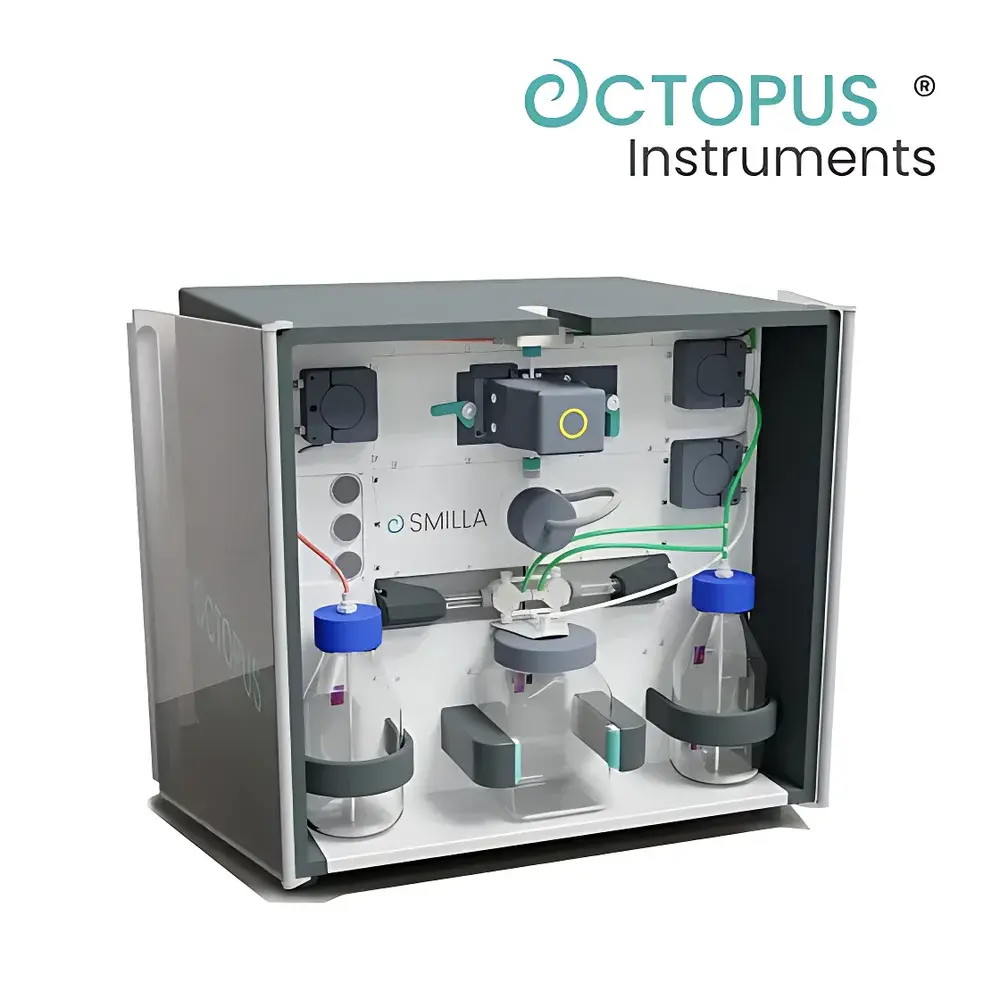
Octopus SAMILLA FIM Insoluble Particle Analyzer with High-Resolution Flow Imaging Microscopy
| Brand | Octopus |
|---|---|
| Origin | Germany |
| Model | SAMILLA FIM |
| Detection Principle | High-Resolution Flow Imaging Microscopy (HiRes-FIM) |
| Particle Size Range | 0.2 µm – 2 mm |
| Camera Options | 12 MP monochrome or color, high-frame-rate sensor |
| Auto-focus | Real-time autofocus without focus beads |
| Magnification Switching | Tool-free, RFID-recognized modular objectives |
| Compliance | USP <788>, USP <789>, Ph. Eur. 2.9.19, ISO 14644-1, FDA 21 CFR Part 11, GLP/GMP-ready |
| Software | SMILLA View v5.x with audit trail, electronic signatures, LIMS integration via ASTM E1384 / LADS framework |
| Cleaning | Fully automated post-run rinse and backflush cycle |
| Pump Configurations | MACRO (peristaltic), MICRO1 (single syringe), MICRO2 (dual alternating syringe), HYBRID (peristaltic + syringe) |
Overview
The Octopus SAMILLA FIM Insoluble Particle Analyzer is a modular, regulatory-compliant platform engineered for quantitative morphological analysis of subvisible and visible particles in pharmaceutical liquids—including injectables, biologics, vaccines, and ophthalmic solutions. At its core lies High-Resolution Flow Imaging Microscopy (HiRes-FIM), a physics-based imaging modality that captures diffraction-limited, in-focus digital images of individual particles as they transit through a precision flow cell at controlled laminar velocity. Unlike light obscuration (LO) alone, HiRes-FIM delivers not only count and size distribution but also validated morphometric descriptors—aspect ratio, circularity, transparency index, edge gradient, and texture features—enabling root-cause differentiation between silicone oil droplets, protein aggregates, cellulose fibers, glass shards, and microbial contaminants. The system operates under ISO 14644-1 Class 5 cleanroom-compatible conditions and meets the optical resolution and image fidelity requirements specified in Ph. Eur. 2.9.19 and USP Annex 3 for image-based particle characterization.
Key Features
- Modular architecture with hot-swappable, RFID-tagged modules—HiRes-FIM, Light Obscuration (LO), Pump, and Auto-Clean—each auto-detected and software-configured upon insertion.
- HiRes-FIM module equipped with dual 12-megapixel CMOS sensors (monochrome or color), programmable exposure times down to 1 µs to eliminate motion blur, and real-time autofocus independent of calibration beads.
- Interchangeable objective modules (10×, 20×, 40×, 60×) enabling rapid adaptation across particle size ranges—from 200 nm protein aggregates to 2 mm foreign particulates—with no mechanical recalibration required.
- Four pump configurations: MACRO (peristaltic, high-volume, bottom-up aspiration), MICRO1 (single-syringe, ±0.5% volumetric accuracy for 10–100 µL samples), MICRO2 (dual alternating syringes for uninterrupted >1 mL flow), and HYBRID (combined peristaltic/syringe for multi-viscosity or multi-phase sample handling).
- Integrated cleaning module featuring programmable ethanol/water flush sequences, reverse-flow backflush capability, and pressure-monitoring sensors to verify line clearance without disassembly.
- Rugged aluminum chassis with vibration-damped optical bench, temperature-stabilized flow path (±0.3°C), and electromagnetic shielding compliant with IEC 61326-1 for laboratory EM environments.
Sample Compatibility & Compliance
The SAMILLA FIM accommodates aqueous buffers, viscous formulations (up to 50 cP), lipid emulsions, and low-conductivity solvents without dilution or filtration—preserving native particle state. It supports standard USP test volumes (5–25 mL), small-volume biologics (≥10 µL via MICRO1), and continuous monitoring mode for process streams. All hardware and firmware are designed to meet ISO/IEC 17025 traceability requirements. The system implements full 21 CFR Part 11 compliance—including role-based user access control, immutable audit trails, electronic signatures with biometric or PKI options, and data integrity validation per ALCOA+ principles. Method templates are pre-validated against Ph. Eur. 2.9.19 verification protocols, including system suitability tests using NIST-traceable polystyrene microspheres (0.5, 2, 10, and 25 µm). Routine operation satisfies GMP Annex 11 and EU GMP Chapter 4 documentation standards.
Software & Data Management
SMILLA View v5.x is a CE-IVD marked, standalone application built on a deterministic real-time acquisition engine and a PostgreSQL-backed relational database. It provides synchronized dual-channel acquisition (brightfield + optional reflected-light mode), AI-assisted particle classification using supervised learning models trained on >20,000 annotated pharmaceutical particulates, and batch-level statistical reporting aligned with ICH Q5C stability guidelines. Each particle record stores raw TIFF image, centroid coordinates, bounding box, 12 morphometric parameters, and optical density histogram—all exportable in CSV, PDF, or XML formats compliant with ASTM E1384. The software supports customizable report generation (including deviation flags per USP thresholds), automated trend analysis across stability timepoints, and direct LIMS interfacing via HL7 v2.5 or RESTful API. All data archives are encrypted at rest (AES-256) and support long-term retention per 21 CFR Part 11 §11.10(d).
Applications
- Subvisible particle characterization in final-fill drug products per USP and Ph. Eur. 2.9.19.
- Differentiation of intrinsic vs. extrinsic particles during formulation development and container-closure integrity assessment.
- Root-cause analysis of aggregation events in monoclonal antibody therapeutics under thermal or mechanical stress.
- Verification of filter performance and leachables screening in single-use bioprocessing systems.
- Supporting comparability studies for biosimilar manufacturing changes per ICH Q5E.
- Environmental monitoring of cleanroom particle composition in isolator glove ports and filling lines.
FAQ
Does SAMILLA FIM require daily calibration with reference beads?
No. The HiRes-FIM module uses an internal laser interferometer and temperature-compensated stage metrology to maintain pixel-to-micron mapping stability. Only annual verification with NIST-traceable standards is required per ISO/IEC 17025.
Can SMILLA FIM distinguish silicone oil from protein aggregates?
Yes. Through combined analysis of refractive index contrast (transmitted light intensity), edge sharpness, and surface texture—validated against orthogonal Raman spectroscopy datasets.
Is the system compatible with sterile sampling manifolds?
Yes. The MACRO pump supports aseptic tubing sets with gamma-sterilizable connectors; all wetted surfaces are USP Class VI-certified and autoclavable up to 121°C.
How is data integrity ensured during network interruptions?
Acquisition continues locally with timestamped SQLite journaling; data syncs automatically to the central PostgreSQL server once connectivity resumes, with SHA-256 hash validation.
What training and qualification support is provided?
Octopus supplies IQ/OQ/PQ protocols, 3-day on-site installation qualification, and certified operator training aligned with GAMP 5 Annex 15. Annual performance verification services include camera MTF testing and flow-cell resolution certification.






